
The desert doesn’t simply provide backdrop for crime fiction—it becomes an active participant in the story, shaping every decision your characters make and every twist your plot takes. Too many writers treat harsh landscapes as scenic decoration, missing the opportunity to create a living, breathing antagonist that can elevate their thriller from competent to unforgettable.
Across eighteen series and more than 150 novels, I’ve found that the most effective desert crime fiction transforms the environment into a character with its own motivations, moods, and methods of influencing the narrative. The desert isn’t neutral territory—it’s a force that reveals character, drives plot, and creates the kind of atmospheric tension that keeps readers turning pages long into the night.
The Desert as Active Antagonist
Desert environments possess inherent hostility that crime writers can exploit to create genuine stakes beyond the human conflict. The landscape becomes a ticking clock, a silent witness, and often the deciding factor in life-or-death situations. Heat exhaustion doesn’t negotiate. Sandstorms don’t care about your protagonist’s deadline. Water scarcity makes every decision critical.
In my Maya Thorne series, the Australian outback functions as more than setting—it’s a character that actively opposes and shapes the investigation. When Thorne pursues leads across remote stations, the landscape determines her options. She can’t simply call for backup when she’s three hours from the nearest town with no mobile coverage. The desert forces self-reliance and creates isolation that intensifies every encounter.
The key is making environmental challenges integral to your plot rather than coincidental obstacles. Don’t have your detective’s car break down because you need drama—have it break down because the desert heat has been building mechanical tension throughout the story, and this failure represents the landscape finally asserting its dominance over human technology.
Sensory Immersion Without Purple Prose
Desert crime fiction demands sensory specificity, but purple prose kills momentum faster than dehydration kills tourists. The goal is making readers feel the environment’s presence without drowning them in flowery description. Focus on details that serve multiple purposes—revealing character, advancing plot, or building tension.
Temperature affects more than comfort. It influences decision-making, alters evidence, and changes human behavior in measurable ways. A witness might be unreliable not because they’re lying, but because heat stress has affected their memory. Blood evidence degrades differently in extreme heat. Electronic devices fail. These aren’t just atmospheric touches—they’re plot elements that emerge naturally from your setting.
Sound travels differently in desert environments. The absence of urban noise makes every footstep, every engine, every gunshot carry further and with greater clarity. This acoustic reality can drive plot points in your thriller, from surveillance challenges to the impossibility of approaching undetected across certain terrain.
How I Actually Approach Desert Settings
When I’m crafting desert scenes, I start with the practical questions that would face any real person in that environment. What time of day minimizes heat exposure? Where do you find shade? How much water do you need, and what happens when you don’t have it? These mundane realities become the foundation for dramatic tension.
I research specific desert types because they differ dramatically. The Australian outback presents different challenges than the American Southwest or the Sahara. Each has distinct weather patterns, flora, fauna, and geological features that can serve your story. Generic desert descriptions feel hollow because they lack the specificity that makes settings feel authentic.
Character reaction to environment reveals personality more efficiently than dialogue. How does your protagonist prepare for desert travel? Do they respect the environment’s power or underestimate it? Are they familiar with desert survival or dangerously ignorant? These responses establish character traits while building environmental credibility.
I also consider how different characters experience the same landscape. An experienced local sees opportunities where a city dweller sees only threats. A criminal might know hidden water sources or cave systems that law enforcement doesn’t. The desert keeps different secrets for different people, and those secrets can drive your plot in unexpected directions.
Environmental Clues and Evidence
Desert environments preserve some evidence while destroying others, creating unique investigative challenges that can distinguish your crime fiction from urban procedurals. Bodies mummify rather than decompose. Tracks remain visible in sand for days or vanish in minutes depending on wind conditions. Extreme temperatures can alter time-of-death calculations.
These environmental factors shouldn’t feel contrived—they should emerge naturally from your setting’s reality. Research how extreme heat affects forensic evidence. Understand how flash floods can relocate crime scenes. Know what desert scavengers do to remains and how quickly they do it. This knowledge transforms setting from backdrop into plot device.
Weather patterns in desert regions can dramatically alter crime scene dynamics. Seasonal variations affect everything from accessibility to preservation of evidence. Monsoon seasons create temporary rivers that wash away evidence or reveal what was previously buried. These aren’t coincidences to exploit—they’re environmental realities that informed criminals might plan around and investigators must account for.
Common Mistakes That Kill Desert Authenticity
The biggest mistake in desert crime fiction is treating the environment as uniformly hostile without understanding its specific dangers and advantages. Writers often default to extreme heat as the only threat, ignoring how desert temperatures can plummet at night or how elevation affects climate within the same region.
Another frequent error involves characters who behave stupidly for plot convenience rather than responding realistically to environmental pressures. Having your FBI agent venture into the desert without water and communication equipment doesn’t create tension—it creates incredulity. Even action thriller novels require characters to make decisions that feel grounded in reality, even when those decisions prove costly.
Many writers also misunderstand desert ecology, populating their settings with generic cacti and tumbleweeds regardless of geographic location. This lazy approach to environmental detail undermines credibility and wastes opportunities for authentic local color. Real deserts have distinct plant and animal life that can serve your story if you take time to research them properly.
The ‘mirage’ cliché appears far too often as a lazy shorthand for desert disorientation. Actual mirages result from specific atmospheric conditions and appear in predictable circumstances. If you’re going to use environmental phenomena in your plot, understand how they actually work rather than relying on Hollywood misconceptions.
Water-related plotting often falls into unrealistic extremes. Characters either find convenient oases or die immediately from dehydration. Reality offers more nuanced possibilities—underground springs, morning dew collection, plant-based water sources—that can create more sophisticated survival scenarios without abandoning credibility for drama.
Building Psychological Pressure Through Isolation
Desert environments excel at creating the isolation that makes psychological thrillers particularly effective. When your characters are hours from help, every decision carries amplified weight. Trust becomes critical when survival depends on cooperation, but suspicion grows when escape routes are limited.
The vast emptiness of desert landscapes can trigger claustrophobia rather than agoraphobia in some characters—the sense of being trapped by infinite space rather than confined quarters. This counterintuitive psychological response can drive character development and plot tension in ways that urban settings cannot replicate.
Silence plays a crucial role in desert psychological pressure. Urban dwellers depend on background noise for comfort. The profound quiet of remote desert areas can be more unsettling than obvious threats. Characters might make poor decisions simply to break the oppressive silence, creating opportunities for conflict and revelation.
Consider how extended exposure to harsh environments affects judgment and behavior. Sleep deprivation from extreme temperatures, stress from constant vigilance, and physical discomfort from environmental conditions all influence character actions in ways that can drive plot development organically.
Integrating Cultural and Historical Elements
Desert regions often contain rich cultural histories that can add depth to your crime fiction without feeling like tourist brochures. Indigenous knowledge about desert survival, historical trade routes, abandoned mining operations, and military testing sites can all provide authentic background that serves your plot.
Modern desert environments frequently juxtapose ancient landscapes with contemporary technology—solar installations, border monitoring systems, satellite communication networks. These contrasts can create interesting opportunities for espionage thrillers or techno-crime plots that feel both timeless and current.
Local law enforcement in desert regions faces unique challenges that differ significantly from urban policing. Jurisdictional issues across vast distances, limited resources, and specialized knowledge requirements can all influence how your investigation unfolds. Understanding these realities helps create more authentic procedural elements.
Consider how different groups use desert spaces—smugglers, off-road enthusiasts, researchers, military personnel, ranchers. Each group possesses specialized knowledge and motivations that can complicate your crime plot in realistic ways. The desert means different things to different people, and those differences can drive conflict and revelation.
Conclusion
Desert crime fiction succeeds when the landscape functions as more than scenery—when it actively participates in the story as antagonist, ally, and witness. The desert’s indifference to human concerns creates authentic stakes that no villain can match, while its harsh beauty provides atmosphere that lingers long after readers finish the final page. Master this environment, and you’ll discover that sometimes the most compelling character in your thriller never speaks a word.
About Phillip Strang
Phillip Strang is an Australian crime and thriller novelist. Across eighteen series and more than 150 novels, his work spans London police procedurals (DCI Isaac Cook), UK investigations (DI Tremayne), Australian outback crime (Maya Thorne), FBI thrillers (Alex Harlan), Scottish Highland mysteries (DI Sarah Lynch), and espionage (Steve Case). Learn more about Phillip or browse his complete catalogue on Amazon.
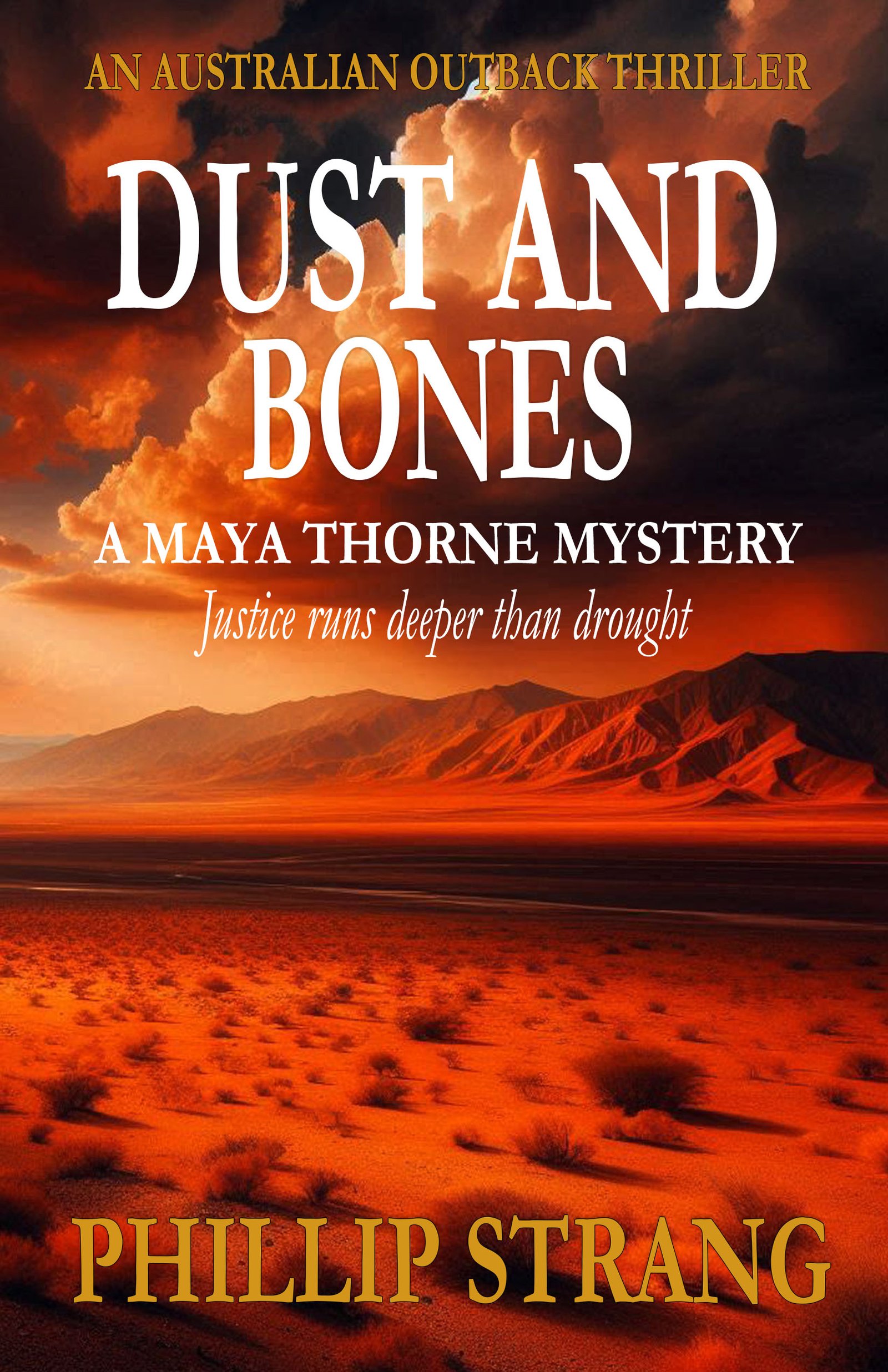
A MAYA THORNE MYSTERY
Get Dust and Bones Free
Justice runs deeper than drought.
Red dust. Shallow graves. A detective who hunts killers where the law runs thin and the nearest help is two hundred miles away.
Send Me the BookYou'll also receive occasional new release emails. Unsubscribe anytime. No spam, ever.
As an Amazon Associate, Phillip Strang earns from qualifying purchases. This page contains affiliate links — buying through them costs you nothing extra.