
Gothic Settings in Modern Crime Fiction present a specific craft challenge: how do you use the full atmospheric weight of decaying architecture, isolated landscapes, and psychological unease without sliding into pastiche or burying your detective under fog that serves only decoration? The question matters because gothic elements are not a genre unto themselves in crime — they are tools, and like all tools, they cut cleanly or they maim depending on how the writer handles them.
Across eighteen series and more than 150 novels I have found that the writers who use gothic settings most effectively are not thinking about mood as an end in itself. They are thinking about pressure. What does this place do to the people inside it? What does it make possible that would be impossible anywhere else? That is the question that separates setting-as-atmosphere from setting-as-architecture.
What the Gothic Actually Offers a Crime Writer
Strip away the candelabras and the melodrama and what the gothic tradition really offers crime fiction is a mechanism for externalising psychological states. A crumbling estate does not just look threatening — it tells us something about the family that still lives inside it, about the secrets they have chosen to preserve rather than repair. That is extraordinarily useful in crime writing, where so much of the work involves making internal concealment visible to the reader.
When I was working on the DI Tremayne series, set in the English countryside, I kept returning to the way certain villages and estates seemed to hold their histories physically — in the arrangement of rooms, in the way light fell, in who was allowed to enter which part of a building. That physical layering became a structural device. The house knew things the characters were pretending not to know. You can do a version of that in any setting, but gothic environments make it honest rather than forced. The architecture is already doing the psychological work before you write a single word of dialogue.
This is also why gothic settings pair so well with secrets that have long histories. A murder committed twenty years ago lands differently in a Victorian mill town than in a glass-and-steel office block. Not because the mill town is more dramatic, but because it carries the visible evidence of time — and crime fiction at its best is almost always about the past arriving uninvited into the present.
Gothic Settings in Modern Crime Fiction: The Question of Authenticity
The single biggest trap for writers reaching for gothic atmosphere is inauthenticity — using setting as costume rather than as lived reality. You can feel it in fiction where the writer has clearly visited the location once, photographed a few gargoyles, and then retreated to their desk to write sentences about mist. The mist is there because gothic settings are supposed to have mist. But mist that serves no purpose except atmosphere is just weather that overstayed its welcome.
Authentic gothic settings in crime fiction are specific in the way that only genuine understanding produces. The right details are never the most obvious ones. They are the detail of the smell of damp stone in a particular building, the sound that the wind makes through a particular gap in a particular wall, the way a room’s proportions make people lower their voices without being asked. These are things you find by inhabiting a place — or by inhabiting the research so thoroughly that the distinction collapses.
With the DI Sarah Lynch series, set in the Scottish Highlands, I had to resist constantly the temptation to reach for the postcard version of the landscape. The Highlands carry a genuine gothic weight — the history of clearances, of communities erased from land they had worked for generations, of violence that left no formal record — and that weight is far more disturbing than any number of atmospheric mists. When I let the actual history do the work, the setting became unsettling in a way that invented atmosphere never achieves. The gothic is most powerful when it is earned, not applied.
How I Actually Build Atmosphere Without Losing the Investigation
The practical craft problem with gothic settings is pacing. Atmosphere accumulates, and that accumulation is genuinely pleasurable for the reader — but a crime novel still needs to move. The investigation still needs to generate questions and answers at a pace that holds attention. Gothic atmosphere and procedural momentum can work against each other if you are not deliberate about where you place each.
My working method is to treat atmosphere as load-bearing rather than decorative. Every scene that does heavy atmospheric work must also do heavy plot or character work simultaneously. A description of an isolated farmhouse matters if it tells us something about the victim’s psychology, or about the killer’s access, or about why no one heard the shot. The atmosphere is not resting time between plot beats — it is part of the plot’s infrastructure. If I can cut a paragraph of setting description without losing any plot or character information, the paragraph was probably ornamental, and ornamental gothic eventually reads as parody.
I also think about the best character-driven novels as a useful benchmark here. The writers who handle gothic atmosphere most convincingly tend to be strong character writers first. The setting presses on the characters, and the characters resist or submit in ways that reveal who they are. That pressure-and-response rhythm is what keeps gothic atmosphere from becoming static. Place should make characters behave differently than they would anywhere else.
What to Avoid: The Common Failures of Gothic Crime Writing
Gothic settings fail in crime fiction in predictable ways, and knowing the patterns saves considerable revision time. The first failure is redundancy — the setting describing what the prose has already told us. If you have established through dialogue and action that a character is haunted by guilt, you do not also need the ancestral home to be crumbling visibly around them. The doubling does not intensify the effect; it diminishes it by suggesting the writer does not trust the reader to have understood the first time.
The second failure is tonal inconsistency. Gothic atmosphere operates at a specific register, and that register can be broken by a single misplaced line of contemporary slang or a procedural detail that is too mundanely bureaucratic. This does not mean gothic crime cannot include humour or institutional reality — it means those elements need to be integrated rather than dropped in. A detective who finds a crumbling estate faintly absurd as well as threatening is more interesting than one who simply shivers in every room. The tension between the mundane and the genuinely eerie is where the best gothic crime writing lives.
The third failure, and perhaps the most damaging, is using gothic setting as a substitute for plot. There is a version of atmospheric crime writing that delays revelation not because the withholding creates genuine suspense but because the writer is not sure yet what they are withholding. Readers feel that delay. The fog thickens, the candles gutter, the house groans — and nothing happens, because nothing has been worked out yet. Gothic atmosphere borrowed against an underdeveloped plot is a debt that compounds. The story needs to know its own secrets even when the reader does not. If you want to see how noir and gothic elements can coexist without collapsing into each other, the key is always the rigour of the underlying investigation.
Conclusion
Gothic settings are not a stylistic indulgence in crime fiction — they are a structural resource that, used precisely, makes the investigation more unsettling, the characters more psychologically legible, and the stakes more deeply felt. The discipline required is the same as any other craft discipline: use what earns its place and cut what does not, regardless of how good it looks on the page in isolation.
About Phillip Strang
Phillip Strang is an Australian crime and thriller novelist. Across eighteen series and more than 150 novels, his work spans London police procedurals (DCI Isaac Cook), UK investigations (DI Tremayne), Australian outback crime (Maya Thorne), FBI thrillers (Alex Harlan), Scottish Highland mysteries (DI Sarah Lynch), and espionage (Steve Case). Learn more about Phillip or browse his complete catalogue on Amazon.
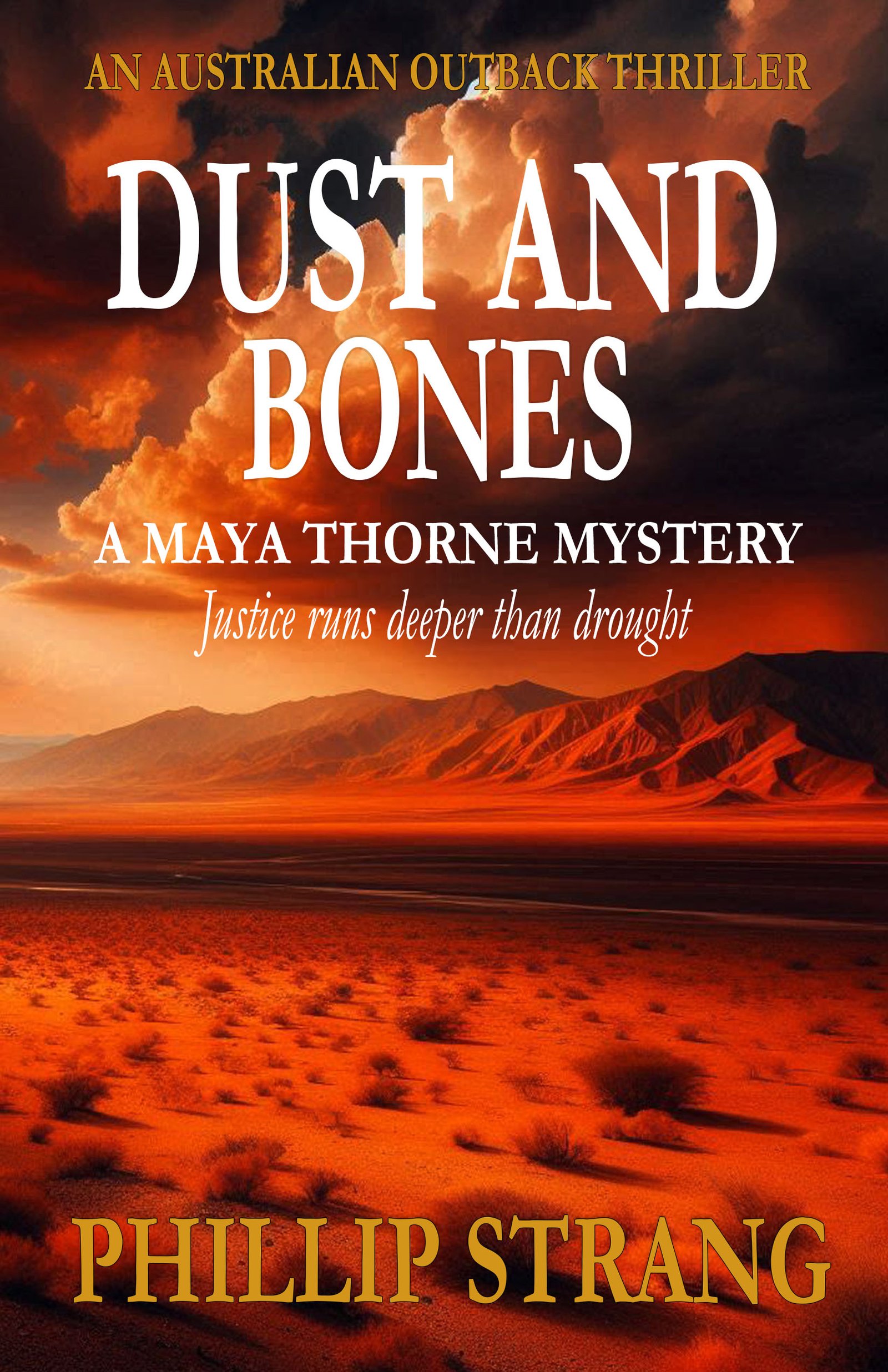
A MAYA THORNE MYSTERY
Get Dust and Bones Free
Justice runs deeper than drought.
Red dust. Shallow graves. A detective who hunts killers where the law runs thin and the nearest help is two hundred miles away.
Send Me the BookYou'll also receive occasional new release emails. Unsubscribe anytime. No spam, ever.
As an Amazon Associate, Phillip Strang earns from qualifying purchases. This page contains affiliate links — buying through them costs you nothing extra.