
The final quarter of any crime novel is where most manuscripts go to die. You’ve built the tension, planted your clues, developed your characters through two-thirds of the story, and now you’re staring at the convergence point where everything must come together with surgical precision.
Across eighteen series and more than 150 novels, I’ve found that finishing the novel isn’t about inspiration or waiting for the perfect ending to reveal itself. It’s about understanding the specific craft mechanics that separate completed manuscripts from abandoned ones, and developing the working author’s mindset that treats completion as a professional skill rather than a creative accident.
The Momentum Trap: Why Speed Matters More Than Perfection
Most authors slow down precisely when they should accelerate. They second-guess their plot threads, polish scenes that don’t need polishing, and convince themselves they need to ‘get it right’ before moving forward. This is backwards thinking that kills more novels than bad plotting ever will.
When I was writing the final DCI Isaac Cook novel in the series, I had three potential resolution paths mapped out. Instead of agonizing over which was ‘best,’ I picked one and wrote it through to completion. The momentum of finishing revealed problems I never would have seen while deliberating, and more importantly, gave me a complete draft to work with rather than a perfect fragment.
The final quarter demands ruthless forward motion. Your job isn’t to write the perfect ending—it’s to write a complete ending that serves your story’s core promise. Polish comes in revision, but you can’t revise what doesn’t exist. The best police procedural novels aren’t perfect on first draft; they’re completed on first draft.
How I Actually Approach the Final Quarter
My process for the final quarter is deliberately mechanical. I write out what I call the ‘resolution cascade’—a simple list of every plot thread, character arc, and mystery element that needs addressing. Not how they’ll be resolved, just what needs resolution.
Then I assign each element to specific scenes in my remaining chapters. If I have six chapters left, I might put the major revelation in chapter four, the confrontation in chapter five, and the consequences in chapter six. This isn’t creative—it’s architectural.
When I was finishing the Maya Thorne series, I had seventeen different clues and character relationships that needed tying together. Instead of hoping it would work itself out organically, I literally drew a chart showing which elements would be addressed in which scenes. The writing itself remained creative, but the structure was predetermined and non-negotiable.
This approach eliminates the paralysis that comes from having too many options. You’re not choosing between infinite possibilities—you’re executing a plan. The plan might change as you write, but you always have forward momentum rather than sideways deliberation.
Managing the Convergence Without Losing Control
Crime fiction demands that seemingly separate elements converge logically in the final act. This convergence is where many authors lose control of their narrative, either rushing through connections or overexplaining relationships between plot elements.
The key is understanding that readers are actively participating in this convergence. They want to make connections, spot patterns, and experience the satisfaction of pieces fitting together. Your job is to provide the pieces clearly, not to explain how they connect.
In thriller writing, this means trusting your setup. If you’ve planted your clues properly in the first three-quarters, the final quarter should feel inevitable rather than surprising. Effective action thrillers create momentum through logical escalation, not through introducing new elements that weren’t properly established.
I’ve learned to resist the urge to add complexity in the final quarter. If a plot thread feels weak at the seventy-five percent mark, the solution isn’t to complicate it further—it’s to resolve it cleanly and focus your energy on the elements that are working strongly.
The Fatal Mistakes That Stop Authors at the Finish Line
The most common error is what I call ‘ending shopping’—constantly changing your mind about how the story should conclude. An author will write three chapters toward one resolution, then decide a different ending would be better and start over. This creates a cycle where you’re always twenty pages from finishing but never actually finish.
Another killer mistake is perfectionism creep, where authors convince themselves they need to fix earlier chapters before they can complete the ending. I’ve seen writers spend months revising chapter two while their climax sits unwritten. The first draft’s job is completion, not perfection.
The third major trap is resolution inflation—feeling that your ending needs to be bigger, more surprising, or more emotionally devastating than your story can actually support. I see this constantly in crime fiction where authors try to layer additional murders, betrayals, or revelations into an ending that would be stronger with cleaner, simpler resolution.
When I was completing my DI Tremayne series, I caught myself adding an unnecessary subplot about police corruption because I thought the ending needed more complexity. Recognizing this as resolution inflation, I stripped it out and focused on the core mystery. The result was a tighter, more satisfying conclusion that served the story I’d actually been telling.
Professional Finishing: Systems Over Inspiration
Working authors finish books because they treat finishing as a system, not an event. This means establishing non-negotiable daily progress markers for your final quarter, regardless of how you feel about the work that day.
My system is simple: one scene per day, regardless of quality, until the draft is complete. Some scenes are brilliant, some are workmanlike, most are somewhere in between. But each scene moves the story definitively toward conclusion, and that forward motion creates its own momentum.
The professional mindset recognizes that finishing creates opportunities for improvement that perfecting prevents. A completed draft can be revised, restructured, and refined. An unfinished draft, no matter how polished its existing chapters, cannot be published, and more importantly, cannot teach you what you need to know about completing stories.
Complex espionage thrillers require particularly disciplined finishing because of their intricate plotting, but the principle holds across all crime subgenres: completion is a skill that improves with practice, and practice requires actually finishing manuscripts.
Conclusion
Finishing novels is a craft skill that working authors develop through repetition, not inspiration. The final quarter demands forward momentum, structural discipline, and the professional understanding that completed imperfection beats perfect incompletion every time.
About Phillip Strang
Phillip Strang is an Australian crime and thriller novelist. Across eighteen series and more than 150 novels, his work spans London police procedurals (DCI Isaac Cook), UK investigations (DI Tremayne), Australian outback crime (Maya Thorne), FBI thrillers (Alex Harlan), Scottish Highland mysteries (DI Sarah Lynch), and espionage (Steve Case). Learn more about Phillip or browse his complete catalogue on Amazon.
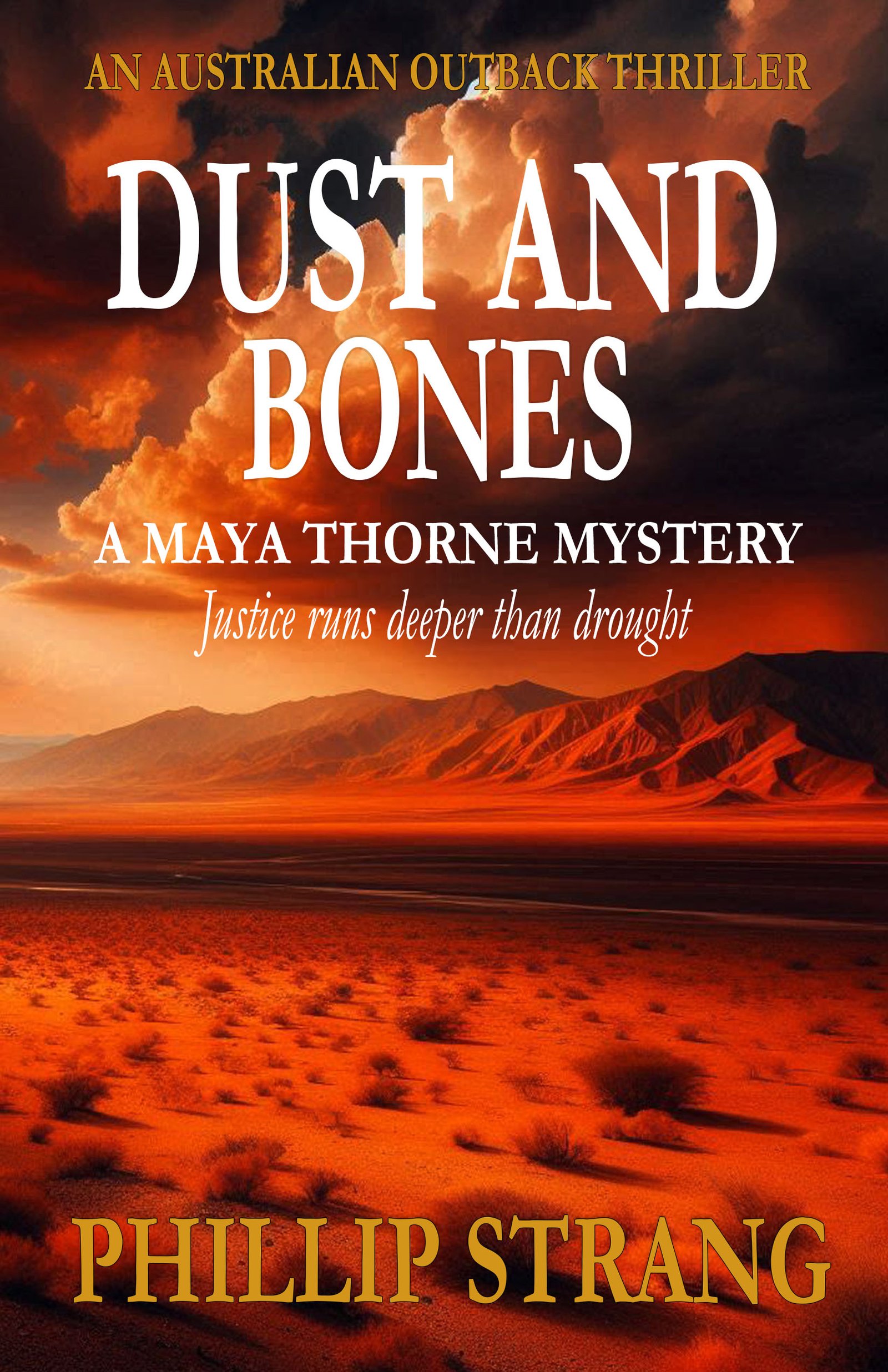
A MAYA THORNE MYSTERY
Get Dust and Bones Free
Justice runs deeper than drought.
Red dust. Shallow graves. A detective who hunts killers where the law runs thin and the nearest help is two hundred miles away.
Send Me the BookYou'll also receive occasional new release emails. Unsubscribe anytime. No spam, ever.
As an Amazon Associate, Phillip Strang earns from qualifying purchases. This page contains affiliate links — buying through them costs you nothing extra.