
The landscape doesn’t just provide backdrop in Australian crime fiction—it fundamentally shapes how you construct character, pace your narrative, and build tension. The choice between setting your crime novel in the red dust of the outback versus the concrete jungle of Sydney or Melbourne isn’t merely aesthetic; it’s a decision that will dictate your entire approach to storytelling craft.
Across eighteen series and more than 150 novels, I’ve found that the most successful Australian crime writers understand this distinction intimately. The techniques that work brilliantly in urban settings can fall completely flat when transplanted to the isolation of the bush, and vice versa.
Character Psychology: Isolation Versus Anonymity
Urban crime thrives on anonymity and the ability to hide in plain sight. Your protagonist moves through crowds, suspects disappear into apartment blocks, and witnesses can vanish into the underground. The psychology here is about disconnection within proximity—being alone while surrounded by millions. In my Campbell series set in Sydney, the city’s sprawl becomes both hunting ground and hiding place, where corruption can flourish in boardrooms thirty floors above street level.
Outback noir operates on the opposite principle. Everyone knows everyone, secrets fester in small communities, and there’s nowhere to run when the nearest town is three hundred kilometers away. The psychology shifts to claustrophobia within vastness. In my Maya Thorne books, I’ve learned that outback characters carry their secrets differently—they’re more guarded, more suspicious, because exposure means social death in a community of fifty people. The craft challenge is making this insularity feel authentic without sliding into caricature.
The mistake many writers make is assuming outback characters are simpler. They’re not—they’re compressed. Urban characters can compartmentalize their lives; outback characters live with everything visible. Your publican is also the town council member, volunteer firefighter, and probably knows which marriages are failing before the couples do.
Pacing: The Rhythm of Investigation
Urban crime allows for rapid-fire plot development. Your detective can interview three suspects in an afternoon, chase leads across multiple suburbs, and access forensics, databases, and backup within minutes. The best police procedural novels often exploit this urban advantage, building momentum through the sheer volume of available actions and resources.
Outback pacing is entirely different. Distance becomes a character in itself. When your nearest backup is four hours away and the phone towers are down, every decision carries exponentially more weight. I’ve found that outback crime demands what I call ‘geological pacing’—building tension through stillness rather than movement. The drama comes from what characters don’t do, can’t do, or won’t do, rather than frantic activity.
This doesn’t mean outback crime is slower—it means the tension accumulates differently. Urban crime explodes; outback crime implodes. The craft lies in making this implosion feel inevitable rather than sluggish.
Setting as Active Element
In urban crime, setting provides opportunity and obstacle in roughly equal measure. The city offers resources, escape routes, and complexity, but also surveillance, witnesses, and institutional oversight. Setting tends to be reactive—responding to character choices rather than driving them.
Outback setting is aggressively active. The heat kills. The distance isolates. The drought creates desperation that drives people to murder. Weather becomes a plot device, not just atmosphere. In my Maya Thorne series, I’ve learned to treat the landscape as an additional antagonist—one that’s indifferent to human suffering but perfectly capable of exposing buried secrets when flash floods uncover decade-old graves.
Urban writers can sometimes get away with generic cityscapes, but outback noir demands intimate knowledge of how the land actually works. Your readers will know if you’ve never experienced the weight of true silence or the particular quality of light at sunset when you’re a hundred kilometers from the nearest electric bulb.
My Working Method: Choosing Between Worlds
When I’m developing a new crime story, the setting choice comes down to what type of pressure I want to apply to my characters. Urban settings excel at external pressure—systemic corruption, organized crime, the machinery of institutions grinding people down. The noir tradition often works best in cities where moral ambiguity can hide behind bureaucracy and anonymous cruelty.
Outback settings excel at internal pressure—family secrets, community hypocrisies, the weight of history in places where nothing is ever truly forgotten. When I conceived Maya Thorne, I knew the outback setting would force characters to confront themselves because there’s literally nowhere else to go. The craft challenge became making isolation feel claustrophobic rather than merely empty.
I test my setting choice by asking: does this story need witnesses or does it need silence? Urban crime needs witnesses—people who saw something, heard something, know something but won’t speak. Outback crime needs silence—the kind of oppressive quiet that makes people confess just to hear their own voice. If my plot depends on forensic resources and rapid response, it belongs in the city. If it depends on psychological pressure and nowhere to hide, it belongs in the bush.
Common Pitfalls: What Destroys Authenticity
The fastest way to ruin urban Australian crime is making it feel like American police procedurals with different accents. Australian cities have their own rhythms, their own institutional cultures, their own criminal ecosystems. Writing Sydney police like New York detectives immediately signals amateur work. Similarly, making urban Australia feel like London or Glasgow ignores the specific colonial and multicultural tensions that drive Australian urban crime.
Outback crime fails most often through romanticism or tourism. Writers who’ve never lived in genuine isolation create picture-postcard landscapes populated by noble savages or colorful characters. Real outback communities are complex, often harsh, sometimes beautiful, but never quaint. The other common failure is making the outback feel like the American West. Australian isolation carries different historical weight, different racial tensions, different economic pressures.
Both urban and outback Australian crime can be destroyed by what I call ‘cultural cringe’—the assumption that Australian stories need international validation to matter. The best Australian crime fiction emerges from specifically Australian problems: water rights, mining disputes, Indigenous land claims, the particular corruptions of resource economies. These aren’t exotic backdrops for generic crime plots; they’re the fundamental tensions that generate authentically Australian stories.
Conclusion
The choice between outback noir and urban Australian crime isn’t about preference—it’s about understanding which environment serves your story’s fundamental tensions. Master both, and you’ve mastered the full spectrum of Australian crime fiction possibilities.
About Phillip Strang
Phillip Strang is an Australian crime and thriller novelist. Across eighteen series and more than 150 novels, his work spans London police procedurals (DCI Isaac Cook), UK investigations (DI Tremayne), Australian outback crime (Maya Thorne), FBI thrillers (Alex Harlan), Scottish Highland mysteries (DI Sarah Lynch), and espionage (Steve Case). Learn more about Phillip or browse his complete catalogue on Amazon.
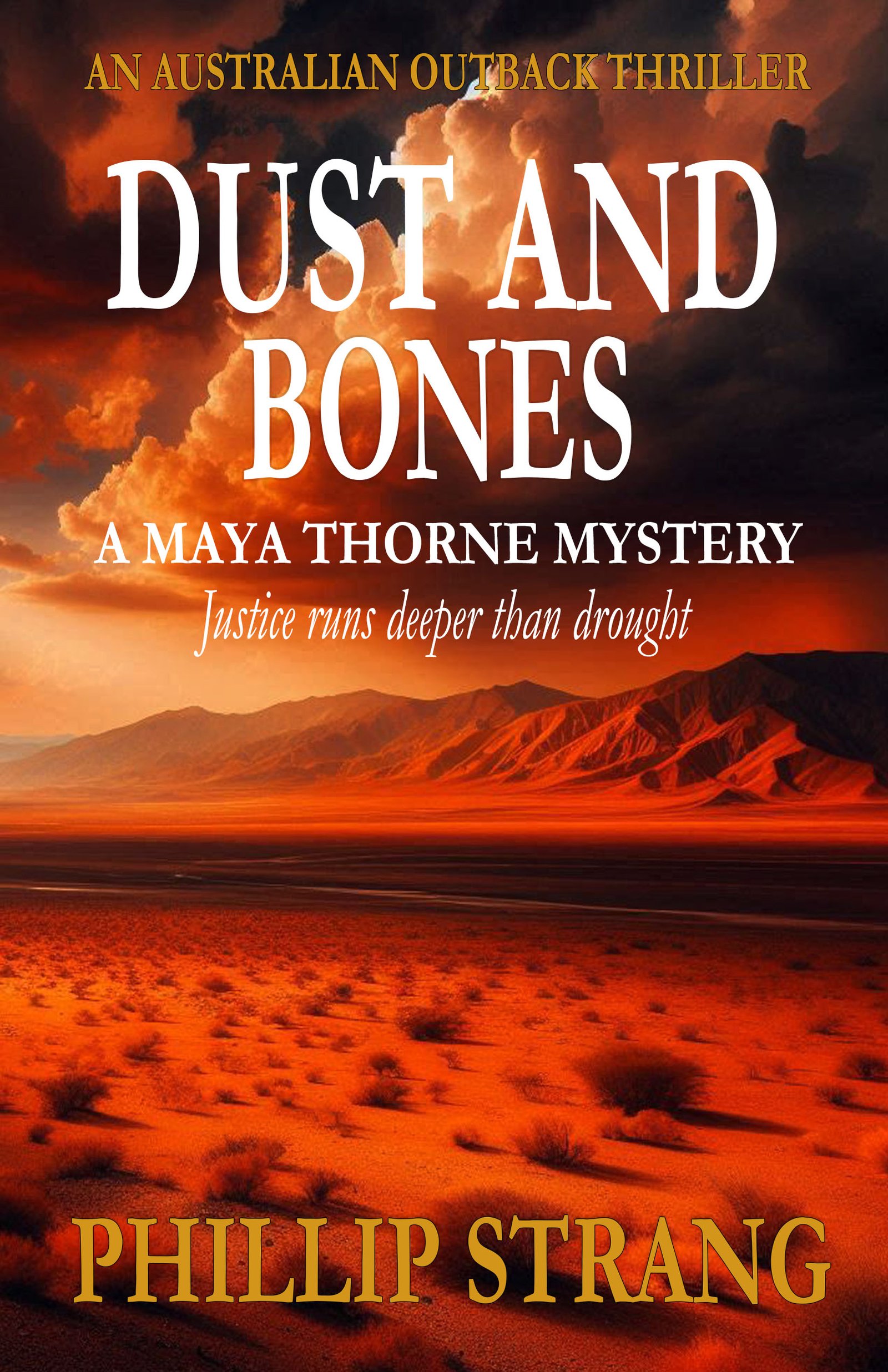
A MAYA THORNE MYSTERY
Get Dust and Bones Free
Justice runs deeper than drought.
Red dust. Shallow graves. A detective who hunts killers where the law runs thin and the nearest help is two hundred miles away.
Send Me the BookYou'll also receive occasional new release emails. Unsubscribe anytime. No spam, ever.
As an Amazon Associate, Phillip Strang earns from qualifying purchases. This page contains affiliate links — buying through them costs you nothing extra.