
The geography of crime isn’t random—it follows the invisible lines that divide neighbourhoods, income brackets, and social hierarchies. Your thriller’s credibility depends on understanding how these urban territories actually function, not just as backdrop, but as active forces that shape both criminal behaviour and investigative procedure.
Writing convincing urban crime requires more than dropping street names and local landmarks into your narrative. Across eighteen series and more than 150 novels, I’ve found that the most compelling crime fiction emerges when you treat the city as a character with its own motivations, prejudices, and secrets.
The Economic Geography of Criminal Opportunity
Crime follows money—both its presence and absence. The mistake many writers make is assuming wealthy areas are simply ‘safe’ and poor areas are uniformly ‘dangerous.’ Real urban crime patterns are far more nuanced. High-end neighbourhoods attract sophisticated financial crimes, art theft, and blackmail schemes, while also serving as hunting grounds for burglars who understand the rhythms of affluent life.
In my DCI Isaac Cook series, set in London, I’ve explored how criminals move between economic zones with calculated precision. A drug dealer operating in Hackney understands that his clientele in Kensington requires different products, different discretion, and different delivery methods. The crime doesn’t change—the methodology does. This isn’t about stereotyping neighbourhoods, but recognizing that criminal enterprise adapts to its environment like any other business.
Physical barriers matter enormously. Railway lines, motorways, rivers, and industrial zones create natural boundaries that criminals either respect or exploit. A killer who dumps bodies knows these geographical divisions intimately. Your detective should too, understanding which jurisdictions these barriers create and how they complicate investigation.
Class Dynamics and Police Response
Police don’t investigate all crimes equally, and pretending otherwise weakens your procedural authenticity. A murder in an affluent suburb generates different pressure, different resources, and different media attention than an identical crime in a council estate. This isn’t necessarily corruption—it’s institutional reality shaped by political pressure, media scrutiny, and resource allocation.
Your detective characters must navigate these inequities while maintaining professional integrity. In crafting police procedural novels, I’ve found that the most compelling conflicts arise when investigators recognize systemic bias but must work within it to achieve justice. A seasoned detective knows which cases will receive overtime authorization, which victims’ families have the political connections to demand progress updates, and which crimes can be quietly back-burnered.
Class also determines witness cooperation. Wealthy witnesses expect different treatment and often receive it, while working-class communities may view police with suspicion earned through decades of over-policing minor offenses while serious crimes go unsolved. Your detective’s approach must adapt to these social realities, understanding that the same questioning technique that works in a boardroom will fail spectacularly in a pub.
How I Map Criminal Territory
When developing a new urban setting, I start with transportation networks—how people actually move through the city. Criminals are practical; they choose locations based on escape routes, surveillance blind spots, and territorial boundaries they understand instinctively. I map tube stations, bus routes, and pedestrian shortcuts before I plot any crimes.
I spend considerable time understanding the economic rhythms of different areas. When do workers arrive and leave? Which streets empty after business hours? Where do shift workers, students, and tourists create predictable foot traffic? These patterns determine when and where crimes occur, and equally important, when they’re discovered.
Property values tell stories that crime writers can exploit. Gentrification creates friction between long-term residents and newcomers, generating conflicts over territory, culture, and belonging. In my Maya Thorne series, though set in the Australian outback, similar territorial tensions exist between mining companies, traditional landowners, and environmental activists. The principle applies universally: competing claims to space create criminal opportunity.
I also research local power structures—not just official authorities, but informal hierarchies. Which families have generational influence? Which businesses everyone knows but no one discusses? Which councillors have financial interests in development projects? These networks often prove more relevant to criminal investigation than official organizational charts.
Avoiding Cartoonish Crime Geography
The biggest error I see in urban crime fiction is treating neighbourhoods as monoliths. Writers create fictional areas that are entirely wealthy or completely deprived, populated by characters who never venture beyond their designated social stratum. Real cities don’t work that way. Expensive restaurants operate next to betting shops, social housing sits adjacent to million-pound developments, and people cross class boundaries daily for work, relationships, and necessity.
Another common mistake is assuming that social problems automatically generate violent crime. Poverty, addiction, and mental illness create vulnerability, not criminality. The most dangerous criminals in my experience are often those with resources, education, and social standing—they simply commit different categories of crime with better lawyers. Don’t conflate social deprivation with criminal intent.
Writers also frequently misunderstand police territorial knowledge. A detective working a patch for years knows every habitual offender, every informal gathering spot, every family feud that periodically erupts into violence. This institutional memory doesn’t depend on technology or databases—it’s conversational intelligence passed between shifts, stored in notebook margins, and shared over post-shift drinks. Your veteran detective character should possess this granular neighbourhood knowledge.
Avoid the trap of making every crime location atmospherically grim. Some of the most disturbing crimes occur in pleasant settings—suburban gardens, family kitchens, community centers. The contrast between setting and crime often proves more unsettling than matching dark deeds to dark places.
Building Authentic Criminal Networks
Professional criminals operate networks that span multiple neighbourhoods and social classes, but these relationships follow logical patterns based on trust, profit, and operational necessity. A successful drug operation requires suppliers, distributors, street-level dealers, money launderers, and corrupt officials. These roles are filled by people from different social backgrounds who rarely socialize but maintain professional relationships.
In developing criminal organizations for my espionage thrillers, I’ve learned that successful criminal networks mirror legitimate businesses in their organizational structure while adapting to their illegal status. They require accountants, logistics coordinators, security personnel, and customer service representatives. The skills remain consistent—the application changes.
Territory matters intensely to criminal organizations, but not in the theatrical way often portrayed. Real criminal territories are defined by practical considerations: police patrol patterns, surveillance camera coverage, loyal business owners, and established customer bases. Territorial disputes arise over business disruption, not abstract concepts of respect or honor.
Cross-class criminal cooperation typically centers on mutual benefit rather than friendship. A corrupt banker laundering money for organized crime maintains that relationship for profit, not camaraderie. These partnerships are business arrangements with specific protocols for communication, payment, and problem resolution. Understanding these dynamics helps create believable criminal enterprises that feel organic to their urban environment.
Conclusion
Effective crime writing treats urban geography as an active participant in the narrative, not mere scenery. The city’s economic divisions, social hierarchies, and physical boundaries shape criminal opportunity and investigative response in ways that determine plot credibility. Master these dynamics, and your urban thrillers will achieve the authenticity that distinguishes professional character-driven novels from amateur attempts.
About Phillip Strang
Phillip Strang is an Australian crime and thriller novelist. Across eighteen series and more than 150 novels, his work spans London police procedurals (DCI Isaac Cook), UK investigations (DI Tremayne), Australian outback crime (Maya Thorne), FBI thrillers (Alex Harlan), Scottish Highland mysteries (DI Sarah Lynch), and espionage (Steve Case). Learn more about Phillip or browse his complete catalogue on Amazon.
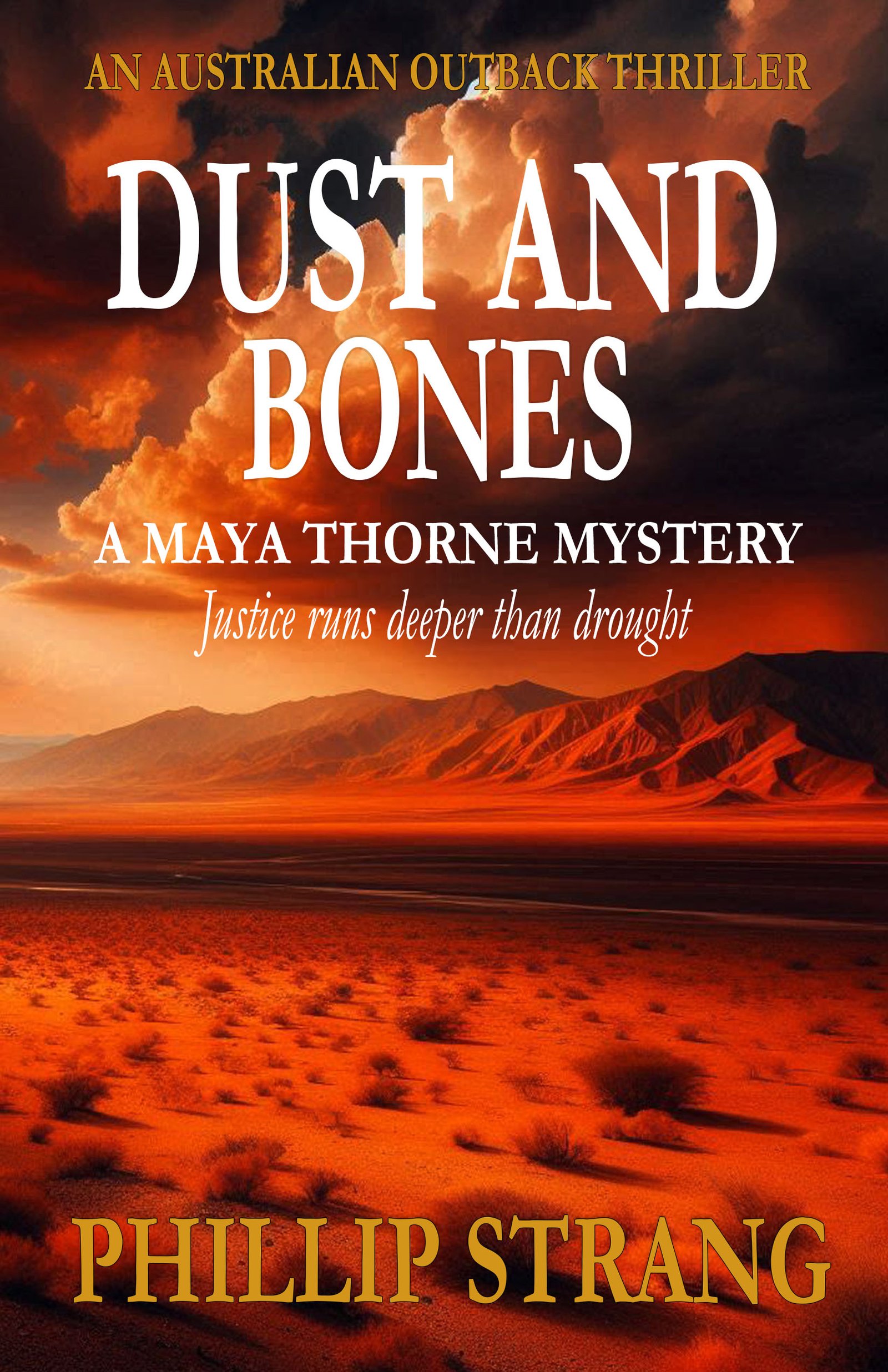
A MAYA THORNE MYSTERY
Get Dust and Bones Free
Justice runs deeper than drought.
Red dust. Shallow graves. A detective who hunts killers where the law runs thin and the nearest help is two hundred miles away.
Send Me the BookYou'll also receive occasional new release emails. Unsubscribe anytime. No spam, ever.
As an Amazon Associate, Phillip Strang earns from qualifying purchases. This page contains affiliate links — buying through them costs you nothing extra.