
The question of Urban vs Rural Crime Fiction Settings is not simply one of backdrop or atmosphere — it is a structural decision that determines how your story moves, how your characters behave under pressure, and what kinds of secrets are even possible. Choose the wrong setting for your story and the whole edifice wobbles, no matter how good your plotting is. The setting is not decoration; it is the engine.
Across eighteen series and more than 150 novels, I have found that the setting question is one writers frequently get backwards — they choose a location they find interesting and then try to make a story fit it, rather than asking which environment makes the specific crime, the specific psychology, and the specific investigative tension inevitable. Both urban and rural crime fiction demand entirely different contracts with the reader, and breaking those contracts without intent is the most common structural error I see in the genre.
What the City Actually Gives You (and What It Takes Away)
Urban crime fiction is not fundamentally about noise or crowds. It is about anonymity. The city allows your killer to disappear, allows your detective to be invisible, allows crimes to go unnoticed for days. That invisibility is the city’s great gift to the crime writer. In my DCI Isaac Cook series, set in London, the urban environment is never merely atmosphere — it is the reason the crimes are possible at all. London’s density, its layered social worlds, its capacity to hold a man or woman in complete isolation within a crowd of millions: these are the mechanisms of the plots, not the wallpaper behind them. The city lets people vanish. It lets evil operate between the cracks.
But the city takes something away too. It takes away intimacy. In an urban police procedural, the detective is almost always working with institutional resources — forensic teams, databases, surveillance footage, colleagues, chain of command. That structure produces a different kind of story. The best police procedural novels understand that the city setting makes the institution central. Isaac Cook’s investigations move through bureaucratic London, through politics and media pressure, through the machinery of a modern police force. That creates one kind of tension. It is not better or worse than rural tension, but it is categorically different.
Urban vs Rural Crime Fiction Settings: The Psychology of Witness and Secrecy
The most important craft difference between urban and rural crime settings is the psychology of observation. In a city, no one is watching — or everyone is watching anonymously, which amounts to the same thing for the investigator. In a rural setting, everyone is watching, everyone remembers, and no one will tell you what they saw. These are opposing narrative logics and they demand opposite investigative strategies from your detective.
When I developed my DI Tremayne series, set in the English countryside and small Wiltshire villages, I had to recalibrate everything. The crimes in those books are visible in a way London crimes never are — the victim is known, the community is bounded, the geography is comprehensible. Yet the truth is harder to reach, not easier. That is the paradox of rural crime fiction. Everyone knows everyone, which means everyone is protecting someone. The silences are structural. The witnesses exist but they will not speak, not because they are afraid in the urban way — afraid of retaliation on a dark street — but because they are embedded in a web of obligation, loyalty, and decades-long resentment. The rural secret is a social secret, held in place by community architecture rather than individual fear.
This means your rural detective must be a social anthropologist as much as an investigator. Tremayne succeeds not by outrunning criminals through London streets but by sitting in pubs, reading the unsaid, understanding which families have not spoken for thirty years and why. The investigative method must grow from the setting. If it does not, you have a city detective awkwardly transplanted into a countryside backdrop, which satisfies neither reader expectation.
Pacing, Geography, and the Shape of Scenes
Setting determines pacing at the scene level in ways writers often underestimate. Urban scenes can cut fast because the city itself is fast. The geography is dense and compressed — a ten-minute walk produces five potential witnesses, three crime scenes, two conflicting narratives. You can pile incident upon incident without it feeling contrived because the city is genuinely incident-dense. Your chapters can be shorter, your cuts sharper, your momentum propulsive.
Rural scenes breathe differently. The drive to the next farm takes twenty minutes, and those twenty minutes matter. They are thinking time, observation time, the space in which your detective processes and the reader absorbs. Truncating that space is a mistake many urban writers make when they attempt a rural story — they try to write countryside at city pace, and the result feels anxious and airless rather than taut. The isolation has to be felt. When I write Maya Thorne in the Australian outback, the physical distance between places is not inconvenience — it is menace. The nearest help is three hours away. That is not a logistics problem; it is a psychological condition the prose must honour.
Geography in rural crime is not background. It is active. Weather, terrain, season — these are characters in the functional sense. They change what is possible. A flooded creek can strand a detective, close off an escape route, make the body unreachable for forty-eight hours. In urban fiction, geography is more likely to be social than physical: which neighbourhood, which building, which floor. Both are legitimate. Neither is more serious or literary. They are different instruments.
What to Avoid: The Mistakes That Break Both Settings
The most persistent error in urban crime fiction is treating the city as generic. London is not New York is not Sydney is not Lagos — yet many novels use urban settings as an undifferentiated mass of traffic and crowds, stripping out the specific social geography that makes a city coherent. If your London novel could be set in any large English-speaking city without adjustment, you have not written London. You have written a placeholder. The specific rhythms of policing in a particular city, the class architecture of particular neighbourhoods, the ethnic and cultural layering of specific districts: these are not colour. They are the load-bearing walls.
The equivalent error in rural crime fiction is the cosy pastoral — the village presented as charming, the murder as a puzzle to be solved over tea, the violence defanged by prettiness. This is a failure of nerve. Rural crime at its most powerful is about the darkness that isolation and proximity breed: the grievances that have nowhere to go, the violence that has no witnesses, the absence of institutional protection. When a crime happens in a remote location, the stakes are different from the city not because they are lower but because the safety net is gone. If your rural setting makes your reader feel comfortable, you have probably missed the point. The countryside in crime fiction is not a retreat from danger. It is a different and often more intimate species of it.
A related mistake is conflating rural with slow and urban with fast as if these were moral qualities. Rural crime can be ruthlessly taut — the right structure, the right claustrophobia, and a village can generate more genuine dread than any city. The best noir crime thriller novels understand that dread is not a function of population density. It is a function of entrapment, and entrapment is available everywhere.
Conclusion
The choice between urban and rural is not an aesthetic preference. It is a decision about what kind of crime is possible, what kind of investigator is necessary, what kind of reader expectation you are entering into — and the novelist who treats it casually will pay for it across every chapter that follows.
About Phillip Strang
Phillip Strang is an Australian crime and thriller novelist. Across eighteen series and more than 150 novels, his work spans London police procedurals (DCI Isaac Cook), UK investigations (DI Tremayne), Australian outback crime (Maya Thorne), FBI thrillers (Alex Harlan), Scottish Highland mysteries (DI Sarah Lynch), and espionage (Steve Case). Learn more about Phillip or browse his complete catalogue on Amazon.
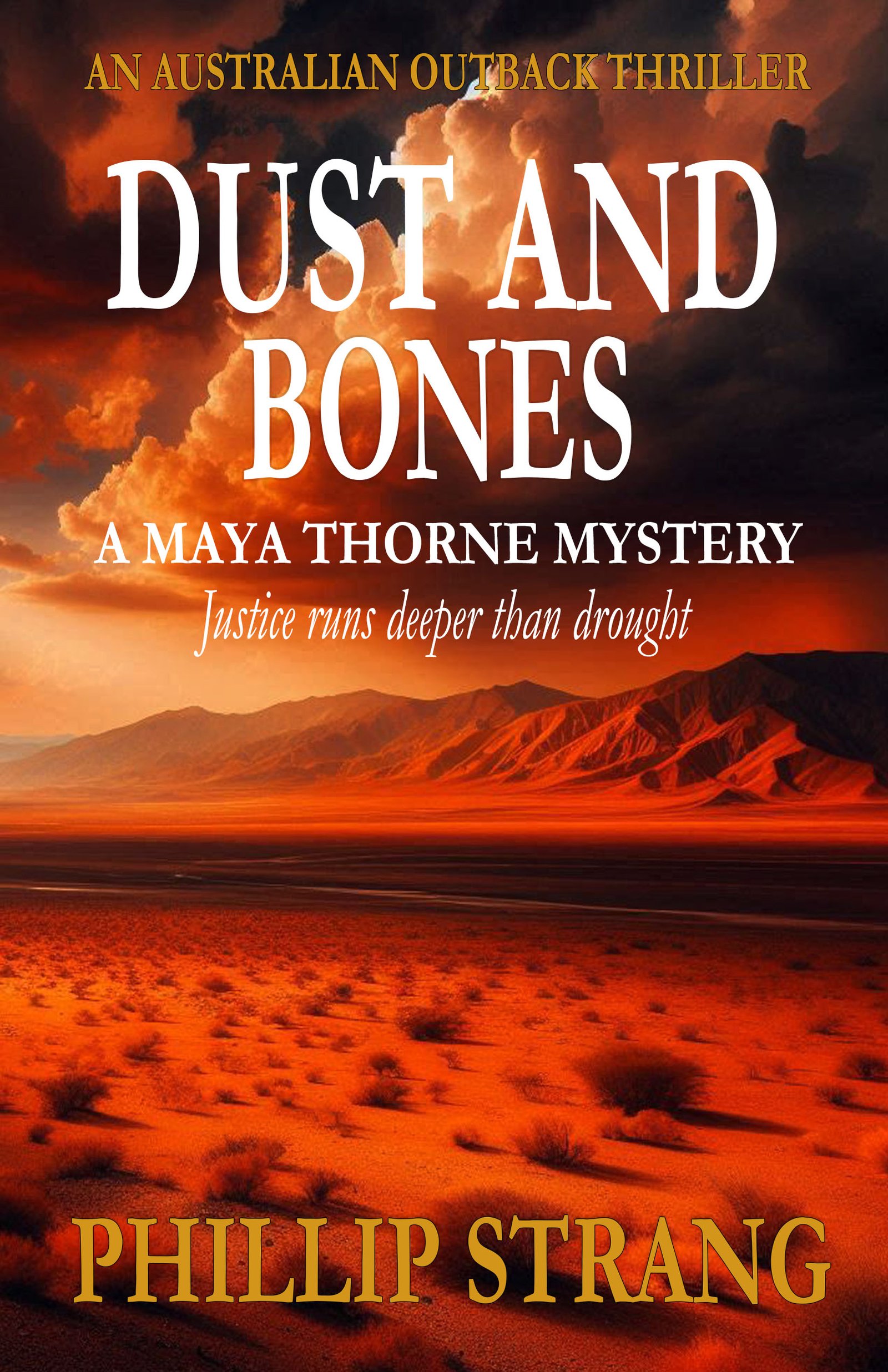
A MAYA THORNE MYSTERY
Get Dust and Bones Free
Justice runs deeper than drought.
Red dust. Shallow graves. A detective who hunts killers where the law runs thin and the nearest help is two hundred miles away.
Send Me the BookYou'll also receive occasional new release emails. Unsubscribe anytime. No spam, ever.
As an Amazon Associate, Phillip Strang earns from qualifying purchases. This page contains affiliate links — buying through them costs you nothing extra.