
The question of Noir Settings: Urban vs Natural is not simply one of backdrop — it is a question of moral architecture. Where your crime happens shapes what kind of crime it can be, what kind of guilt lingers, and what kind of investigator can survive it. Get the landscape wrong and you do not just have a weak setting; you have a structurally dishonest novel.
Across eighteen series and more than 150 novels, I have found that setting is never decorative in crime fiction — it is argumentative. The landscape makes a claim about human nature, and the story either confirms or complicates that claim. I have written London murders in cramped terraces and Australian disappearances under open sky, and the two experiences of writing are as different as the crimes themselves.
What Urban Noir Actually Does to a Story
Urban noir operates through compression. The city forces people together who have no business being near each other — old money beside desperate poverty, corrupt institutions within walking distance of the people they exploit. That proximity is the engine of urban crime fiction. A detective moving through London, Edinburgh, or Sydney is moving through a landscape that has already decided certain things: that anonymity is possible, that power is concentrated, that evidence leaves traces on concrete and CCTV and in the memories of people who saw everything and will say nothing.
When I built the DCI Isaac Cook series across multiple London novels, I had to reckon with what London actually does to a crime investigation. The city provides bureaucracy, racial tension, class friction, and an almost infinite supply of witnesses who are also suspects. London noir is never clean — it is layered in the way geological strata are layered, with old crimes embedded in the sediment beneath new ones. The urban setting gave me the ability to use institutional rot as a plot mechanism, which is something a forest simply cannot offer you. If you are writing noir crime fiction set in a major city, the city itself must be corrupt in some structural sense — not just incidentally criminal, but systemically compromised. That is what gives urban noir its particular flavour of hopelessness.
Natural Landscapes and the Specific Weight of Isolation
Natural noir works through a completely different mechanism. Where urban settings compress, natural settings expand — and that expansion creates dread of a different order. There are no witnesses. Evidence does not accumulate on CCTV; it dissolves in rain, bleaches in sun, or gets eaten. The isolation means that whoever is doing wrong has had time and space to do it thoroughly, and whoever is investigating is exposed and outnumbered in a way that no city detective ever quite is.
The Australian outback is a particularly unforgiving noir landscape. Writing the Maya Thorne series gave me direct experience of what natural isolation demands from a crime plot. In the outback, the landscape itself is antagonistic — not in a metaphorical sense, but in a practical one. People die from exposure. Evidence disappears. Communities are so small that everyone knows everyone else’s secrets, but no one will confirm anything to an outsider. That is a completely different investigative world than Islington or Shoreditch. The natural setting forces a crime novelist to think about information scarcity rather than information overload, and that changes not just plot mechanics but the emotional register of the entire novel. Fear in the outback is quiet and enormous; fear in the city is sharp and specific.
The Scottish Highlands operate similarly — vast, cold, resistant to inquiry. The DI Sarah Lynch series demanded I understand how geography shapes the culture of silence that exists in remote communities, where families have lived for generations and institutional law is viewed with deep suspicion. Natural settings generate a different kind of conspiracy than urban settings. Urban conspiracies are typically about power and money moving through institutions. Rural conspiracies are about land, blood, history, and the long memory of communities that predate the state.
Noir Settings: Urban vs Natural — Where Writers Make the Wrong Choice
The most common mistake is treating setting as scenery rather than as argument. I see this in crime fiction constantly: a writer drops their plot into London or the Yorkshire moors and then proceeds to write a story that could have happened anywhere. The setting is described — grey streets, rolling hills — but it does not generate the crime, shape the investigation, or constrain the resolution. That is a waste of a setting.
A related error is importing urban noir conventions wholesale into a natural setting. The hard-boiled detective who moves through the city trading information with informants, working the street, following the money — that figure does not function in a remote landscape. There are no informants. There is no street. An investigator in a natural setting has to work differently: slower, more patient, dependent on trust rather than leverage. When writers try to transplant the urban noir detective into a rural or wilderness setting without adjusting the investigative logic, the novel feels false. The pace is wrong, the methods are wrong, and the emotional atmosphere does not cohere.
The opposite error is equally damaging: romanticising the natural setting to the point where it loses menace. Natural noir requires the landscape to be genuinely threatening, not picturesque. The moment your Scottish loch or your Australian desert starts reading like a tourism brochure, you have lost the genre. The landscape in noir has to be capable of complicity — it has to feel like it is on the side of whatever darkness is operating within it. If it is beautiful in a reassuring way, it cannot carry noir weight.
How I Actually Make the Decision
When I am beginning a new series or a new novel, I do not ask myself what setting would be interesting. I ask what setting is necessary for the specific moral problem I am trying to examine. Urban settings are necessary when the crime requires institutional scale — when it cannot happen without corruption moving through multiple layers of a city’s power structure. A single murderer hiding in plain sight in a city of eight million people, protected by systems that were never designed to find people like him, is an inherently urban story. Natural settings are necessary when the crime requires time and secrecy and the particular complicity that comes from a community that has decided, collectively, to look away.
I also think carefully about what the setting permits the investigator. Writing police procedural fiction means understanding that investigative tools are shaped by geography. In London, my detective has forensic labs, a vast institutional infrastructure, colleagues, rivals, political pressure from above. In the outback or the Highlands, the investigator is often genuinely alone, with limited forensic support and a community that provides obstruction rather than assistance. These are not just logistical differences — they are character-defining conditions. The investigator you can be in a city is a different person from the investigator you must become in an isolated natural setting. Writers who understand this will write more coherent characters; writers who ignore it will write protagonists who feel inconsistent without understanding why.
I should also say that hybrid settings are among the most interesting territory available to noir writers. The industrial town that sits at the edge of wild landscape, the coastal village that is neither fully urban nor fully isolated — these liminal settings generate a particular kind of crime story where neither the urban nor the natural rules apply completely, and where the investigator has to navigate both worlds without the support structures either provides fully. That instability, handled well, can produce some of the most unsettling crime fiction available.
Conclusion
Setting in noir fiction is not atmosphere — it is structure. The choice between urban and natural is a choice about what kind of human failure you are going to examine, what kind of investigator can survive the examination, and what kind of reader experience results. Make it deliberately, make it early, and then make the rest of your novel answer to it.
About Phillip Strang
Phillip Strang is an Australian crime and thriller novelist. Across eighteen series and more than 150 novels, his work spans London police procedurals (DCI Isaac Cook), UK investigations (DI Tremayne), Australian outback crime (Maya Thorne), FBI thrillers (Alex Harlan), Scottish Highland mysteries (DI Sarah Lynch), and espionage (Steve Case). Learn more about Phillip or browse his complete catalogue on Amazon.
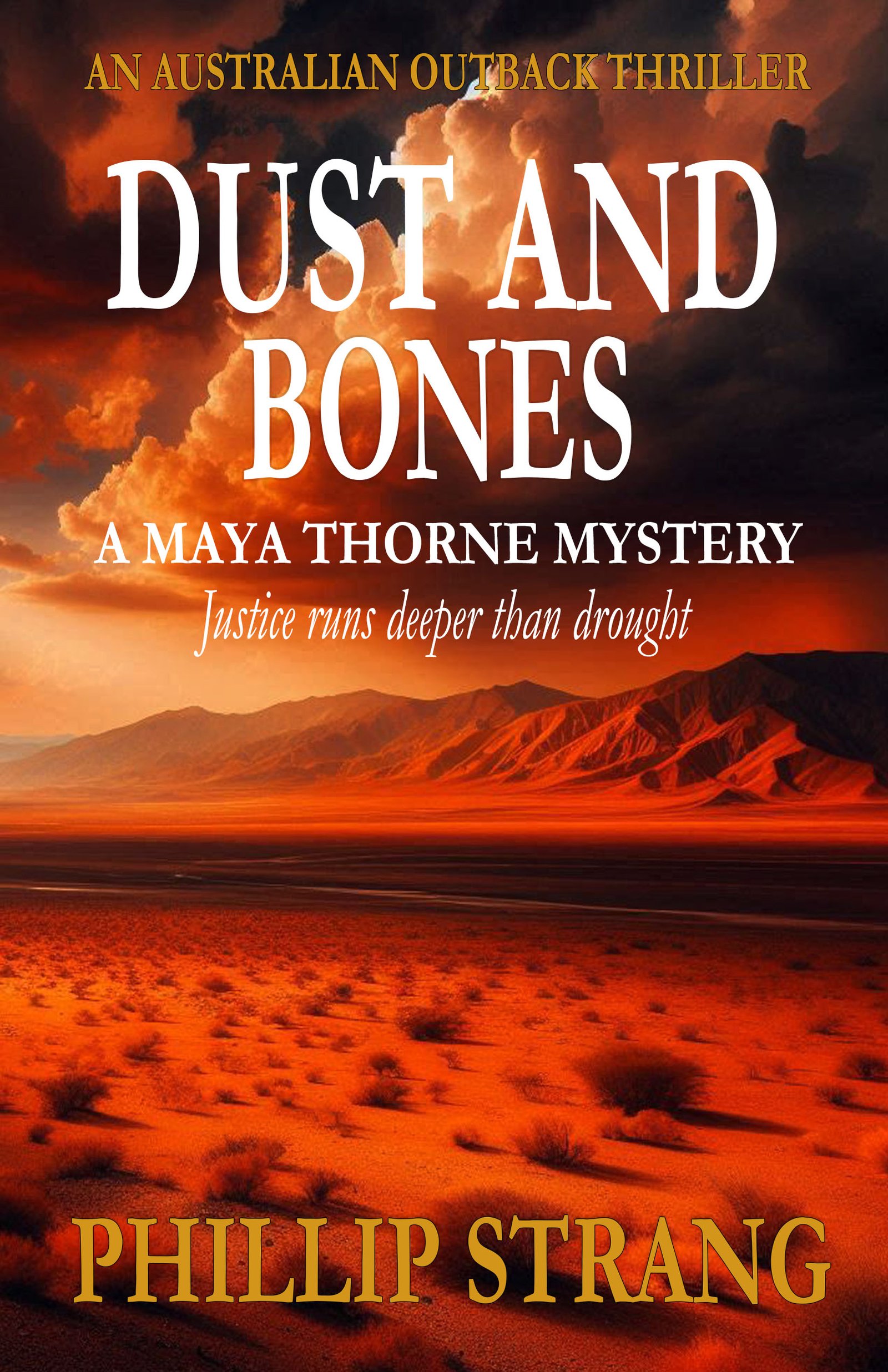
A MAYA THORNE MYSTERY
Get Dust and Bones Free
Justice runs deeper than drought.
Red dust. Shallow graves. A detective who hunts killers where the law runs thin and the nearest help is two hundred miles away.
Send Me the BookYou'll also receive occasional new release emails. Unsubscribe anytime. No spam, ever.
As an Amazon Associate, Phillip Strang earns from qualifying purchases. This page contains affiliate links — buying through them costs you nothing extra.