
Remote Settings in Modern Crime Fiction present a particular kind of structural problem that most writers underestimate: isolation is not inherently dramatic. A Scottish moor, an Australian outback station, a Hebridean ferry terminal in January — none of these settings generates tension on their own. What generates tension is what the setting prevents, denies, and makes irreversible.
Across eighteen series and more than 150 novels, I have found that the writers who use remote locations most effectively treat geography as a plot mechanism rather than a mood board. The setting does not dress the story; it constrains it, forces decisions, and removes the easy options that urban crime fiction can always reach for.
What Remote Settings Actually Do to a Story
The most important thing a remote setting does is remove optionality. When a detective is in London, there is always another forensic specialist, another witness to track, another avenue of inquiry that can be pursued by tomorrow morning. Strip that infrastructure away and every choice becomes load-bearing. The investigator cannot afford to alienate the only witness in a fifty-kilometre radius. The killer cannot simply vanish into a crowd. Evidence cannot be handed off to a lab and forgotten for three chapters.
This is the real craft value of remote settings in crime fiction, and it is frequently squandered. Writers fall in love with the landscape and forget that the landscape needs to be doing narrative work. A blizzard that closes the roads is only useful if it changes what the investigator can do — not just how cold they feel while doing it. The constraint must have consequence. If your remote setting could be swapped out for a London suburb without materially altering the plot, you have a backdrop, not a setting.
Working with DI Sarah Lynch in the Scottish Highlands, I learned this discipline the hard way across early drafts. The temptation is to linger in the geography — the light off a loch, the particular silence of a glen in early morning. That material has value, but only when it costs Sarah something. When the road washes out and she cannot get the body to the pathologist, when the only person who saw the vehicle is an elderly farmer who will not speak to police on principle — that is when the Highlands become a structural element rather than a postcard.
Remote Settings in Modern Crime Fiction and the Question of Community
One of the consistent craft challenges in remote settings is the community problem. Small, isolated communities are closed systems. Everyone knows everyone, grudges are generational, and an outsider investigator — which is usually what we give readers because we need a fresh perspective — is immediately a social disruption. This is narratively rich territory, but it demands rigour.
The danger is that the community becomes a chorus of eccentrics, each one colourful and obstructive but none of them genuinely motivated. The writer has to ask hard questions about why people in this place keep the secrets they keep. Not because they are generically suspicious of outsiders, but because they have specific, historically grounded reasons. A community that has survived by not involving authorities does not suddenly become forthcoming because a detective arrives with a warrant card and decent intentions.
When I set Maya Thorne in the Australian outback, the community dynamics required the same level of structural honesty. Remote Australian communities — particularly those with Indigenous history and contested land relationships — carry a weight of institutional mistrust that cannot be flattened into atmosphere. Maya has to earn every piece of information she gets, and the reader has to understand why the withholding is rational, not merely picturesque. That discipline forces better plotting, because every revelation has to be made credible by what precedes it.
How I Actually Build a Remote Setting From the Inside Out
My working method starts with a practical audit of what the setting denies. I make a list — and this is genuinely the only list I find useful in early drafting — of what a detective would normally reach for that this setting makes impossible or significantly harder. Forensic support. Legal counsel. Safe houses. Anonymous movement. Digital infrastructure. Each denial becomes a potential plot engine.
Then I ask what the setting provides that an urban environment cannot. Not aesthetically — narratively. A remote setting often provides a compressed witness pool, which means the investigator can know with reasonable certainty who had access and who did not. It provides physical evidence that persists differently — a vehicle track in red dirt, a disturbed fence line, the particular way a gate was left. It provides time pressure that is meteorological rather than bureaucratic: the wet season will close the roads, the ferry runs once a week, the muster will scatter every potential witness across three hundred kilometres of grazing country.
I also build the geography before I build the plot. Not in the sense of mapping every landmark, but in the sense of understanding travel time and its consequences. If it takes four hours by dirt road to reach the nearest town, that is not background detail. That is a structural fact that shapes every scene involving movement. Readers who understand crime fiction are alert to logistical realism — and they notice when writers fudge the geography for convenience. For anyone interested in how isolation functions across the broader genre, the craft principles overlap significantly with what makes the best noir crime thriller novels work: environment as moral pressure, not mere scenery.
What Writers Get Wrong About Remote Settings
The most common mistake is treating remoteness as a synonym for simplicity. The logic seems to run: fewer people, fewer complications. This produces fiction where the mystery resolves too neatly because the suspect pool was never credibly constructed. A small community is not a simple community. It is a layered one, where decades of proximity have created obligations, resentments, and entanglements that a city of millions could never sustain. The crime writer who understands this writes a more complex book, not a simpler one.
A related error is using the remote setting to excuse research shortcuts. Because the location is unfamiliar to many readers, some writers assume they can generalise. They cannot. The reader who knows the Kimberley, or the Orkneys, or the Montana hi-line will spot a generalised version of their place immediately and disengage. Specificity is not just atmospheric craft — it is a credibility contract with the reader. Get the specific wrong and you lose the general.
There is also the problem of the imported investigator who never genuinely inhabits the place. The fish-out-of-water dynamic is legitimate — it creates immediate narrative friction. But if the investigator remains merely bemused by the setting for the entire novel, the setting has not done its work. The character must be changed by the geography, or at minimum must have their assumptions tested by it in ways that matter to the resolution. An investigator who solves the crime despite the setting, rather than through it, has wasted the location. This is a craft principle that applies just as forcefully to the best police procedural novels as to standalone crime fiction — the procedural mechanism must interact with the environment, not run parallel to it.
Conclusion
Remote settings earn their place in crime fiction only when they function as active structural elements — limiting, revealing, and ultimately shaping what the story can become. The landscape is not the point. What the landscape makes impossible, and what that impossibility forces the investigator and the criminal to do, is the point.
About Phillip Strang
Phillip Strang is an Australian crime and thriller novelist. Across eighteen series and more than 150 novels, his work spans London police procedurals (DCI Isaac Cook), UK investigations (DI Tremayne), Australian outback crime (Maya Thorne), FBI thrillers (Alex Harlan), Scottish Highland mysteries (DI Sarah Lynch), and espionage (Steve Case). Learn more about Phillip or browse his complete catalogue on Amazon.
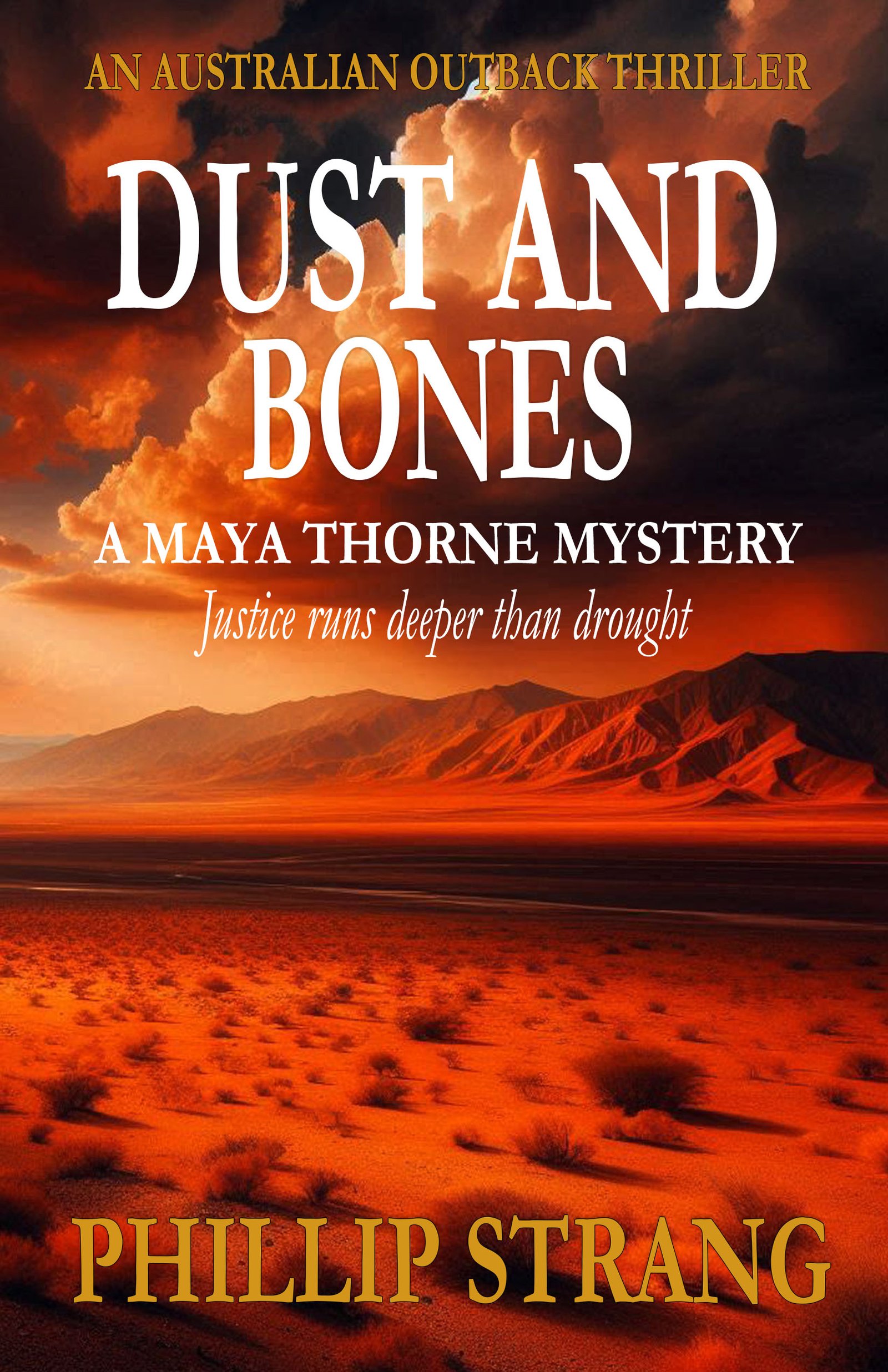
A MAYA THORNE MYSTERY
Get Dust and Bones Free
Justice runs deeper than drought.
Red dust. Shallow graves. A detective who hunts killers where the law runs thin and the nearest help is two hundred miles away.
Send Me the BookYou'll also receive occasional new release emails. Unsubscribe anytime. No spam, ever.
As an Amazon Associate, Phillip Strang earns from qualifying purchases. This page contains affiliate links — buying through them costs you nothing extra.