
The question of Australian vs Scottish Crime Settings is not simply about geography — it is about the fundamentally different emotional grammars that each landscape imposes on a crime narrative. One setting gives you vast, indifferent space where isolation is total and rescue is never coming; the other gives you enclosure, mist, and a social architecture ancient enough to have its own categories of silence. These are not interchangeable backdrops. They demand different plotting logic, different character psychology, and different relationships between the detective and the world they are trying to make sense of.
I have written extensively in both traditions, and across eighteen series and more than 150 novels I have found that the setting is never decoration — it is argument. The landscape takes a position on your crime before your detective arrives. Understanding what position each setting takes, and how to use it without surrendering to cliché, is one of the more underrated technical skills in crime fiction.
What the Australian Outback Actually Does to a Crime Story
The defining feature of Australian crime writing is not heat, though heat is real and consequential in ways that northern hemisphere writers routinely underestimate. The defining feature is scale and its psychological consequence: the absence of witness. In a Scottish village, someone always sees something. The postmistress, the farmer, the woman at the window. The social fabric is surveillance. In the Australian outback, there is no fabric. There is space so absolute that a body can disappear for decades and geography itself becomes the accomplice.
This creates a specific kind of dread that is entirely different from claustrophobic Scottish unease. Australian crime dread is agoraphobic in structure. The threat is not what is hiding in the dark close — it is what you cannot reach, cannot call for help against, cannot escape toward. When I developed Maya Thorne, my Australian outback crime series, I kept returning to this idea: that the landscape functionally removes the scaffolding of civilisation. There is no ambulance twenty minutes away. There is no neighbourhood to canvas. The detective operates in a condition that resembles the crime itself — exposed, unsupported, and making decisions without a net. That structural parallel between detective and victim is one of the great gifts the Australian setting offers, but only if you actually use it rather than simply mentioning the red dirt and moving on.
The Indigenous dimension of Australian crime settings is also not optional background colour. Land, law, and silence carry specific meaning in that context, and writers who treat it as atmospheric texture rather than structural force produce fiction that is both culturally dishonest and narratively weaker than it could be. The outback is not empty. It is densely storied. The crime writer who understands that has access to a completely different order of tension.
The Scottish Highlands and the Craft of Enclosure
The Scottish Highlands operate on entirely different principles. Where Australia offers scale as threat, Scotland offers enclosure. The mist, the mountain passes, the village where everyone has known everyone for four generations — these are not simply scenic. They are the architecture of secrets that cannot leave. A crime in a Highland community is a crime that happened inside the community, and the detective investigating it is investigating a closed system that has already processed the event through its own logic before any official arrives.
When I built DI Sarah Lynch, I was specifically interested in what it means to be an outsider — or a partial insider — trying to break into that closed logic. The Highlands have an economy of disclosure that is not about hostility so much as a deeply embedded cultural understanding that information shared is power surrendered. The detective does not simply investigate. She negotiates. And the landscape enforces this: roads that close in winter, communities that genuinely cannot be reached, a geography that turns physical isolation into social isolation and back again in a continuous loop.
Scottish crime also operates with history as active pressure. The clearances, the clan structures, the specific weight of Protestant and Catholic divisions in certain regions — these are not background. They shape what crimes are possible, what motives are legible, and what kinds of justice the community will and will not accept. A crime writer working in the Scottish Highlands who ignores this is not merely being superficial; they are misunderstanding the causal architecture of the world they are writing about. The most compelling character-driven crime fiction set in Scotland tends to be fiction where the history is structural, not decorative.
Australian vs Scottish Crime Settings: The Craft Decisions That Diverge
When you sit down to write in each setting, the practical craft decisions diverge sharply and specifically. In Australian outback crime, your pacing is controlled by distance. A character who needs to reach another character, needs to call for backup, needs to get forensics to a scene — the time required is not a subplot inconvenience. It is the plot. I use distance as a pressure valve deliberately: the time it takes to close a gap is the time available for things to go wrong, for the killer to move, for the evidence to be destroyed by weather or animals or simple entropy. The outback does not wait for the detective.
In Scottish Highland crime, pacing is controlled by information rather than distance. The bottleneck is not getting there — it is getting anyone to talk. The withholding is social and psychological, and your plotting must be structured around the incremental release of what the community knows. This demands a different relationship with secondary characters. In Australian outback crime, secondary characters are often isolated themselves — the station owner, the Indigenous elder, the passing truckie — and their information tends to come in complete, context-free fragments that must be assembled. In Scottish crime, secondary characters are embedded in a network, and what they reveal is always shaped by their relationship to everyone else in that network. The detective is essentially doing social network analysis, not just evidence gathering.
The forensic logic also changes. Scotland has infrastructure — pathologists, labs, police databases, reasonably reliable communications. Australia, at distance, does not. This affects not just the procedural mechanics but the epistemological character of the investigation. What counts as evidence when you cannot verify it through institutional channels? That is a genuinely interesting craft problem, and it is one that the best outback crime writing exploits rather than papers over. Writers who are interested in the nuances of the police procedural form will find that the Australian setting stress-tests many of the genre’s assumptions about institutional support in ways that produce unexpected creative pressure.
What to Avoid: Common Failures in Both Settings
The most consistent failure in Australian outback crime is using the landscape as metaphor without earning it through physical specificity. Writing that tells us the landscape reflects the character’s interior state — vast, empty, unknowable — without first making us feel the actual temperature, the actual silence, the actual distance, is writing that reaches for meaning before establishing fact. The reader does not yet believe in the landscape, so the metaphor has nothing to stand on. Show me the flies, the cracked clay, the single-bar phone signal that drops out, and then you have earned the right to say something about emptiness.
The equivalent failure in Scottish crime is tartan mysticism: the idea that Scottishness is itself a sufficient source of atmosphere. Dour fishermen, whisky, drizzle, and a vaguely Celtic sense of doom do not constitute a setting. They constitute a set. The specific social mechanics — who owes whom, which families have not spoken in decades, what the local economy actually runs on and who controls it — are what make a Highland community real enough to generate crime that feels inevitable rather than planted. When the crime feels planted, the setting has failed to do its structural work.
A subtler mistake is writing Australian or Scottish crime from a tourist’s distance — describing what a visitor would notice rather than what a resident would take for granted. The resident does not notice the landscape. They are inside it. The detective who has worked that area for fifteen years does not see the mountains as dramatic. They see them as a problem or a comfort depending on the day. That shift in perceptual register, from the observed to the inhabited, is where both settings begin to generate genuine fiction rather than illustrated tourism.
Conclusion
The craft argument I keep returning to is this: setting in crime fiction is not where the story takes place — it is one of the mechanisms by which the story becomes possible. Australia and Scotland each make specific crimes possible, specific psychologies credible, and specific kinds of justice legible or illegible. The writer who understands that is not choosing between beautiful landscapes. They are choosing between fundamentally different narrative engines.
About Phillip Strang
Phillip Strang is an Australian crime and thriller novelist. Across eighteen series and more than 150 novels, his work spans London police procedurals (DCI Isaac Cook), UK investigations (DI Tremayne), Australian outback crime (Maya Thorne), FBI thrillers (Alex Harlan), Scottish Highland mysteries (DI Sarah Lynch), and espionage (Steve Case). Learn more about Phillip or browse his complete catalogue on Amazon.
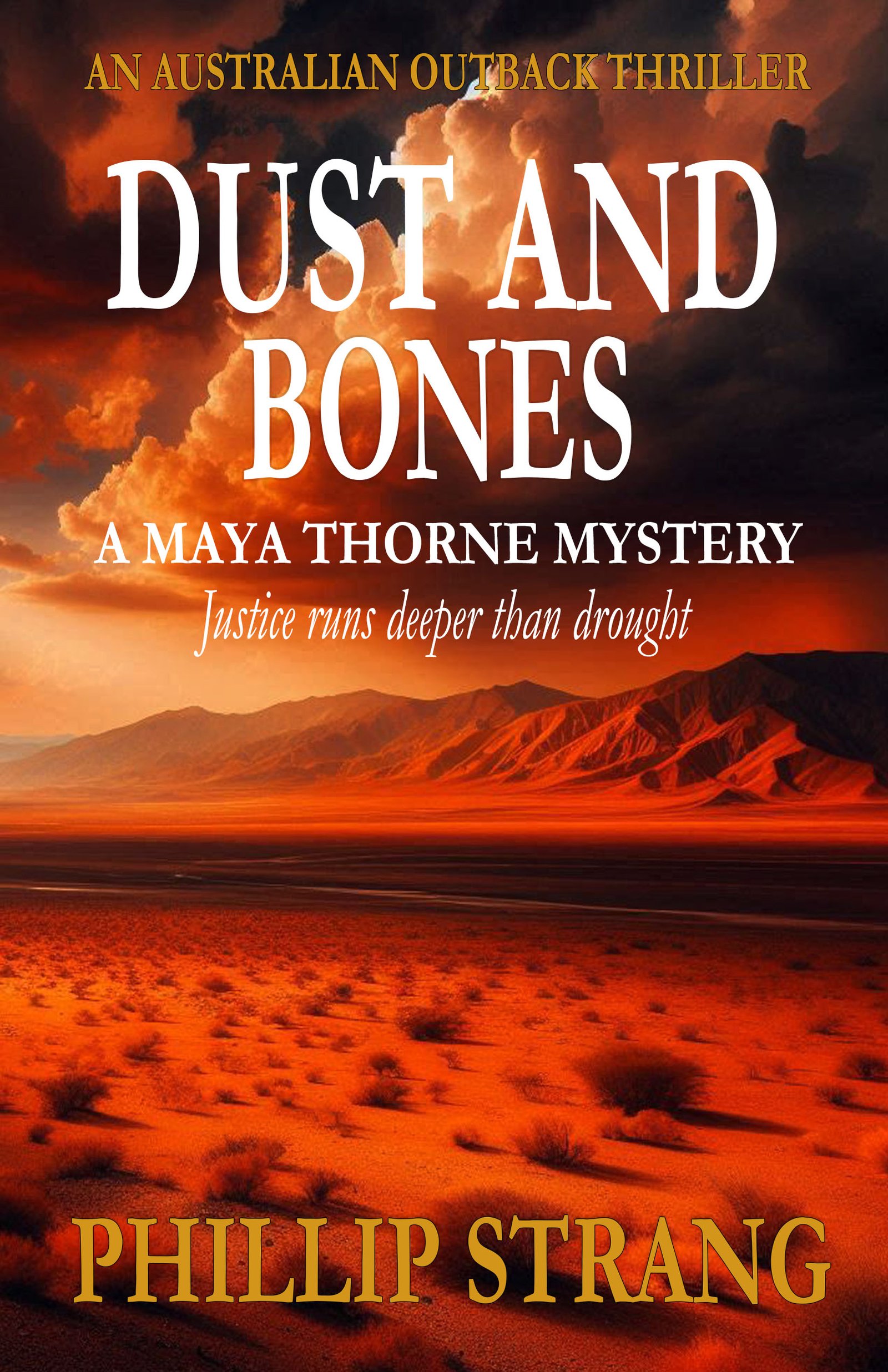
A MAYA THORNE MYSTERY
Get Dust and Bones Free
Justice runs deeper than drought.
Red dust. Shallow graves. A detective who hunts killers where the law runs thin and the nearest help is two hundred miles away.
Send Me the BookYou'll also receive occasional new release emails. Unsubscribe anytime. No spam, ever.
As an Amazon Associate, Phillip Strang earns from qualifying purchases. This page contains affiliate links — buying through them costs you nothing extra.