
Chase sequences: using geography as an active structural force rather than a painted backdrop is the single most important decision a thriller writer makes when building pursuit into a narrative. The terrain your characters run through, hide within, or navigate under pressure is not decoration — it is plot. Get it wrong and the chase deflates into a blur of breathless verbs; get it right and the reader’s pulse actually quickens.
Across eighteen series and more than 150 novels, I have found that the writers who produce genuinely memorable chase sequences are not the ones with the fastest prose rhythms — they are the ones who have done the geographic thinking before they type the first word of the scene. The geography determines the physics, the psychology, and the moral weight of a pursuit.
Geography as Character, Not Stage Dressing
The most persistent mistake I see in crime and thriller manuscripts is treating location as a container — a named street, a vague industrial precinct, a forest with no particular character. The writer imagines the chase and then drops a setting around it like a film set being wheeled onto a stage. The result is geography that is technically present but functionally absent. Nothing about the place shapes the chase, and the reader senses this even if they cannot articulate why.
Consider what geography actually does when it is working: it creates natural chokepoints that make the pursuer’s advantage mean something specific; it provides psychological texture that bleeds into the fugitive’s decision-making; it encodes social information about who has power and who does not. When I write DCI Isaac Cook navigating a chase through South London, the geography is doing ideological work. The council estates of Lambeth or Hackney are not interchangeable with Mayfair, and Isaac’s understanding of those spaces — who controls the sightlines, which doors will open and which will not — is directly tied to his long experience as a Black detective working neighbourhoods where institutional trust is complicated. Strip out the specific geography and you strip out half the meaning.
This is why I resist the impulse to invent entirely fictitious street layouts for chase sequences. Composite geography is fine and sometimes necessary for legal reasons, but the underlying spatial logic — the rhythm of how a city opens and closes, how it funnels and releases — must feel like it was earned by someone who actually walked those streets. Readers who know a city will forgive a renamed pub. They will not forgive a chase that contradicts how cities actually work.
The Mechanics of Using Chase Sequences: Using Geography Effectively
There is a mechanical question that has to be answered before any chase scene is written: what is the fugitive trying to achieve, and does this landscape make that goal plausible or impossible? This sounds elementary but it is constantly violated. Writers give their characters the wrong geography for their objective.
A character trying to disappear needs density — crowds, competing sightlines, the anonymising blur of urban mass. A character trying to reach a specific point under time pressure needs route options, which means the geography has to have both obvious paths and hidden alternatives. A character trying to survive a physical hunt in open country needs terrain that offers intermittent concealment without providing so much cover that the tension evaporates. Each of these is a different geographic brief and they require different kinds of research and different kinds of writing.
When I was building the pursuit sequences in the Maya Thorne series, the Australian outback imposed its own brutal geometry. There is nowhere to hide in the flat red country north of Broken Hill. That is not a problem to be solved — it is the problem, and making it the problem is what gives those chases their particular dread. The landscape does not care. It does not provide cover because it was never designed to accommodate human need. Maya’s survival depends on her reading of micro-terrain — dry creek beds, scrub lines, the shallow shadow of a ridge — and those details only carry weight because I have spent time understanding what the country actually looks like and what it actually does to a person moving through it under stress.
For DI Sarah Lynch, the Scottish Highlands create a different set of geographic constraints. The mist-wrapped glens and remote single-track roads are not interchangeable with the outback — they impose a different kind of isolation, one where civilization is technically close but functionally unreachable. A Highland chase is as much about navigating the absence of infrastructure as it is about physical distance. That distinction changes everything: the psychology of the fugitive, the options available to the pursuer, and the kinds of mistakes each character is likely to make.
Pacing and the Geography of Time
Geography controls pace in ways that prose rhythm alone cannot. This is one of the more counterintuitive craft truths I have arrived at. Writers often try to accelerate a chase by shortening sentences and dropping subordinate clauses, and there is merit in that, but the reader does not feel speed — they feel constraint. Speed is only meaningful when measured against something that resists it.
An urban chase through a market crowd is slow in physical terms but fast in information terms: the sensory load is enormous, the decision points come rapidly, and the danger is close and chaotic. A rural chase across open ground can be physically fast while feeling agonisingly slow — because the fugitive can see exactly how much distance remains and the pursuer can see exactly where the quarry is going. These are different temporal textures, and geography generates them.
The most effective action thrillers — the kind you find discussed among readers of best action thriller novels — deploy geography to modulate tension rather than relying solely on writing technique. The landscape itself has a rhythm, and skilled thriller writers learn to compose against that rhythm rather than with it. Put your fastest prose in the moment the character enters dense cover; slow down and go granular when they break into open ground. The contrast creates the sensation of pace.
What Goes Wrong: The Geography Mistakes That Kill Chase Tension
The first and most common failure is the omniscient landscape — a chase geography that conveniently provides exactly what the protagonist needs at each moment. The alley appears when the character needs to hide. The crowd materialises when they need anonymity. The bridge appears when they need to cross the river. This is not geography, it is wish fulfilment, and readers clock it immediately as rigged. The geography in a chase scene has to have its own integrity; it has to refuse the protagonist as often as it helps them.
The second failure is the geography that exists only in the writer’s head. This produces chase scenes full of directional confusion — characters turning left when the scene logic requires right, crossing spaces that have not been established, emerging from buildings whose interiors were never mapped. I draft a rough spatial diagram before writing any significant chase: not an architect’s plan, just a working understanding of the major sightlines, chokepoints, and transitions. Without this, I produce chase scenes that drift spatially, and drift destroys tension.
The third failure is using geography without consequence. If a character sprints through a construction site, that site should leave traces: dust, injury risk, the specific sounds that echo off steel and concrete, the altered sight-lines created by scaffolding. If none of this registers in the prose, the geography was not really there — it was just a label. Writers working in the police procedural tradition understand this instinctively because procedural fiction demands forensic attention to place. That attention is exactly what chase sequences require.
How I Actually Work: Geography Before Plot
My working method for chase sequences is unambiguous: I map before I write. Not the plot of the chase but the terrain of the chase. I research or revisit the actual location, walk as much of it as I can, and note the specific details that would be salient to someone moving through it at speed and under threat. Then I work out what the geography will refuse to allow — which routes are blocked, which advantages cannot be held — and I build the chase inside those constraints rather than around them.
This sounds restrictive but it is actually liberating. When the geography is doing real work, plot problems solve themselves. Characters make the decisions that their environment imposes rather than the decisions I need for the story, and paradoxically those decisions are almost always better — more surprising, more grounded, more resonant — than the ones I would have invented sitting at a desk.
Conclusion
Geography in a chase is not a setting — it is a collaborator. The best pursuit sequences in crime and thriller fiction are the ones where you could not lift the chase out of its specific landscape and transplant it elsewhere without destroying the scene entirely. That specificity is the work, and it has to be done before the first sentence is written.
About Phillip Strang
Phillip Strang is an Australian crime and thriller novelist. Across eighteen series and more than 150 novels, his work spans London police procedurals (DCI Isaac Cook), UK investigations (DI Tremayne), Australian outback crime (Maya Thorne), FBI thrillers (Alex Harlan), Scottish Highland mysteries (DI Sarah Lynch), and espionage (Steve Case). Learn more about Phillip or browse his complete catalogue on Amazon.
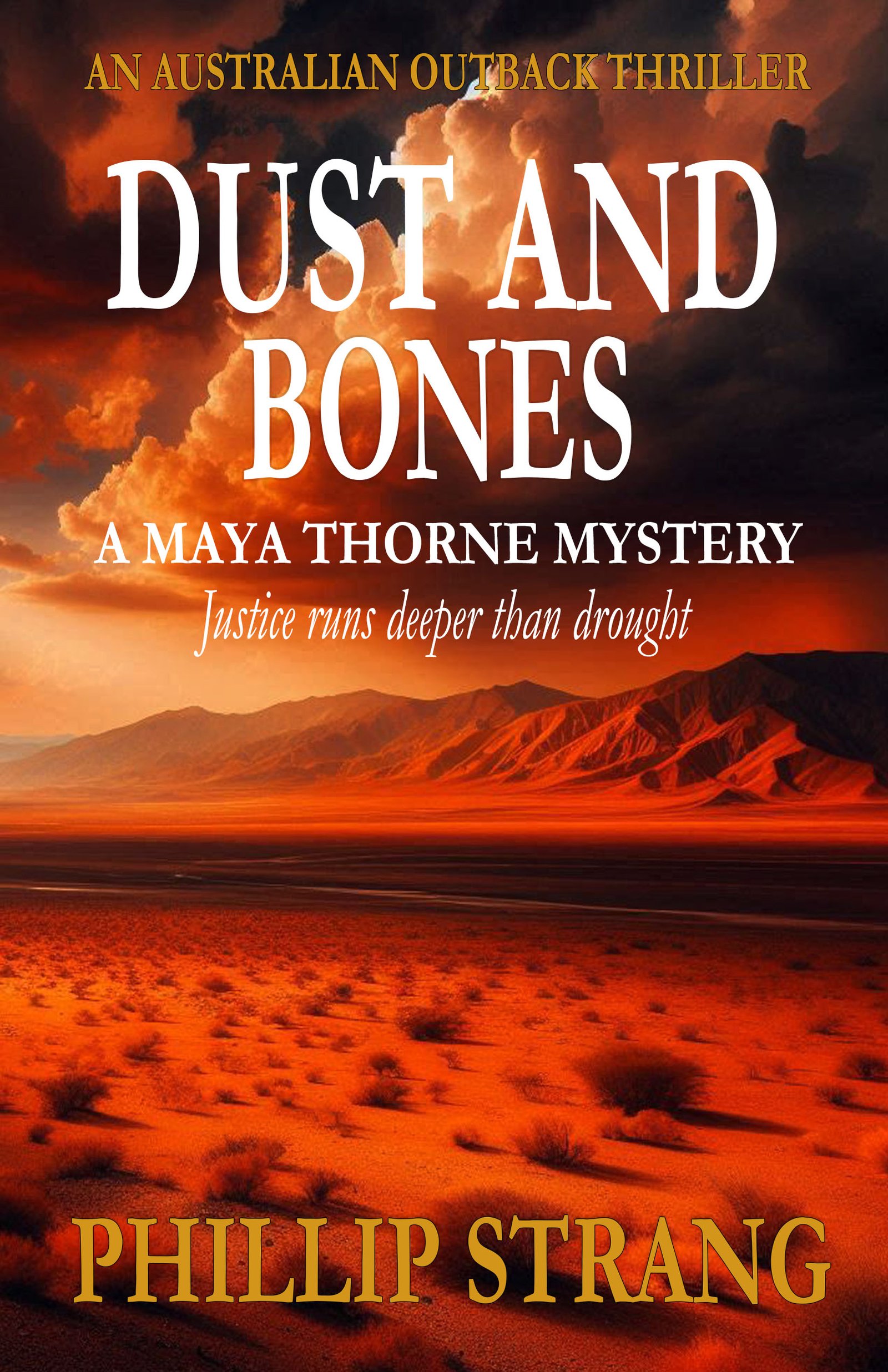
A MAYA THORNE MYSTERY
Get Dust and Bones Free
Justice runs deeper than drought.
Red dust. Shallow graves. A detective who hunts killers where the law runs thin and the nearest help is two hundred miles away.
Send Me the BookYou'll also receive occasional new release emails. Unsubscribe anytime. No spam, ever.
As an Amazon Associate, Phillip Strang earns from qualifying purchases. This page contains affiliate links — buying through them costs you nothing extra.