
Contrast Settings in Crime Fiction is not a decorative technique. It is structural. When two locations sit in deliberate tension with each other, the friction between them does work that no amount of expository prose can replicate. The question every crime writer should be asking is not where does my story happen, but what does the gap between my settings mean?
Across eighteen series and more than 150 novels, I have found that the most effective tension in a crime story rarely comes from the crime itself. It comes from the dissonance between the world in which a murder is discovered and the world the investigation forces the detective to enter. That dissonance, managed with precision, is what keeps a reader turning pages at midnight.
Setting Is Not Backdrop — It Is Argument
There is a persistent misconception among newer crime writers that setting is where you put your characters, the way you choose a room for a meeting. That instinct produces flat, forgettable fiction. Setting in crime fiction is an argument about the world. When you place a murder in a particular environment, you are making a claim: this place shapes people in ways that lead to violence, concealment, loyalty, or betrayal. When you then pull your detective out of their native environment and push them into the crime’s territory, you are creating philosophical friction as much as geographical movement.
Think about what it means when a London detective who understands hierarchy, bureaucracy, and the slow grind of institutional power is confronted with a crime embedded in a community that operates on entirely different social logic. The setting isn’t window dressing. It is the antagonist’s home field. The detective is always slightly wrong-footed, and that wrongness generates every scene. The best best police procedural novels understand this instinctively. The procedural elements — the interviews, the warrants, the chain of command — collide with environments that don’t recognise or respect those procedures.
How I Use Contrast Settings in Crime Fiction Across Different Series
In my DCI Isaac Cook series, the contrast is largely social and economic rather than geographical. Isaac operates within the formal structures of the Metropolitan Police, but the crimes consistently drag him into London’s margins — communities shaped by poverty, immigration, cultural insularity, and distrust of authority. The setting contrast is not between London and somewhere else. It is between the London of institutions and the London that institutions have failed. That gap is where the crime lives, and Isaac must constantly negotiate it.
The Maya Thorne series gave me a different kind of contrast entirely. The Australian outback operates on scale and silence that European crime settings simply cannot replicate. When Maya moves between the vast, indifferent landscape of the interior and the small, tight-knit communities embedded within it, the contrast works in both directions. The land dwarfs human drama; the communities amplify it. Violence in those settings carries a different weight. There is nowhere to run. There is no anonymity. Everyone knows the wound before the investigation begins, and the detective’s job is not to discover what happened but to force a community to say it aloud. That particular setting contrast — immensity outside, claustrophobia inside — is one I find endlessly productive.
My DI Sarah Lynch series in the Scottish Highlands works a similar mechanism but with different emotional registers. The Highlands carry historical weight that the outback does not. Every landscape there is also a memory of clearance, of displacement, of a culture that was dismantled. Sarah operates in communities where the past is not subtext but present argument, and the contrast between the austere beauty of the setting and the specific historical grievances driving crime gives each book a moral dimension that a generic urban setting would flatten entirely.
The Working Method: Building Contrast Before the First Scene
My practical approach to contrast settings begins before I write a word of narrative. I ask two questions. First: what is the native world of my detective — the environment that shaped their assumptions, their methods, their blind spots? Second: what is the world of the crime — the environment the victim inhabited, that protected or enabled the perpetrator, that will resist the investigation?
Once I have clear answers, I map the specific points of friction. Not vaguely — specifically. If my detective expects deference to rank, I need environments where rank is irrelevant. If my detective reads social cues from an urban context, I need communities where those cues work differently. If my detective is accustomed to institutional support, I need settings where they operate without it. These friction points become the architecture of scenes. They dictate what goes wrong, what information arrives too late, what assumptions lead to dead ends.
For those interested in how setting and atmosphere intersect with moral complexity, the best noir crime thriller novels offer useful study. Noir has always understood that environment is not neutral. The setting is corrupt, and the detective is either corrupted by it or destroyed trying to resist it. That is contrast working at maximum pressure.
What Goes Wrong: The Mistakes Crime Writers Make With Setting Contrast
The most common failure I see is what I would call the postcard mistake. A writer chooses a striking or exotic setting, describes it beautifully, and then runs a generic investigation inside it. The setting becomes tourism. The contrast is visual rather than structural. A murder in Marrakech that could have happened anywhere, with a detective who is essentially unaffected by the environment, wastes its location entirely. Beautiful sentences about the souk do not constitute contrast. The detective must be changed, challenged, or compromised by the environment for the contrast to function as craft.
The second mistake is symmetrical settings. This sounds counterintuitive, but some writers create contrast by alternating between two environments that share the same emotional register. Two grim urban landscapes, two bleak post-industrial towns. The settings are different in specifics but identical in tone and social logic. There is no friction. The detective moves easily between them because both worlds operate by the same rules. Real contrast requires genuine asymmetry — not just visual difference but difference in power, in social logic, in what counts as truth and who is entitled to tell it.
The third failure is introducing the contrast too late. Setting tension must be established early, in the first scenes of investigation, or the reader has no framework for why the friction matters. If your detective doesn’t feel wrong-footed until chapter eight, you have lost four chapters of structural energy that nothing else can replace.
Conclusion
Contrast settings work because crime fiction is fundamentally about worlds colliding — the world of order meeting the world of violence, the detective’s certainties meeting the community’s secrets. The gap between those worlds is not a problem to be solved. It is the engine of the story. Build it deliberately, map its specific friction points, and let your detective suffer inside it. That suffering, in the right setting, is the reason readers stay.
About Phillip Strang
Phillip Strang is an Australian crime and thriller novelist. Across eighteen series and more than 150 novels, his work spans London police procedurals (DCI Isaac Cook), UK investigations (DI Tremayne), Australian outback crime (Maya Thorne), FBI thrillers (Alex Harlan), Scottish Highland mysteries (DI Sarah Lynch), and espionage (Steve Case). Learn more about Phillip or browse his complete catalogue on Amazon.
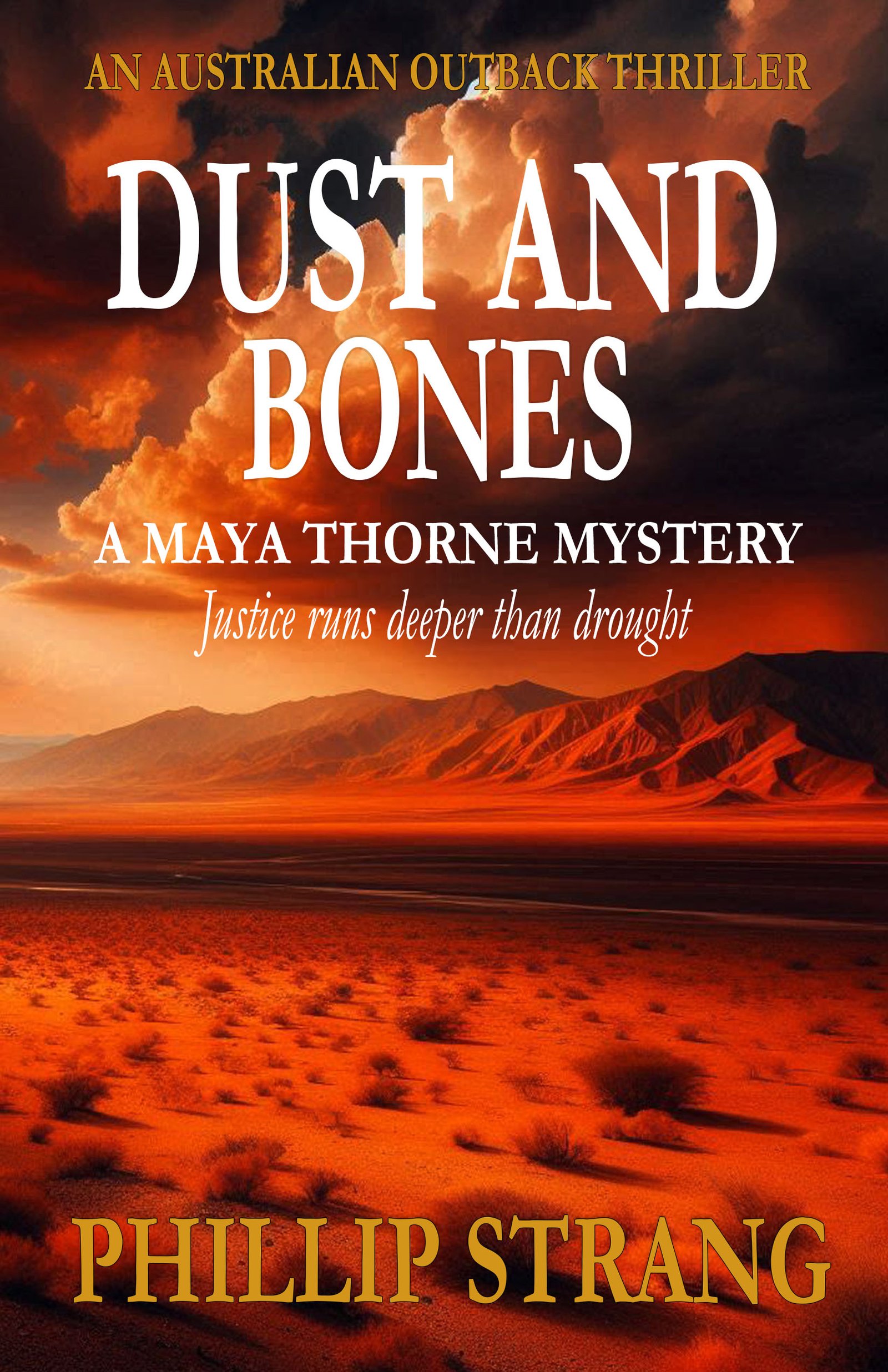
A MAYA THORNE MYSTERY
Get Dust and Bones Free
Justice runs deeper than drought.
Red dust. Shallow graves. A detective who hunts killers where the law runs thin and the nearest help is two hundred miles away.
Send Me the BookYou'll also receive occasional new release emails. Unsubscribe anytime. No spam, ever.
As an Amazon Associate, Phillip Strang earns from qualifying purchases. This page contains affiliate links — buying through them costs you nothing extra.