
Cosy mystery settings get dismissed by writers who work in darker subgenres, treated as decorative wallpaper rather than structural architecture. That is a mistake, and it costs writers who attempt the form more than they realise. The setting in a cosy mystery is not backdrop — it is the engine of the entire plot, the source of motive, and the reason the reader accepts that murder can happen somewhere charming enough to sell tea towels.
Across eighteen series and more than 150 novels, I have found that the writers who struggle most with setting are those who think atmosphere is a matter of adjectives rather than constraint. Setting works when it functions as a cage.
The Enclosed World Is the Real Protagonist
The fundamental craft principle behind cosy mystery settings is enclosure. The village, the manor house, the island, the small-town bakery — these locations work because they limit the suspect pool, concentrate social pressure, and make secrets dangerous. When your setting is genuinely small, everyone knows everyone’s business, which means everyone has a reason to lie. That is not a cute literary device. It is the mechanism that drives every scene.
The enclosed world has to feel complete before the crime occurs. This means the writer must do the unglamorous work of establishing social hierarchy, economic anxiety, old grievances, and petty rivalries before the body appears. Readers of the cosy form are sophisticated about this. They know the geography of these communities. If your English village exists only as a postcard, they will feel it within the first chapter. The butcher needs a difficult relationship with the landlord of the pub. The retired schoolteacher needs to know something she should not. These are not flourishes — they are load-bearing walls.
Cosy Mystery Settings and the Problem of Threat
Here is the tension that defines the entire form: the setting must feel safe enough to be desirable and dangerous enough to be credible. Solve that tension badly in either direction and you lose the reader. Too much darkness and you have written something that sits uncomfortably between cosy and noir — which is actually a legitimate subgenre worth exploring, as I discuss in relation to best noir crime thriller novels, but it is a different beast. Too much charm and your murder becomes unconvincing, a puzzle without stakes.
The craft solution is to let the setting accumulate dread beneath its pleasant surface. The summer fete is lovely, and also the place where two families have not spoken for fifteen years. The tea room is welcoming, and also the place where the dead woman used to come every Thursday without fail, until she stopped. Setting generates threat not through weather and shadow — those are the tools of noir and gothic — but through proximity and history. People who live side by side for decades accrue damage. That damage is what makes cosy murder plausible.
My DI Tremayne series taught me a great deal about this. Wiltshire, with its villages and chalk downs and deep historical memory, gives the stories exactly this quality — communities that appear serene but are threaded through with old injuries. Tremayne himself is a figure slightly outside the village world, which means the reader discovers the community’s layers through his investigations rather than assuming familiarity. That outsider perspective is a reliable technique for making a known setting feel strange enough to be dangerous.
Social Architecture Comes Before Scenery
Writers planning a cosy mystery setting often begin with the visual: the cobblestone streets, the stone walls, the mist off the harbour. That is the wrong starting point. Begin instead with the social architecture. Who holds power in this community? Who resents them for it? What event from the past shaped the current arrangements? Where does money come from, and who controls its flow?
This social mapping does most of the work that writers mistakenly assign to atmosphere. Atmosphere is the result of social tension made physical — the stiffness in a room when two particular people enter together, the way a particular house is spoken about in lowered voices. If you know your community’s internal politics with precision, the atmosphere generates itself. The craft is in the social understanding, not the scenery.
Compare this with what I had to build for Maya Thorne, set in the Australian outback. That setting is as far from the English village cosy as you can travel, but the underlying requirement is identical: a community with its own internal logic, its own history of grievance and loyalty, its own reasons for silence. The outback isolates people differently — through distance rather than social density — but the effect on the crime plot is structurally similar. Isolation forces confrontation. Secrets become unbearable when there is nowhere else to go.
What to Avoid: Common Failures in Setting Construction
The most common failure I see is what I call the theme park setting — a location assembled from cosy mystery conventions rather than built from the inside out. You recognise it immediately. The village has a quirky cast of characters who exist only to be suspects, a cosy shop or cottage that serves as the amateur detective’s base, and a local detective who is either incompetent or conveniently absent. None of it connects. The butcher’s financial trouble has nothing to do with the old feud that has nothing to do with the recent planning dispute. Everything is decorative rather than functional.
A related failure is treating the setting as static. Real communities change, and those changes generate crime. The developer who wants to buy up the village. The new family who moved in five years ago and still are not trusted. The young people who left and came back different. If your setting is frozen in an imagined past, your plots will feel thin because they lack the fuel of genuine social friction.
There is also the problem of convenience — the setting arranged purely to serve plot mechanics rather than to feel like a real place. If the only reason your village has a disused mill is so the body can be hidden there, readers feel that contrivance. The mill needs to have existed in the story’s world before the murder required it. Establish geography, establish history, establish use and ownership, and then the mill can do its work as a plot location without feeling manufactured.
For writers thinking about how setting intersects with character and investigation, the discussion around best character-driven novels offers useful perspective on how place shapes the people who inhabit it — which is ultimately what the cosy mystery depends on.
How I Actually Approach a New Setting
My practical method begins with a period of what I can only call organised nosiness. I want to know the economy of the place first — what do people actually do for money? That single question unlocks more about a community than anything else. Economic relationships create dependency, and dependency creates leverage, and leverage is the raw material of both motive and blackmail.
Then I map the fault lines: the families that have been in conflict for generations, the outsiders who arrived and changed things, the institutions — the church, the pub, the local paper, the estate — that organise people’s loyalties. By the time I am ready to place a body, I have a community that is already under pressure. The murder does not introduce tension; it reveals tension that was always there.
I also pay attention to what the setting is not. The cosy mystery village is not London. It is not a police procedural environment with access to forensic laboratories and specialist units. The constraints of the setting shape the investigation. Your amateur detective — or your overworked local officer — solves the crime through local knowledge, social intelligence, and an understanding of the community that outsiders lack. The setting is not just where the story happens. It is why the story can only be solved the way it is solved.
Conclusion
Cosy mystery settings are not simpler than the settings of darker crime fiction — they are differently demanding, requiring the writer to build a complete social world in miniature and then make that world credible as a place where murder is possible and investigation is inevitable.
About Phillip Strang
Phillip Strang is an Australian crime and thriller novelist. Across eighteen series and more than 150 novels, his work spans London police procedurals (DCI Isaac Cook), UK investigations (DI Tremayne), Australian outback crime (Maya Thorne), FBI thrillers (Alex Harlan), Scottish Highland mysteries (DI Sarah Lynch), and espionage (Steve Case). Learn more about Phillip or browse his complete catalogue on Amazon.
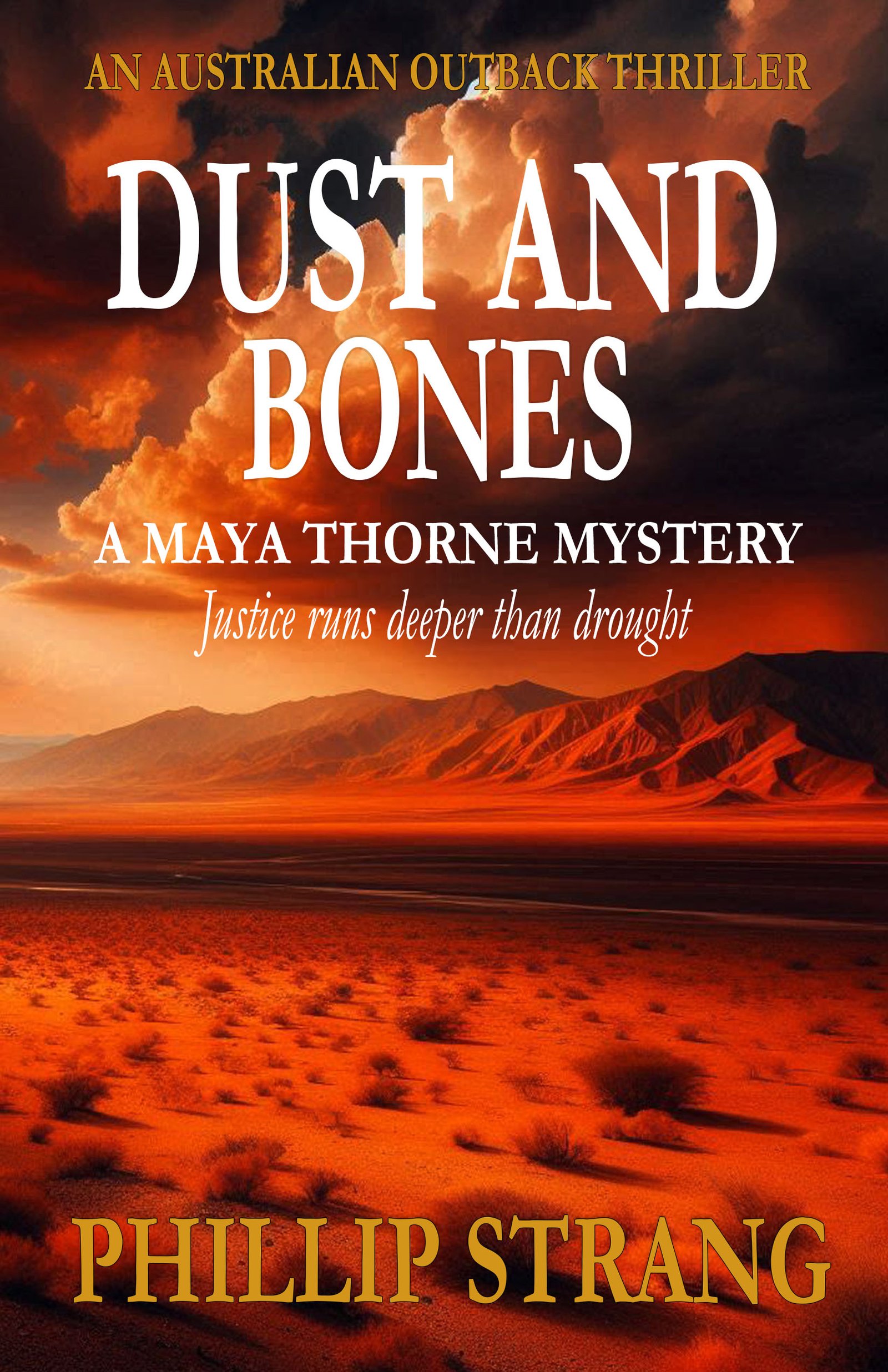
A MAYA THORNE MYSTERY
Get Dust and Bones Free
Justice runs deeper than drought.
Red dust. Shallow graves. A detective who hunts killers where the law runs thin and the nearest help is two hundred miles away.
Send Me the BookYou'll also receive occasional new release emails. Unsubscribe anytime. No spam, ever.
As an Amazon Associate, Phillip Strang earns from qualifying purchases. This page contains affiliate links — buying through them costs you nothing extra.