
The Australian outback demands a different approach to atmospheric writing than the fog-shrouded streets of London or the rain-soaked highlands of Scotland. The vastness, the silence, the brutal honesty of the landscape strips away urban pretenses and forces both characters and readers into confrontation with something far more primal than city crime.
Across eighteen series and more than 150 novels, I have found that creating authentic outback atmosphere requires understanding the land not as scenic backdrop, but as an active participant in the crime itself. The outback doesn’t merely witness violence—it shapes it, conceals it, and sometimes delivers its own harsh justice.
The Outback as Character, Not Setting
Too many writers treat the outback as exotic wallpaper, throwing in references to red dirt and endless horizons without understanding how the landscape functions within crime narrative. The outback operates by different rules than urban environments. Distance becomes a weapon. Isolation becomes both sanctuary and trap. The very elements that make the outback beautiful—its vastness, its silence, its indifference to human concerns—are precisely what make it terrifying.
In my Maya Thorne series, I learned early that the outback must actively participate in every scene. When a body is discovered fifty kilometers from the nearest road, that distance isn’t just logistical detail—it’s psychological pressure. Every character understands that help is hours away, that mistakes become fatal, that the normal social contracts of civilization carry less weight when you’re surrounded by country that could kill you as easily as any murderer.
The mistake many writers make is describing the outback from a tourist’s perspective rather than from the viewpoint of people who live and work there. Locals don’t constantly marvel at red sunsets. They notice when the wind changes direction, when the silence carries differently, when something feels wrong in country they know intimately.
Sound and Silence as Atmospheric Tools
Urban crime writers rely heavily on the constant background noise of city life—traffic, sirens, voices. Outback crime demands the opposite skill: understanding how to use silence and the sudden intrusion of sound. The crack of a branch in country where nothing should be moving. The distant sound of a vehicle where no road appears on any map. The complete absence of birdsong in an area that should be teeming with life.
I discovered while writing outback scenes that silence itself becomes a form of dialogue. Characters respond to it, are oppressed by it, or find comfort in it depending on their relationship with the land. A city detective transferred to rural duty will experience the silence as hostile, threatening. A local tracker uses that same silence as a source of information, reading the landscape through what it doesn’t reveal.
The key atmospheric technique here is contrast. When you establish the normal rhythm of outback sounds—wind through scrub, the distant call of crows, the creak of old timber—any deviation becomes instantly significant. The reader learns to listen as carefully as your characters do.
Weather as Plot Driver
Outback weather isn’t atmospheric seasoning—it’s often the difference between life and death, between solving a case and losing vital evidence forever. The relationship between weather and crime in outback fiction operates on practical and psychological levels that urban writers rarely need to consider.
Heat becomes more than discomfort; it affects thinking, judgment, the reliability of witnesses. I’ve used sustained high temperatures in my Maya Thorne books not just to create mood, but to drive character decisions that would seem irrational in different circumstances. When you’re genuinely worried about dying of thirst, priorities shift in ways that transform both criminal behavior and investigative procedure.
Drought reveals things meant to stay hidden—old foundations, unmarked graves, evidence buried when water levels were higher. Flash floods wash away crime scenes but also expose new ones. Bushfire season brings its own set of rules, where evacuation routes become escape routes, where the criminal investigation might halt entirely for days while everyone fights for survival.
The atmospheric power comes from treating weather as an active agent with its own agenda, indifferent to human plans but constantly reshaping the possibilities of both crime and justice.
How I Actually Approach Outback Atmosphere
My working method starts with the specific physical location, mapped in detail before I write a single scene. I need to know the geology, the water sources, the seasonal patterns, the human infrastructure—or lack thereof. This isn’t research for research’s sake; every detail must earn its place by contributing to either plot advancement or character development.
I build atmosphere through accumulation of precise, functional details rather than sweeping descriptions. The texture of sand that holds footprints versus sand that shifts. The species of trees that provide concealment versus those too sparse to hide anything. The sounds that carry for miles versus those absorbed by the landscape. Each detail serves multiple purposes—advancing plot, revealing character, and building the atmospheric pressure that makes outback crime fiction distinct from urban procedurals or traditional police procedurals.
I also learned to write the landscape from multiple perspectives within the same book. The same stretch of country looks entirely different to a criminal seeking to dispose of evidence, a detective following days-old tracks, and a local resident who knows every landmark. These shifting perspectives create atmospheric depth that single-viewpoint description cannot achieve.
Common Atmospheric Mistakes in Outback Crime
The biggest error is treating the outback as merely a larger version of rural countryside. Writers coming from urban or suburban backgrounds often underestimate the psychological impact of true isolation, defaulting to clichéd descriptions of ‘endless red dirt’ without understanding how that endlessness functions within crime narrative. They’ll have characters behave exactly as they would in populated areas, ignoring how distance and isolation fundamentally alter both criminal and investigative behavior.
Another frequent mistake involves romanticizing the landscape instead of respecting its dangers. Characters venture into harsh country without adequate preparation, survive conditions that would kill experienced locals, or treat the outback as somehow noble or spiritually purifying. Real outback country is beautiful but utterly indifferent to human survival, and effective atmospheric writing must acknowledge this indifference.
Many writers also rely too heavily on visual description while ignoring the other senses that become crucial in outback settings. The smell of rain on hot dirt that signals a storm hours before it arrives. The taste of dust that reveals wind direction. The feeling of ground vibration that indicates vehicles or machinery beyond visual range. Action thriller elements work differently when tracking becomes more important than high-speed chases, when survival skills matter more than urban street knowledge.
The final common error is inconsistency in maintaining the atmospheric rules once established. If you’ve shown that help is hours away, you cannot suddenly produce convenient rescue without destroying credibility. If you’ve established the psychological pressure of vast empty spaces, characters cannot simply adjust and behave normally without showing that adaptation process.
Building Sustained Atmospheric Tension
Outback crime requires different pacing than urban thrillers, but this doesn’t mean slower pacing—it means tension that builds through different mechanisms. Instead of the immediate physical danger of city crime, outback tension builds through accumulating awareness of vulnerability, through the gradual realization that normal rules don’t apply, through the growing understanding that the landscape itself might be the most dangerous character in the book.
I maintain this tension through layered threats operating on different timescales. The immediate threat might be a pursuing criminal, but underlying that runs the slower threat of dehydration, exposure, disorientation. Characters must solve problems on multiple levels simultaneously—escape the killer and find water, track the suspect and avoid getting lost themselves, gather evidence and survive the approaching storm.
This technique works because it mirrors how people actually experience the outback—constantly aware that beauty and danger coexist, that the same landscape that provides shelter can become a trap, that human conflicts play out against the backdrop of much larger and more indifferent forces. The atmosphere succeeds when readers feel that same layered awareness, that same recognition that in the outback, crime and survival become inseparable challenges.
Conclusion
Creating atmosphere in outback crime fiction means respecting the landscape as an active participant in your narrative, not merely a scenic backdrop for human drama. The outback demands precision, authenticity, and an understanding that effective atmosphere serves story rather than existing for its own sake. When done properly, the landscape becomes as memorable and complex as any human character, driving plot and revealing truth in ways that no urban setting could achieve.
About Phillip Strang
Phillip Strang is an Australian crime and thriller novelist. Across eighteen series and more than 150 novels, his work spans London police procedurals (DCI Isaac Cook), UK investigations (DI Tremayne), Australian outback crime (Maya Thorne), FBI thrillers (Alex Harlan), Scottish Highland mysteries (DI Sarah Lynch), and espionage (Steve Case). Learn more about Phillip or browse his complete catalogue on Amazon.
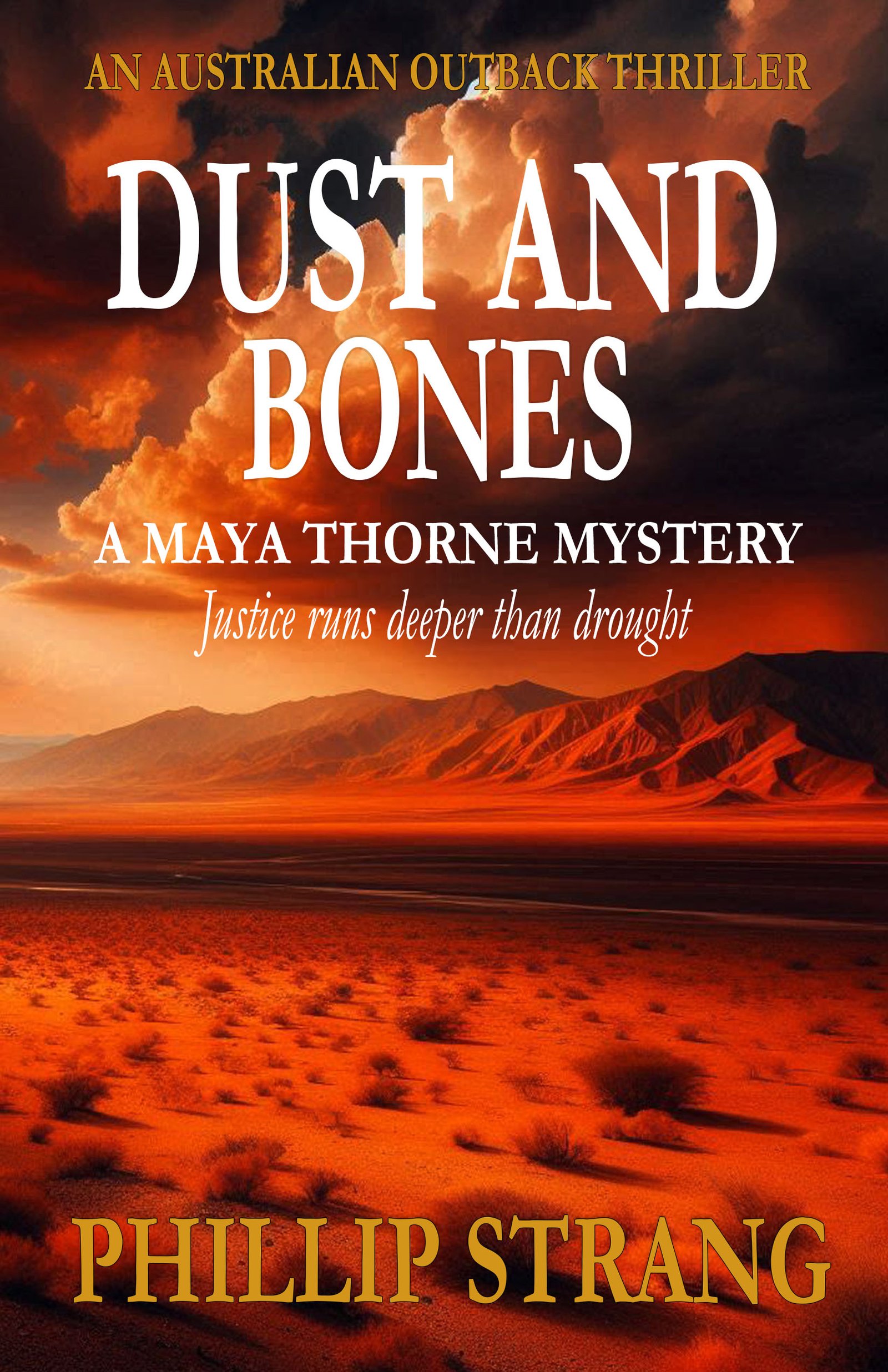
A MAYA THORNE MYSTERY
Get Dust and Bones Free
Justice runs deeper than drought.
Red dust. Shallow graves. A detective who hunts killers where the law runs thin and the nearest help is two hundred miles away.
Send Me the BookYou'll also receive occasional new release emails. Unsubscribe anytime. No spam, ever.
As an Amazon Associate, Phillip Strang earns from qualifying purchases. This page contains affiliate links — buying through them costs you nothing extra.