
Creating Sense of Place in Crime Fiction is not about describing a street or naming a postcode. It is about making the geography of your story do actual narrative work — carrying tension, shaping character, and telling the reader something the dialogue cannot. Place, done properly, is never decorative.
Across eighteen series and more than 150 novels, I have found that the writers who struggle most with setting are not the ones who fail to research their locations — they are the ones who treat setting as a backdrop rather than a participant. The moment you stop thinking of place as something behind your characters and start thinking of it as something pressing against them, everything changes.
Setting as Pressure, Not Scenery
The fundamental mistake most crime writers make early in their careers is confusing setting with description. They write a paragraph about a city, they name the landmarks, they note the weather, and then they get on with the plot. That is not a sense of place. That is a postcard.
What a location needs to do in a crime novel is exert pressure. The DCI Isaac Cook series is set in London, but not the London of tourist brochures. It is the London of Notting Hill before and after gentrification swallowed it whole, of communities that exist in proximity without integration, of a city that contains a hundred different cities depending on which door you walk through. That layering matters because it creates friction. When Isaac moves between a crime scene in a council estate and a meeting in Whitehall, the distance between those two places is not measured in miles. It is measured in everything that divides them — class, power, history. The setting is generating the tension, not simply holding it.
This is what I mean by setting as pressure. The place should make things harder, stranger, or more morally complicated than they would be anywhere else. If your story could happen in any city without losing anything, you have not written a sense of place. You have written a location tag.
Creating Sense of Place in Crime Fiction Through Specificity
Specificity is the engine of place. Not generic specificity — not ‘the dusty red roads of the outback’ — but the kind of detail that could only come from someone who has thought hard about this particular piece of ground. The detail that is slightly unexpected. The kind that makes a reader who knows the location say yes, that is exactly right, and makes a reader who does not know it believe unconditionally that it is.
When I began the Maya Thorne series, set in the Australian outback, the temptation was to lean on the obvious imagery: the heat, the red earth, the isolation. Those elements are real and they matter, but they become clichés the moment you deploy them without precision. What makes a remote Australian crime scene feel genuinely unsettling is not just the heat — it is the particular quality of silence that follows a death out there, the way the land absorbs violence without registering it, the fact that the nearest town is two hours away and everyone in it already knows something is wrong before the police arrive. That is the specificity that creates place rather than merely evoking it.
The practical rule I follow is this: find the detail that is local and slightly inconvenient to the narrative. The thing that does not fit neatly into the plot but insists on being true. Those details are the ones readers feel.
How I Actually Work With Location
My process is not romantic. I do not wait to visit every location before I write it, though I research obsessively through other means — maps, local journalism, court records, interviews, anything that gives me the texture of how a place actually functions rather than how it looks to an outsider. What I am looking for is not colour. I am looking for systems: how does crime operate in this place, how does law enforcement navigate its particular constraints, what does the local power structure look like and who is invisible within it.
With the DI Sarah Lynch series, set in the Scottish Highlands, the research question was not ‘what does the Highlands look like’ — any photograph answers that. The question was ‘what does policing look like when resources are thin, communities are small enough that the detective knows the victim personally, and the landscape itself creates investigative problems that a city detective would never face?’ The answer to that question is where the sense of place lives. It is not in the heather.
I also pay attention to how place changes under stress. A town that seems unremarkable in daylight reads differently at two in the morning during a murder investigation. A landscape that is beautiful in summer becomes something else entirely when a body turns up in winter. The seasonal and temporal dimensions of place are underused by most crime writers, and they are free. You do not need to invent anything — you just need to think about what the location is doing at this particular moment in the story.
What to Avoid: Common Failures of Setting
The most common failure I see is front-loaded description — a long establishing passage at the start of a chapter that stops the narrative dead while the writer explains where we are. This is the ghost of bad creative writing instruction, the idea that you must ‘set the scene’ before anything can happen. In crime fiction, it is lethal. Readers tolerate an establishing shot lasting perhaps two sentences. After that, they want the scene to be moving, and the place must be woven into that movement rather than announced before it begins.
The second failure is using setting as mood signalling. Rain equals melancholy. Grey skies equal dread. Sunshine at a crime scene equals ironic counterpoint. These are not wrong exactly — weather does affect mood — but when they become reflexive, they cheapen the prose. The place should be doing something more specific than telling the reader how to feel. If I write that a village in the Highlands looks picturesque on the morning after a murder, that tension should come from the scene itself, from what the characters are doing and saying in that space, not from my underlining it with a symbolic weather report.
A third, subtler failure is treating place as fixed. Locations change through the course of an investigation, not physically but in terms of meaning. A house that was simply an address at the start of a novel should feel like something else entirely by the end — loaded with what happened there, what was discovered, what was lost. Writers who describe place once and move on miss the opportunity to let it accumulate weight across the narrative. This is one of the reasons the best police procedural novels tend to return obsessively to the same locations — the crime scene revisited is never the same place it was on the first visit.
Place and Character: The Relationship That Matters Most
Ultimately, place in crime fiction earns its keep through its relationship with character. The question that unlocks everything is: what does this particular person see when they look at this particular place? A detective who grew up in a neighbourhood that later becomes a crime scene is not seeing what an outsider would see. A detective who is a stranger to the environment — brought in from outside, unable to read the social codes — sees differently again, and that disorientation is itself a narrative resource. The place is filtered through consciousness, and that filtration tells us something about the character that nothing else can.
This is why the most character-driven crime novels tend to have the most vivid sense of place. The two things are not separate disciplines. They are the same discipline approached from different angles.
Conclusion
Place in crime fiction is not atmosphere. It is argument. Every location choice you make is a statement about the kind of crime story you are telling, the kind of society it exists within, and the kind of pressure it places on the people moving through it. Get the place right and you have a novel with a spine. Get it wrong and no amount of plot mechanics will compensate.
About Phillip Strang
Phillip Strang is an Australian crime and thriller novelist. Across eighteen series and more than 150 novels, his work spans London police procedurals (DCI Isaac Cook), UK investigations (DI Tremayne), Australian outback crime (Maya Thorne), FBI thrillers (Alex Harlan), Scottish Highland mysteries (DI Sarah Lynch), and espionage (Steve Case). Learn more about Phillip or browse his complete catalogue on Amazon.
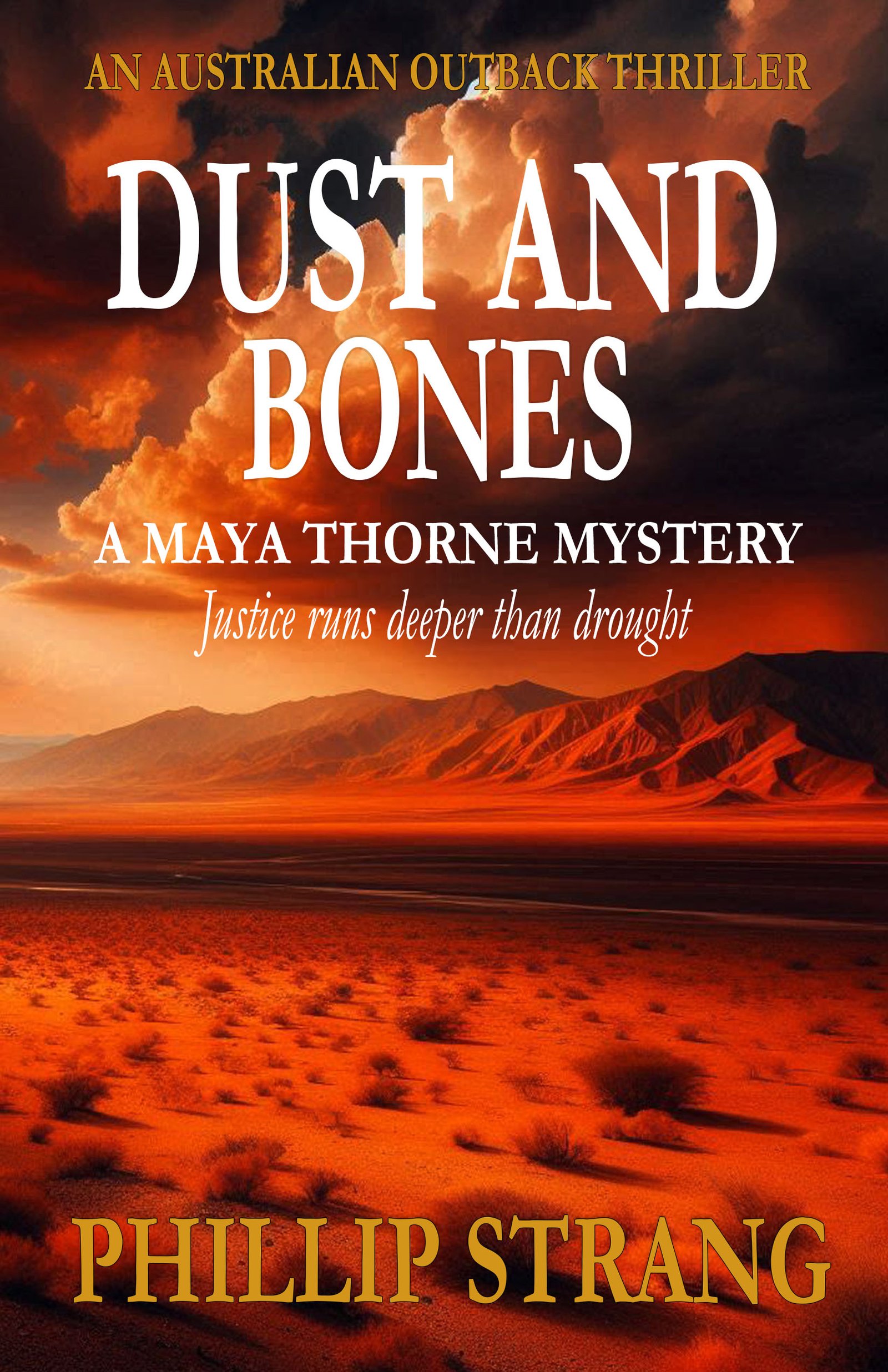
A MAYA THORNE MYSTERY
Get Dust and Bones Free
Justice runs deeper than drought.
Red dust. Shallow graves. A detective who hunts killers where the law runs thin and the nearest help is two hundred miles away.
Send Me the BookYou'll also receive occasional new release emails. Unsubscribe anytime. No spam, ever.
As an Amazon Associate, Phillip Strang earns from qualifying purchases. This page contains affiliate links — buying through them costs you nothing extra.