
Local dialect in regional crime fiction is not decoration. It is load-bearing structure — part of how a novel earns the right to call itself set somewhere specific rather than merely using a postcode as backdrop. Get it wrong and the dialogue reads like a tourist’s impression of the locals. Get it right and the reader stops noticing the prose entirely and simply hears the place.
Across eighteen series and more than 150 novels I have found that dialect, cadence, and regional idiom are among the most technically demanding elements I work with — not because they require exotic knowledge, but because they demand a kind of disciplined restraint that runs against the instinct to show everything you know.
What Dialect Actually Does in Crime Fiction
The first thing to understand is that dialect is not about spelling. The instinct for many writers — particularly those new to regional fiction — is to reach for phonetic transcription the moment they want to signal place. Dropped letters, apostrophes standing in for consonants, vowels stretched across the page. What this usually produces is not the sound of a region but the look of a parody. Readers do not hear it; they stumble over it. The momentum of a police procedural, which depends on crisp exchange and forward movement, collapses under the weight of half a paragraph of phonetically rendered Glaswegian or broad Dorset.
What dialect actually does — when handled well — is establish a social world. The vocabulary a character reaches for, the rhythm of how they construct a sentence, the things they say obliquely rather than directly: these are the markers of where someone is from and who they are within that community. In a crime novel, where so much depends on what people reveal and conceal under pressure, those markers carry genuine plot weight. A detective who speaks differently from the communities they work inside is already in friction with their environment, and that friction is story.
Local Dialect in Regional Crime Fiction: The Line Between Authentic and Alienating
There is a line between authentic dialect and alienating transcription, and it moves depending on your reader. Writing a crime series set in the Scottish Highlands, as I do with DI Sarah Lynch, means navigating how much Gaelic-influenced syntax and Highland cadence to carry into the dialogue without either flattening it to generic English or making the exchanges feel like a language exercise. My approach is to let the rhythm do the work. Highland English has a particular music — a tendency toward the formal in informal situations, a softness in how negatives are constructed. That cadence, reproduced consistently without phonetic decoration, carries the place without slowing the read.
The same challenge presents itself differently in London. The DCI Isaac Cook series operates across communities — West Indian, Nigerian, Eastern European, white working-class South London — each with its own idiomatic register. Isaac himself speaks a careful, educated English that is partly professional self-construction and partly the complicated inheritance of a second-generation immigrant who has learned to move between registers. That mobility is characterisation. The contrast between how he speaks and how those around him speak tells you about power, assimilation, aspiration, and belonging without a single expository paragraph. If I had tried to render every community voice phonetically, the books would have become unreadable. Instead the idiomatic vocabulary, the sentence rhythm, and the cultural reference points carry each voice distinctly.
How I Actually Work With Regional Voice
My process starts before a word of dialogue is written. I spend time — a great deal of it — listening. Not just to how people in a region speak, but to what they talk about, what they avoid, what they assume their interlocutor already knows. That last element is particularly important in crime fiction. A local detective and a witness from the same community will leave enormous amounts unsaid. They share a world. That shared understanding, rendered as ellipsis and implication rather than full statement, is one of the most powerful dialect tools available.
With Maya Thorne, set in the Australian outback, the voice challenge is partly about the sparse, laconic quality of rural Australian speech — an understatement that is cultural bedrock — and partly about the registers that open up when Aboriginal communities are part of the story. Outback Australian English has its own idiom, its own indirection, its own humour that is never quite what it appears. I do not try to capture it fully on the page. I try to gesture at it, accurately and consistently, so that the reader does their own imaginative work. The best dialect writing always invites the reader to complete the picture.
I also work against my own ear. If a phrase sounds too vivid, too much like a local colour set piece, I cut it. The job is not to demonstrate how well I have researched a region. The job is to make the region feel inhabited.
The Mistakes That Kill Regional Authenticity
The most damaging mistake is inconsistency. A character who speaks in broad regional idiom in chapter three and then speaks in flat, neutral English in chapter seven does not feel like a real person. They feel like a plot function the author forgot to costume. Dialect, once established, must be maintained. Not exhaustively — not every speech tag needs a regional marker — but consistently enough that the reader always knows whose voice they are in.
Close behind inconsistency is the mistake of using dialect for secondary characters but not primary ones. This usually happens because writers are most attentive to their protagonists and their major suspects, and dialect starts to feel like characterisation shorthand for everyone else. The result is a world where the important people speak a kind of universal educated English and the locals provide colour. That is not regional fiction. That is tourism fiction — and it reads as condescension.
The third mistake is researching dialect academically rather than aurally. Knowing that a particular region uses a specific archaic word is not the same as knowing how it sits in a sentence, what emotional register it carries, and whether a character of a specific age and background would actually use it. Dialect exists in context. A phrase that reads as authentic in one scene reads as stagey in another. The test is always whether the speech sounds like something a person would say, not like something a person from that region is supposed to say.
Writers who work in the best police procedural novels understand that the interview room is the crucible of dialect — it is where different registers collide under pressure, and where the gap between how a detective speaks and how a witness or suspect speaks becomes either a wall or a bridge. That gap should never be accidental.
When to Pull Back
There are moments in any crime novel when dialect must step back entirely. Action sequences, moments of extreme psychological stress, and the interior voice of a character processing trauma tend to flatten into something more direct and less regionally marked. This is not a failure of craft — it is craft. The human mind under extreme pressure retreats to something more immediate. If your character maintains their full regional voice while running from a killer or processing the death of someone they loved, it reads as theatrical rather than felt. Using dialect as a dynamic register — present when the world is ordinary, reduced when it fractures — is one of the most sophisticated moves available to the regional crime writer.
Dialect is not about where a character is from. It is about what they carry with them, who they are performing for, and what they allow themselves to drop when the performance stops. That is the whole of character work, in four words dressed as linguistics.
Those who write best character-driven novels know this intuitively: the voice a character uses is never simply regional — it is situational, relational, and always, in crime fiction, a little bit dangerous.
Conclusion
Local dialect in regional crime fiction earns its place when it reveals character, establishes social tension, and makes a place feel genuinely inhabited — and it wastes its place when it becomes performance. The discipline is in knowing the difference, and applying it every time a character opens their mouth.
About Phillip Strang
Phillip Strang is an Australian crime and thriller novelist. Across eighteen series and more than 150 novels, his work spans London police procedurals (DCI Isaac Cook), UK investigations (DI Tremayne), Australian outback crime (Maya Thorne), FBI thrillers (Alex Harlan), Scottish Highland mysteries (DI Sarah Lynch), and espionage (Steve Case). Learn more about Phillip or browse his complete catalogue on Amazon.
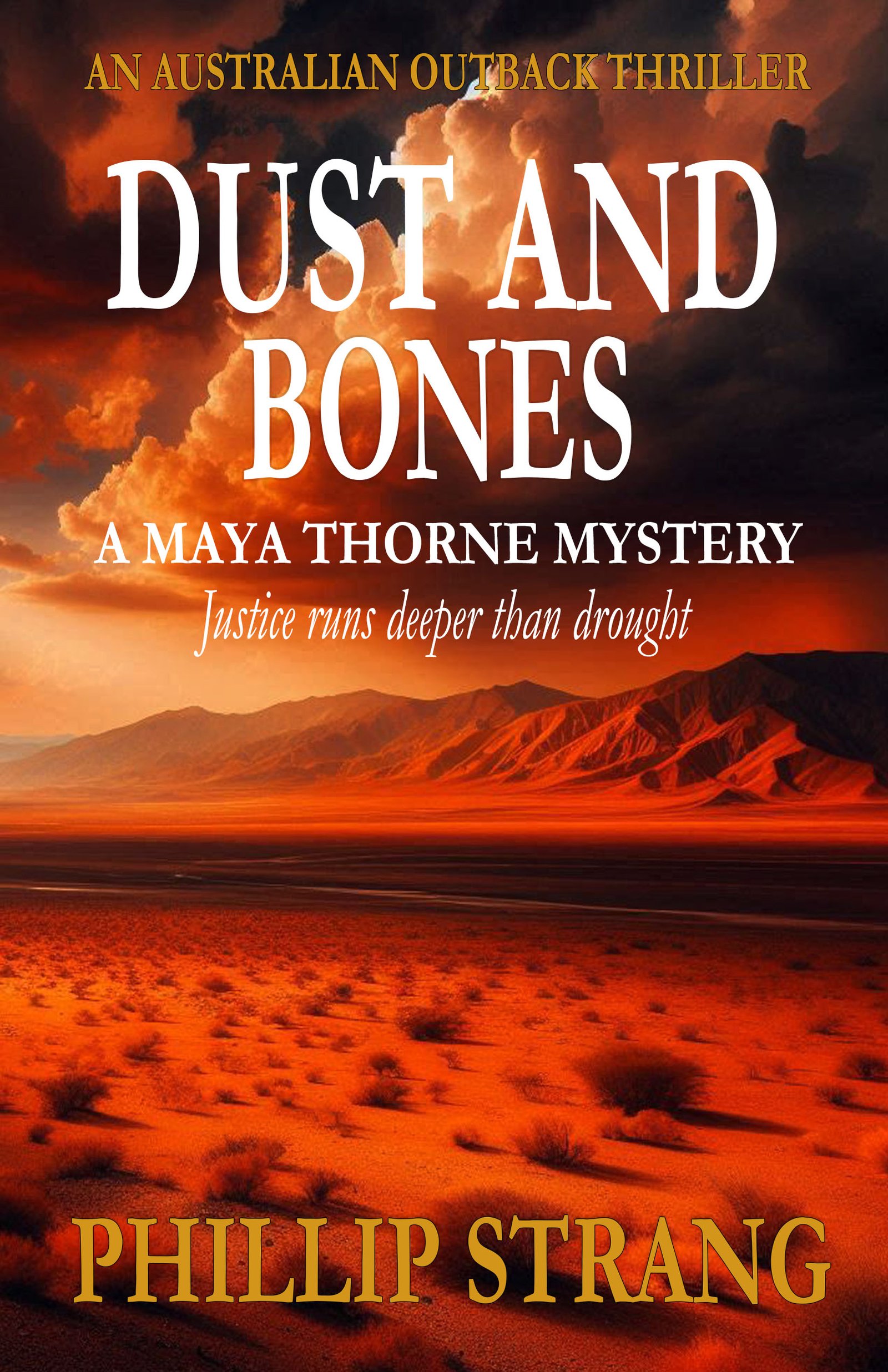
A MAYA THORNE MYSTERY
Get Dust and Bones Free
Justice runs deeper than drought.
Red dust. Shallow graves. A detective who hunts killers where the law runs thin and the nearest help is two hundred miles away.
Send Me the BookYou'll also receive occasional new release emails. Unsubscribe anytime. No spam, ever.
As an Amazon Associate, Phillip Strang earns from qualifying purchases. This page contains affiliate links — buying through them costs you nothing extra.