
The debate around Outback Noir vs Highland Noir is not really about geography. It is about what landscape does to a crime story at the structural level — how the physical world shapes character psychology, investigative logic, and the particular flavour of dread that makes noir distinct from ordinary crime fiction. Both traditions are grounded in isolation, but they are isolated in entirely different ways, and a writer who confuses them will produce something that feels generic rather than specific.
Across eighteen series and more than 150 novels, I have found that the landscape is never just backdrop — it is an active narrative force that makes certain plot moves credible and others impossible. Get the landscape wrong, or treat it as decoration, and your story collapses at the structural joints. Get it right, and the setting does a significant portion of the psychological heavy lifting for you.
What Landscape Actually Does to a Noir Story
Noir is fundamentally a literature of entrapment. The protagonist — usually a detective or investigator of some kind — cannot simply walk away. They are caught between what they know and what they can prove, between institutional pressure and personal conscience. Landscape intensifies that entrapment by making the external world an echo of the internal one. The best noir crime thriller novels understand this instinctively: the world outside the window is not neutral.
In Highland Noir, the entrapment is claustrophobic despite the apparent openness of the glens. The mist comes down. The single-track roads go nowhere useful. The community is small, long-memoried, and deeply suspicious of anyone asking questions — particularly a detective from outside. Everyone knew the victim, and everyone has a reason to stay quiet. The darkness is intimate. It lives in the silences between neighbours, in the thing nobody will name at the pub, in the history of a family that stretches back generations. With DI Sarah Lynch, I work this territory deliberately. Sarah is not from the Highlands. She is a Scottish detective operating in communities that consider her an outsider regardless of her nationality, and that friction — being nominally one of them but practically not — is what drives the investigative tension. The landscape withholds. The people withhold. They are the same gesture.
Outback Noir works through scale rather than intimacy. The entrapment here is the opposite of claustrophobic — it is agoraphobic. There is too much space. There are no witnesses for five hundred kilometres. The nearest court is a three-hour drive. The nearest forensic laboratory is in another state. A body can disappear into the red dirt and not be found for years. With Maya Thorne, the Australian outback is not just a setting but a working narrative constraint. It determines what evidence exists, how quickly it degrades, who has any reason to be out there, and who has the local knowledge to make a murder look like misadventure. The land is not mysterious in the Highland sense — it is brutally indifferent.
The Craft of Writing Isolation: Outback Noir vs Highland Noir
The most important craft distinction is what kind of isolation you are writing. Highland isolation is social and communal — the village that closes ranks, the community that has survived by not talking to authorities, the landscape that reflects a long history of cultural suppression. The Highlands carry weight. The silences are loaded with historical grievance, religious division, clan loyalty. When you write a Highland murder, you are writing about what people protect and why they protect it. The crime is nearly always entangled in something older than the victim’s death.
Outback isolation is ecological and logistical. The communities that exist in the deep interior of Australia are there because of something — a mine, a cattle station, a mission, an Aboriginal land claim. They have reasons to exist that are economic and political and deeply contested. The crime is nearly always entangled in land, in resources, in the violence of colonial history that has never been properly reckoned with. This is not the same darkness as the Highland version. It is rawer, less coded, less concerned with manners. People in the outback don’t necessarily refuse to talk — they may have no reason to trust that talking will help anyone, including themselves.
A useful way to think about it: in Highland Noir, the investigator is trying to break through silence. In Outback Noir, the investigator is trying to navigate a world where official processes — law, jurisdiction, forensic procedure — are simply less relevant than they would be anywhere else. The procedural machinery that underpins police procedural novels operates differently when the nearest forensic team is eight hours away and the local sergeant knew the victim since primary school.
How I Actually Approach Each Tradition
When I sit down to write Highland fiction, I start with the community before I start with the crime. I need to understand the social architecture — who defers to whom, where the old grudges live, which family names carry what weight. The crime, when it comes, emerges from that social structure like a fault line becoming visible. It was always there. The murder simply makes it impossible to ignore any longer.
When I write outback fiction, I start with the land itself. I need to know the distances, the seasonal conditions, the practicalities of who can get where and when. A body found in a dry creek bed in summer is a different investigative problem from the same body found in the same place after three days of rain. The environment is not atmospheric shorthand — it is logistical reality. Maya Thorne cannot call for backup the way a London detective can. She has to work with what is physically available, which means her decisions have a different weight and a different kind of moral complexity.
What both traditions share is the requirement for a protagonist who is constitutively uncomfortable. They have to be wrong-footed by the world they are operating in. That discomfort is what generates the narrative energy. A detective who is perfectly suited to their environment has no friction, and friction is everything in noir.
What Goes Wrong: The Mistakes That Flatten Both Traditions
The most common error in Highland Noir is using the landscape purely as atmosphere without earning its social specificity. The writer describes the mist and the mountains but gives the community the same social dynamics as a suburban English village. The result is a picturesque setting with no real bite — a cosy mystery in a kilt. The Highland landscape only works when the community’s relationship to that landscape is part of the story. The remoteness has consequences. People have adapted to it in ways that matter.
In Outback Noir, the equivalent mistake is exoticism. The writer treats the landscape as spectacle — the red dust, the heat haze, the strange animals — without engaging with who actually lives there and why. This produces a tourist’s version of the outback rather than a working novelist’s version. It is particularly damaging when the Indigenous dimension of the landscape is reduced to mysticism rather than engaged with as political and historical reality. The outback is not eerie in the way that fiction often makes it. It is specific, contested, and inhabited by people with complex relationships to the land that have nothing to do with crime fiction’s appetite for the uncanny.
A subtler mistake in both traditions is letting the landscape do the mood work that character should be doing. If your detective is only brooding because the weather is bad, you have not actually built a brooding detective — you have built a weather report. The internal landscape and the external landscape need to be in genuine dialogue, not simple correspondence.
Conclusion
Both traditions are serious, demanding, and capable of producing work of real literary and commercial weight — but they require the writer to go beyond setting-as-atmosphere and engage with the specific social, historical, and logistical realities that make each landscape what it is. The outback and the Highlands are not interchangeable modes of isolation. They are different kinds of darkness, and they ask different things of the novelist willing to work in them.
About Phillip Strang
Phillip Strang is an Australian crime and thriller novelist. Across eighteen series and more than 150 novels, his work spans London police procedurals (DCI Isaac Cook), UK investigations (DI Tremayne), Australian outback crime (Maya Thorne), FBI thrillers (Alex Harlan), Scottish Highland mysteries (DI Sarah Lynch), and espionage (Steve Case). Learn more about Phillip or browse his complete catalogue on Amazon.
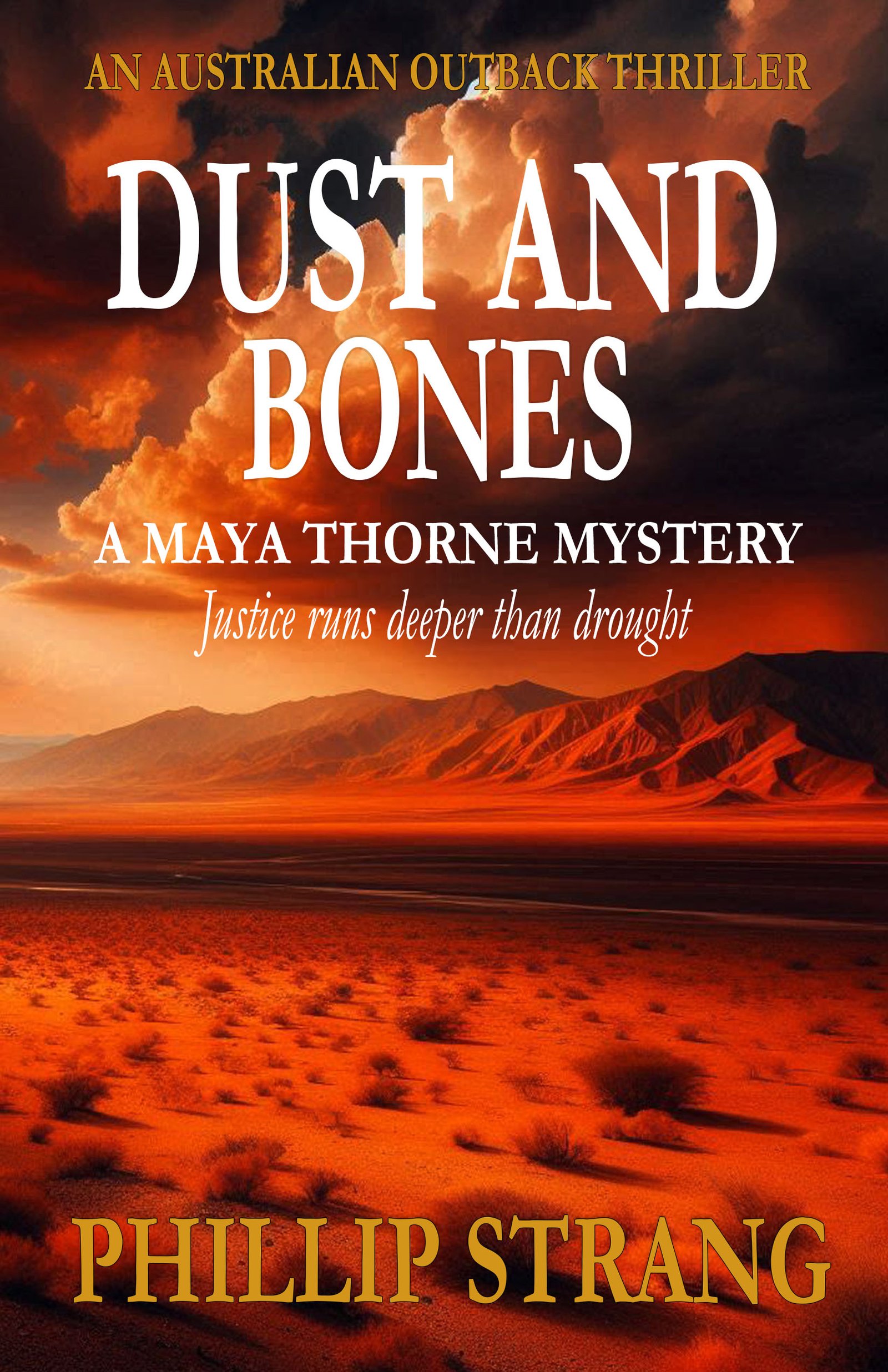
A MAYA THORNE MYSTERY
Get Dust and Bones Free
Justice runs deeper than drought.
Red dust. Shallow graves. A detective who hunts killers where the law runs thin and the nearest help is two hundred miles away.
Send Me the BookYou'll also receive occasional new release emails. Unsubscribe anytime. No spam, ever.
As an Amazon Associate, Phillip Strang earns from qualifying purchases. This page contains affiliate links — buying through them costs you nothing extra.