
Police Procedural Settings are not backdrop. They are not the decorative layer you apply after the plot is assembled. The setting of a procedural — the precinct, the city, the landscape, the social geography — is doing investigative work of its own, shaping what crimes are plausible, what detectives are possible, and what kind of tension the reader will feel before a single body is found.
Across eighteen series and more than 150 novels, I have found that the writers who struggle with procedurals are almost never struggling with plot mechanics — they are struggling with place. They have not yet decided what their setting demands of the story, and so the story floats, technically correct but oddly unconvincing.
Setting Is Not Atmosphere — It Is Constraint
The most useful reframe I ever made about setting was this: a location does not provide atmosphere, it imposes constraint. And constraint, in crime fiction, is generative. When a detective operates in a specific geography, institutional culture, and social ecosystem, the number of things she can plausibly do narrows — and that narrowing is what produces tension.
Consider what a Scottish Highland setting does to an investigation. The isolation is not picturesque; it is procedural. Witnesses are harder to reach. Forensic resources are thinner. Community loyalty to local families runs deep, which means information flows differently than it would in an urban precinct. When I built the world of DI Sarah Lynch, the Highlands were not chosen for aesthetic reasons. They were chosen because that specific geography would force Sarah to work with fewer institutional tools, greater personal exposure, and a community that remembered everything and forgave slowly. The setting made her a particular kind of detective. Remove the Highlands, and she becomes someone else entirely.
This is the test I apply to every setting decision: what does this place prevent my detective from doing? What resources does it withhold? What knowledge does it assume? A London detective in a cramped Hackney terrace case operates inside a web of surveillance cameras, specialist units, and multi-ethnic community dynamics that simply do not exist in a rural Welsh market town. Both settings are legitimate. Neither is interchangeable.
Urban Police Procedural Settings and the Problem of Scale
City-based procedurals carry a specific structural challenge that rural ones do not: scale. A major metropolitan police force is enormous, hierarchical, politically entangled, and shot through with inter-departmental rivalry. That complexity is both the gift and the problem. The gift is richness — there is always another layer to excavate. The problem is that the complexity can swallow the investigation if the writer has not decided what portion of the institution the story actually inhabits.
With DCI Isaac Cook, I made a deliberate choice early: Isaac would operate within the Metropolitan Police but he would inhabit a specific corner of it — a small, under-resourced Homicide unit that sat slightly sideways to the main institutional machinery. That choice was architectural. It meant I could show the city’s scale through what Isaac bumped up against — the politics, the turf wars, the bureaucratic friction — without having to render the whole apparatus in every scene. The unit’s smallness gave me intimacy. The city’s size gave me pressure. The tension between them gave me story.
Writers new to urban procedurals often make the mistake of trying to render the entire institution. The result is a novel that reads like a org chart with dialogue. Pick a corner. Understand it forensically. Let the rest of the institution appear at the edges, as obstacle and context.
Rural and Remote Settings: What They Give, What They Cost
There is a persistent romanticisation of remote settings in crime fiction, and I want to push back on it. Rural and outback settings are not inherently more atmospheric or more literary than urban ones. They are different. The romanticism becomes a problem when writers use isolation as a shortcut to tension — as if merely placing characters in a remote location generates dread without further effort.
What remote settings actually give you is a different kind of community dynamics. In a small town or an isolated region, everyone’s history is visible. Secrets are older, more layered, and more dangerous because they are load-bearing — they hold the community’s self-image in place. The crime, when it surfaces, does not just disrupt an individual life. It threatens a collective fiction. That is potent material, but it requires careful handling. The setting has to be rendered in its specificity — the economic pressures, the land tenure disputes, the generational tensions — not just its geography.
When I developed Maya Thorne in the Australian outback, the landscape was never just scenery. The distances between stations, the water politics, the relationship between Indigenous land knowledge and settler farming practice — all of that became investigative territory. Maya’s cases were only solvable because she understood the specific social architecture of those communities, not because she could outrun a villain across red dirt. Anyone writing remote procedurals who treats the landscape as decorative is leaving the best structural material on the table.
Common Mistakes in Police Procedural Settings
The most common error is what I call setting drift — the location established in chapter one quietly changes its rules by chapter five. A village that was described as intensely close-knit suddenly produces a witness no one knew. A city precinct that was established as under-resourced abruptly has access to specialist surveillance technology. The reader may not consciously articulate the inconsistency, but they feel it as a loss of confidence in the world. Setting must be internally consistent, which means the writer has to know the rules before the story begins — not discover them mid-draft.
A second mistake is treating institutional culture as set dressing. The politics of a police organisation — who defers to whom, who is resented, who is protected by what — are not just colour. They are the medium through which the investigation moves or stalls. When a detective cannot pursue a lead because the lead points toward someone the superintendent owes a favour, that is not a subplot. That is the setting doing its structural work. Writers who treat institutional politics as background noise lose the procedural’s most distinctive feature: the investigation is always happening inside a machine with its own interests.
A third, subtler problem is borrowed geography — using a real location without understanding its specific social texture. There is a category of procedural that names famous streets and landmarks to signal authenticity but never actually renders the particular class dynamics, demographic history, or institutional character of that place. The result is a novel that feels like a tourist’s impression of a city rather than an insider’s. Readers who know the location clock it immediately. If you want to write about a real place, you have to earn it — through research, through time, through the specific rather than the general.
If you want to understand the range of what well-executed settings can do within the genre, looking at examples across the best police procedural novels is a useful exercise — not to imitate, but to audit how setting choices shape investigative possibility. Similarly, procedural thinking intersects interestingly with the best noir crime thriller novels, where setting is often the dominant character.
Conclusion
Setting in a police procedural is not the frame around the painting. It is the pressure the canvas is under — determining what shapes hold and what breaks. Get it right, and the investigation feels inevitable. Get it wrong, and no amount of plot engineering will make the reader believe the world you are asking them to enter.
About Phillip Strang
Phillip Strang is an Australian crime and thriller novelist. Across eighteen series and more than 150 novels, his work spans London police procedurals (DCI Isaac Cook), UK investigations (DI Tremayne), Australian outback crime (Maya Thorne), FBI thrillers (Alex Harlan), Scottish Highland mysteries (DI Sarah Lynch), and espionage (Steve Case). Learn more about Phillip or browse his complete catalogue on Amazon.
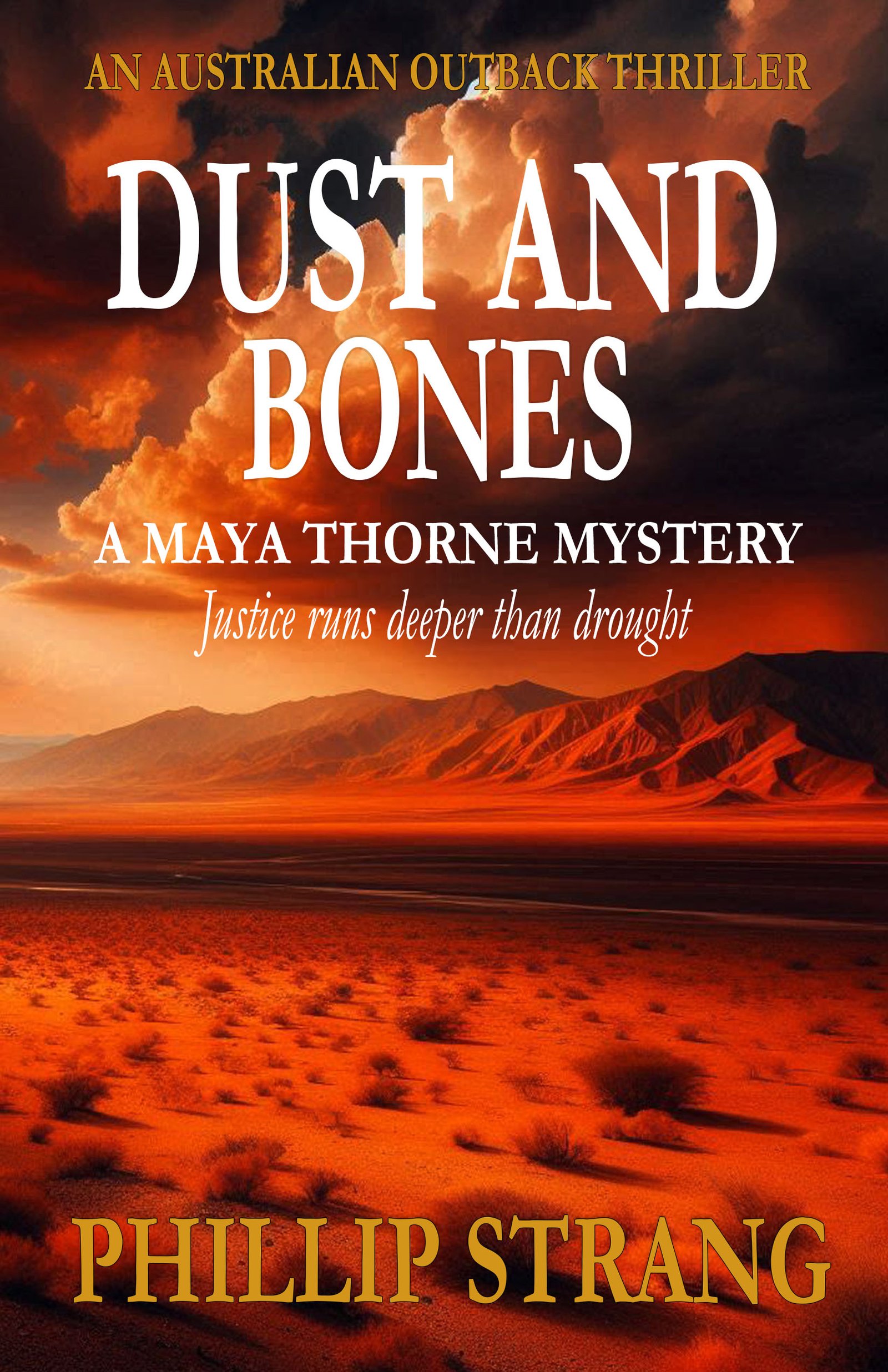
A MAYA THORNE MYSTERY
Get Dust and Bones Free
Justice runs deeper than drought.
Red dust. Shallow graves. A detective who hunts killers where the law runs thin and the nearest help is two hundred miles away.
Send Me the BookYou'll also receive occasional new release emails. Unsubscribe anytime. No spam, ever.
As an Amazon Associate, Phillip Strang earns from qualifying purchases. This page contains affiliate links — buying through them costs you nothing extra.