
The most disturbing violence in psychological thrillers often happens in the spaces between words, in the character’s fractured memory, or in the reader’s imagination. Unlike action thrillers where violence drives plot momentum, psychological thrillers use violence as a scalpel to dissect the human psyche. The craft question becomes not whether to include violence, but how to deploy it for maximum psychological resonance.
Across eighteen series and more than 150 novels, I’ve found that the most effective violence in psychological thrillers works like a slow-acting poison rather than a sledgehammer. The reader should feel unsettled, disturbed, even haunted, but not necessarily because they witnessed graphic brutality on the page. Instead, the violence should burrow into their subconscious and take root there.
The Power of Implied Violence
Implied violence leverages the reader’s imagination, which is invariably more creative and disturbing than anything you can write explicitly. When you show the aftermath rather than the act itself, you force readers to fill in the horrific blanks themselves. This technique transforms them from passive observers into unwilling participants in the violence.
In my DI Tremayne series, I often show Tremayne arriving at crime scenes where the violence has already occurred. Rather than flashbacks to the murder, we see his psychological response to what he discovers. The blood spatter pattern, the victim’s final expression, the disturbed furniture—these details allow readers to reconstruct the violence while experiencing it through the detective’s trained but still human perspective.
The key to effective implied violence is specificity in the aftermath. Don’t simply write ‘the scene was horrific.’ Instead, focus on concrete details that suggest the horror: the way a photograph has been deliberately placed face-down, the precise angle of an overturned chair, or the fact that the victim’s reading glasses remain perfectly clean despite everything else being destroyed. These details whisper the story of what happened without shouting it.
When to Show Violence Directly
Witnessed violence—violence that unfolds on the page—serves different purposes in psychological thrillers. It’s most effective when it reveals character psychology rather than simply advancing plot. The violence should illuminate something crucial about the perpetrator, victim, or witness that couldn’t be revealed any other way.
Direct violence works best when it’s unexpected and brief. In psychological thrillers, violence often erupts suddenly from seemingly mundane situations, mirroring how real violence actually occurs. A dinner conversation that turns lethal, a routine traffic stop that explodes into brutality, a therapy session that becomes an interrogation—these moments work because they subvert the reader’s expectations of safety.
The cardinal rule for witnessed violence in psychological thrillers is that it must serve the psychological arc of your characters. If you can remove the violent scene without affecting your character development or the reader’s understanding of the story’s psychological landscape, then it probably doesn’t belong. Among the best action thriller novels, violence drives external plot, but in psychological thrillers, violence should drive internal revelation.
Violence Through Memory and Trauma
Remembered violence offers the richest possibilities for psychological exploration because memory is inherently unreliable, fragmented, and emotionally charged. When characters recall violent events, their memories are filtered through trauma, guilt, self-deception, and time. This creates natural opportunities for unreliable narration and psychological complexity.
Memory allows you to reveal violence gradually, in pieces that don’t quite fit together until the psychological picture becomes clear. A character might remember the sound of breaking glass but not what broke it, the smell of antiseptic but not why they were in a hospital, the feeling of running but not what they were running from. These fragmented memories create psychological tension that’s often more compelling than explicit violence.
In my Maya Thorne series, the harsh Australian outback setting becomes intertwined with violent memories that characters carry. The landscape itself triggers recollections—a particular rock formation recalls where a body was hidden, the sound of wind through scrub brings back screams from years past. The environment becomes a psychological minefield where memory and present reality intersect.
My Approach to Crafting Violence
When I’m writing violent scenes, I first determine what psychological truth the violence needs to reveal. Is it showing us the killer’s pathology? The victim’s final act of defiance? The detective’s growing obsession with justice? Once I know the psychological purpose, I can choose the most effective approach—implied, witnessed, or remembered.
I write the violent scene fully first, regardless of how I plan to present it in the final draft. This complete version helps me understand exactly what happened, even if readers will only see fragments. Then I decide what to show, what to imply, and what to filter through memory or trauma. Often, the most powerful approach combines all three—a character witnesses violence, represses the memory, then recalls it in fragments throughout the story.
The revision process is crucial for violence in psychological thrillers. I look for places where explicit violence can be replaced with implication, where witnessed violence can be refracted through psychological states, and where remembered violence can be made more fragmentary and emotionally resonant. The goal is always to maximize psychological impact while minimizing gratuitous content.
Common Mistakes to Avoid
The most frequent error I see is violence that exists purely for shock value rather than psychological necessity. Writing ‘The killer carved intricate patterns into the victim’s flesh’ doesn’t create psychological depth unless those patterns reveal something crucial about the killer’s mental state or connect to broader themes in your story. Violence without psychological purpose is just pornography.
Another common mistake is making violence too clinical or detached. In trying to avoid exploitation, some writers drain all emotional reality from violent scenes, making them feel academic rather than human. Your characters should have authentic psychological responses to violence—horror, guilt, fascination, denial—not just proceed as if brutality is routine paperwork. Even experienced detectives in police procedural novels carry emotional weight from the violence they encounter.
Writers also often mishandle the pacing around violent scenes. Violence in psychological thrillers should create psychological ripples that continue throughout the story, not be contained within a single dramatic scene. If your characters experience or witness violence and then continue unchanged, you’ve missed the opportunity to explore how violence reshapes human psychology.
Conclusion
Violence in psychological thrillers is a tool for excavating the human psyche, not a blunt instrument for generating thrills. Whether implied, witnessed, or remembered, violence should serve the psychological architecture of your story, revealing character depths that couldn’t be accessed any other way. The most haunting violence often happens in the spaces between what’s said and what’s understood, between memory and reality, between what characters can bear to remember and what they’re forced to forget.
About Phillip Strang
Phillip Strang is an Australian crime and thriller novelist. Across eighteen series and more than 150 novels, his work spans London police procedurals (DCI Isaac Cook), UK investigations (DI Tremayne), Australian outback crime (Maya Thorne), FBI thrillers (Alex Harlan), Scottish Highland mysteries (DI Sarah Lynch), and espionage (Steve Case). Learn more about Phillip or browse his complete catalogue on Amazon.
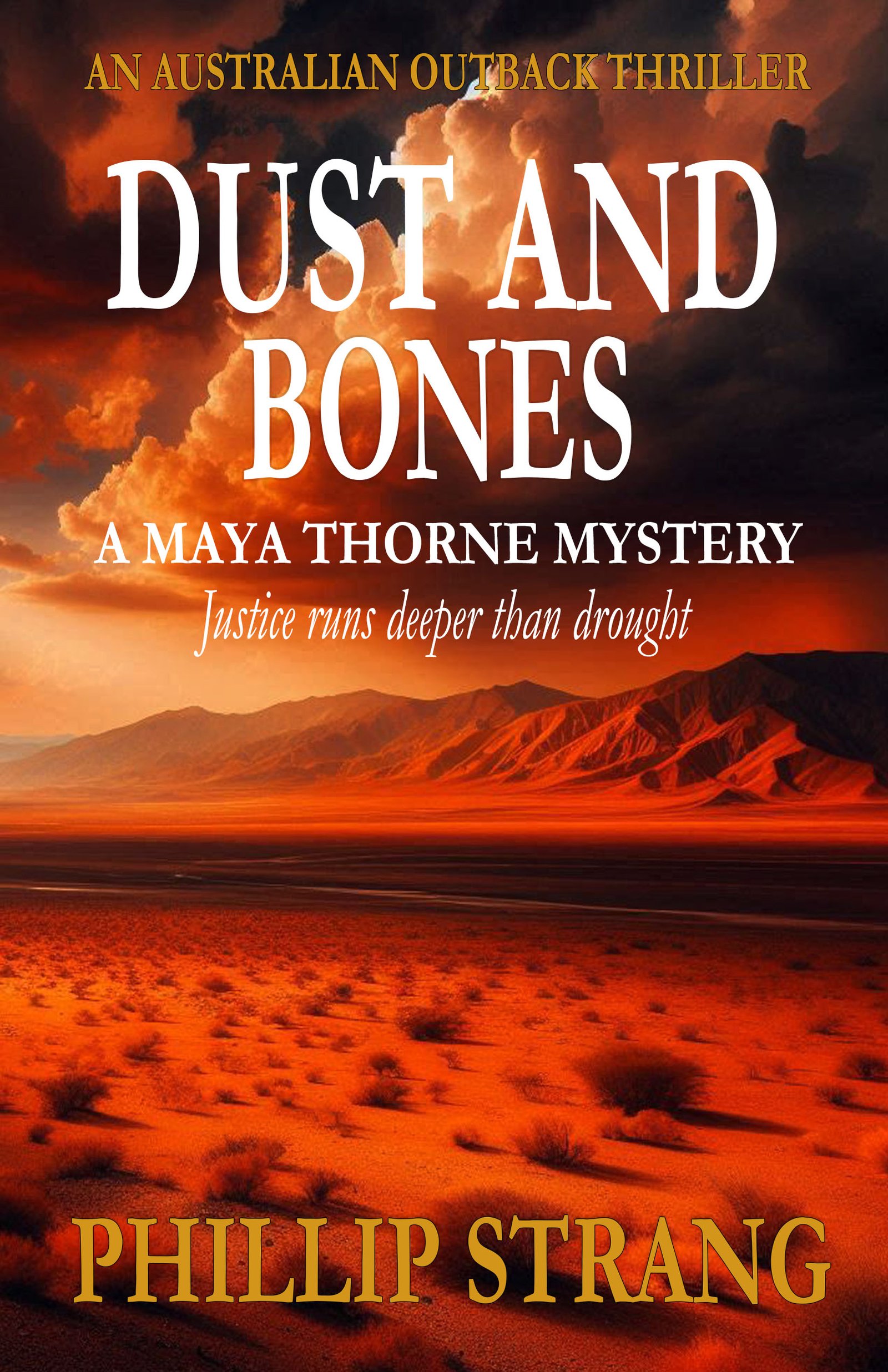
A MAYA THORNE MYSTERY
Get Dust and Bones Free
Justice runs deeper than drought.
Red dust. Shallow graves. A detective who hunts killers where the law runs thin and the nearest help is two hundred miles away.
Send Me the BookYou'll also receive occasional new release emails. Unsubscribe anytime. No spam, ever.
As an Amazon Associate, Phillip Strang earns from qualifying purchases. This page contains affiliate links — buying through them costs you nothing extra.