
The victim in crime fiction faces a unique narrative challenge: they must generate reader investment while often being dead before page fifty. Unlike protagonists who have entire novels to develop reader attachment, victims must accomplish emotional resonance through limited page time, flashbacks, and the testimonies of others.
Across eighteen series and more than 150 novels, I have found that the most effective crime fiction treats the victim as more than a plot device—they become the emotional engine that drives both the investigation and the reader’s need for resolution. The difference between a forgettable corpse and a victim readers genuinely mourn often determines whether a crime novel succeeds or fails.
The Victim as Story Foundation
Every crime story is built on the premise that someone’s death matters enough to warrant investigation and reader attention. This means establishing the victim’s worth before their demise, not after. The traditional approach of revealing character through post-mortem discovery creates distance rather than connection. Instead, I open many of my police procedural novels by showing the victim alive, making choices, interacting with their world. When readers witness the person before they become the case file, the subsequent investigation carries genuine emotional weight.
In my DCI Isaac Cook series, I often dedicate the opening chapter to the victim’s final day, not in a gratuitous way, but to establish their humanity. A businessman worried about his daughter’s university fees, a teacher planning her summer holiday, a retired carpenter feeding pigeons in the park—these details transform abstract victims into people readers care about losing. The key lies in selecting details that resonate universally while remaining specific to the individual character.
Avoiding the Perfect Victim Trap
One critical mistake I see repeatedly is creating victims who are too pure, too innocent, too universally beloved. Real people are complicated, and readers instinctively distrust perfection. When everyone describes the deceased as ‘wonderful’ and ‘couldn’t hurt a fly,’ the victim becomes a cardboard saint rather than a believable human being. Conversely, making victims entirely unsympathetic—the abusive husband, the corrupt politician, the drug dealer—reduces the story to a puzzle without emotional stakes.
Effective victims occupy the messy middle ground of human complexity. They might be devoted parents who also gamble, charitable volunteers with sharp tongues, or successful professionals hiding personal failures. In my Maya Thorne series set in the Australian outback, I created a victim who was simultaneously a pillar of the community and someone who’d made enemies through well-intentioned but heavy-handed involvement in others’ business. This complexity gave multiple characters realistic motives while maintaining reader sympathy for the deceased.
The goal is creating victims whose deaths feel like genuine losses while providing enough character flaws to generate believable suspects and motives. Perfect victims produce implausible suspect pools; entirely unlikeable victims make readers indifferent to justice.
Revealing Character Through Investigation
Since victims cannot speak for themselves, their characterization must emerge through the investigation itself. This requires strategic deployment of evidence, witness testimony, and physical spaces that reveal personality. A victim’s home tells a story—the books on their shelves, the photos they chose to display, the state of their kitchen, the contents of their medicine cabinet. These details should feel naturally discovered rather than artificially planted.
Phone records, email accounts, and financial statements become character-revealing documents rather than mere plot mechanics. A victim who donated regularly to animal charities while struggling with debt shows different priorities than one who hoarded money while living in squalor. Social media profiles, work relationships, and family dynamics all contribute layers to the victim’s character profile.
I structure these revelations to complicate rather than simply expand the victim’s character. Early discoveries might suggest one type of person, while deeper investigation reveals contradictions and hidden aspects. This mirrors real life, where we rarely know people as completely as we assume, and it provides natural story momentum as investigators—and readers—reassess their understanding of who the victim really was.
My Approach to Victim Development
When developing victims for my novels, I begin with the relationship web rather than individual characteristics. I map out who the victim mattered to and why, identifying the various ways their death disrupts different lives. The grieving spouse, the business partner facing financial ruin, the child losing their primary caretaker, the friend who depended on them for emotional support—each relationship reveals different aspects of the victim’s character and provides different investigation angles.
I also consider what the victim wanted and how their death prevents them from achieving it. Unfulfilled desires create poignancy—the person planning to reconcile with an estranged sibling, the couple about to adopt a child, the individual finally ready to pursue their dream career. These interrupted futures make death feel like genuine loss rather than mere plot convenience.
In my action thriller novels, where pacing demands efficiency, I condense victim development into powerful, specific details rather than extended character exploration. A single photograph, an overheard conversation, or a character’s reaction to news of the death can establish the victim’s significance more effectively than pages of background exposition.
The Victim’s Role in Theme
Strong victims embody or illuminate the story’s central themes. A crime novel exploring class conflict might feature a victim whose death exposes societal divisions—perhaps someone who bridged different social worlds and whose murder reveals the tensions between them. Stories examining family dynamics benefit from victims whose relationships exemplify the complexities being explored.
The victim’s character should also influence the investigation’s direction and the protagonist’s emotional journey. Certain types of victims push investigators in particular directions, challenge their assumptions, or trigger personal responses that complicate the professional task. A detective investigating the murder of someone who reminds them of their own child will approach the case differently than one dealing with a victim who represents everything they dislike.
This thematic integration prevents victims from becoming interchangeable plot devices. Instead, they become essential to the story’s meaning as well as its mechanics. The right victim makes certain themes possible while foreclosing others, shaping both the investigation’s practical elements and its emotional resonance.
Conclusion
Writing effective victims requires treating them as complete characters whose deaths genuinely matter, not just convenient corpses around which to build puzzles. When victims feel real and their deaths constitute actual losses, readers become invested in seeing justice done—which is, ultimately, what transforms a mere puzzle into compelling crime fiction.
About Phillip Strang
Phillip Strang is an Australian crime and thriller novelist. Across eighteen series and more than 150 novels, his work spans London police procedurals (DCI Isaac Cook), UK investigations (DI Tremayne), Australian outback crime (Maya Thorne), FBI thrillers (Alex Harlan), Scottish Highland mysteries (DI Sarah Lynch), and espionage (Steve Case). Learn more about Phillip or browse his complete catalogue on Amazon.
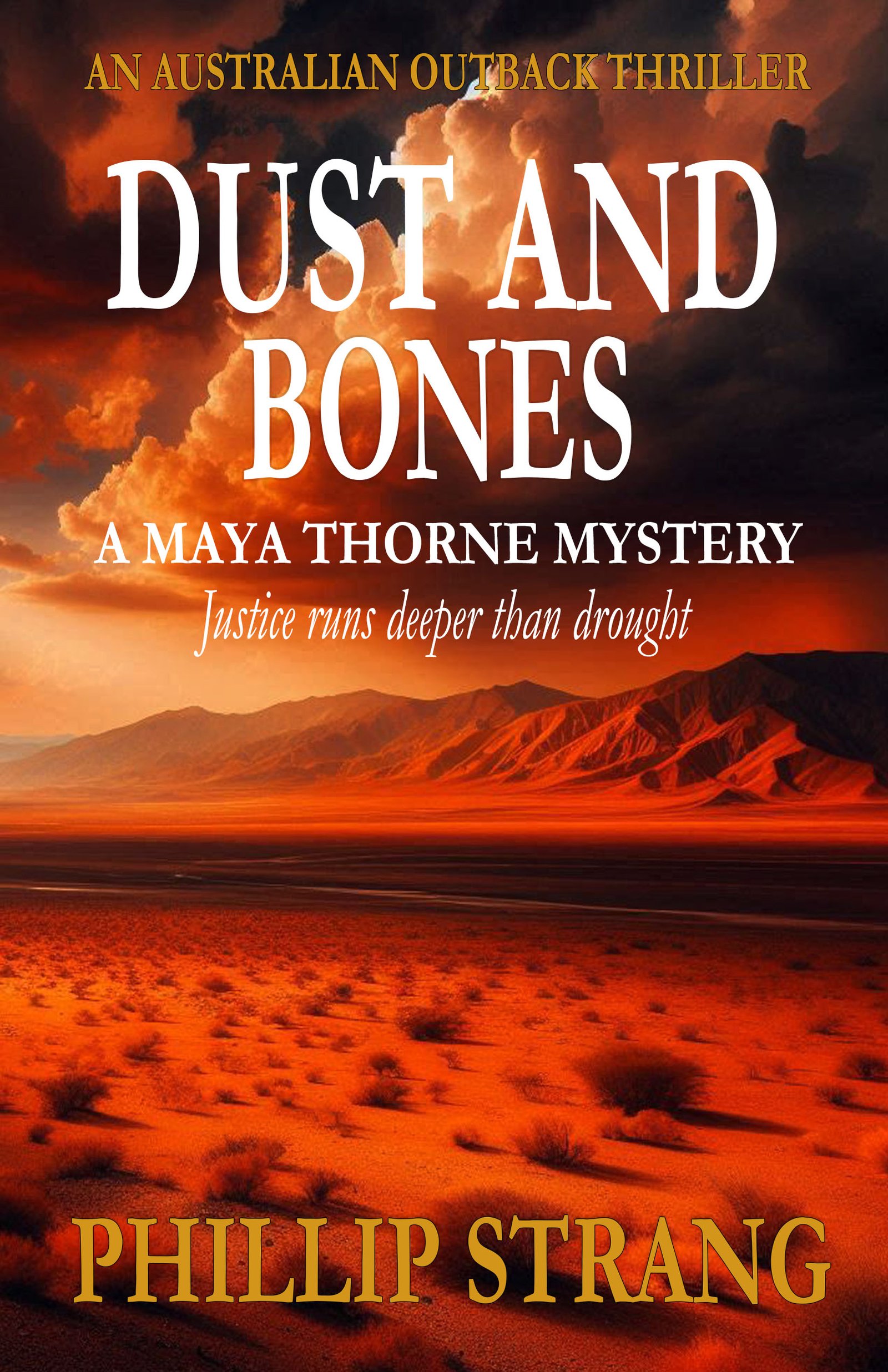
A MAYA THORNE MYSTERY
Get Dust and Bones Free
Justice runs deeper than drought.
Red dust. Shallow graves. A detective who hunts killers where the law runs thin and the nearest help is two hundred miles away.
Send Me the BookYou'll also receive occasional new release emails. Unsubscribe anytime. No spam, ever.
As an Amazon Associate, Phillip Strang earns from qualifying purchases. This page contains affiliate links — buying through them costs you nothing extra.