
Cultural Authenticity in Location-Based Crime is not a courtesy extended to readers who happen to know the place — it is a structural demand that the genre itself makes on every writer who plants a murder in a specific geography. Get the culture wrong and you have not just offended the locals; you have undermined the entire moral architecture of the story, because crime fiction depends on a believable social order being disrupted, and you cannot disrupt what you have never honestly built.
Across eighteen series and more than 150 novels, I have found that the single most reliable indicator of whether a crime novel will hold its tension from first chapter to last is not plot construction, not prose style, not even character — it is whether the place feels like it could actually generate this particular crime. Every location has its own criminal ecology, its own silences, its own way of protecting secrets and exposing them. A writer who ignores that ecology is working against the grain of the genre.
Place Is Not Backdrop — It Is Causation
The mistake most writers make with location is treating it as scenery: something to describe before the real business of the novel begins. But in crime fiction, place is causal. The crime that happens in a tight-knit Highland village is not the same crime that happens in South London, even if the victim is the same age, the weapon is the same, and the motive on paper looks identical. The social pressures that produce it are different, the likelihood of witnesses is different, the relationship between the detective and the community is different, and the speed at which information travels is different.
When I built DI Sarah Lynch in the Scottish Highlands, I was not reaching for aesthetic atmosphere — snow on the hills, mist on the loch — I was reaching for a specific kind of social claustrophobia. Small communities in remote Highland settings carry an extraordinary burden of collective memory. People remember who your grandmother was. They remember a dispute over a boundary fence from forty years ago. That memory is not background colour; it is the engine of the crime. The killer’s motive is often buried in that communal history, and Lynch has to dig through layers of local loyalty and long-held grievance to reach it. None of that works if I get the cultural texture wrong — the way deference operates, the way outsiders are regarded, the particular Presbyterian reserve that shapes how people withhold information even from investigators they trust.
Compare that to the dynamics I work with in DCI Isaac Cook, set across the diverse boroughs of London. The crimes there grow from urban anonymity, from the collision of communities that share postcode but not history, from institutional pressures within the Metropolitan Police itself. London’s criminal ecology is not more or less interesting than the Highlands — it is structurally different. And that difference has to be earned, not assumed.
Research Is Not Tourism
There is a version of location research that produces technically accurate but culturally hollow fiction. A writer visits a place for a week, notes the street names, records the weather, photographs the architecture, eats in the local restaurants, and comes home believing they have done their work. They have not. They have done tourism. Cultural authenticity requires a different order of inquiry — into how people actually relate to each other in this place, what the unspoken rules are, what shame looks like here versus what it looks like somewhere else, who has power and how that power is exercised and concealed.
For the Maya Thorne series, set in the Australian outback, the surface details — the heat, the red dust, the distances, the isolation — are easy enough to render. What is harder, and what actually determines whether the fiction breathes, is understanding the particular social dynamics of remote Australia: the relationship between Indigenous communities and white settler communities, the specific way that water rights and land tenure create simmering long-term conflict, the codes of masculine silence in rural towns, the way that violence gets normalised or concealed in places where the nearest police station is an hour’s drive away. These are not details you pick up from a travel article. They require sustained attention, genuine curiosity, and — where possible — conversations with people who live inside that culture rather than people who have observed it from outside.
The test I apply to my own research is simple: can I write a scene in which two local characters talk to each other — not to the detective, not for the reader’s benefit, but to each other — and have that conversation feel like something that could actually happen between people who have lived in this place for twenty years? If I cannot pass that test, I am not ready to write the book.
Cultural Authenticity in Location-Based Crime: What the Genre Demands
Crime fiction as a genre has a particular relationship with cultural authenticity that differs from literary fiction or historical fiction. In literary fiction, a writer can use a place impressionistically — the place as internal landscape, as metaphor, as mood. Crime fiction does not grant that latitude because the plot mechanics depend on social reality. Witness credibility depends on understanding community loyalty. Alibi construction depends on understanding how people in this place account for their time. The detective’s procedural authority depends on understanding what the local power structures will and will not tolerate.
Writers who excel at this — and you can observe it in the best police procedural novels — understand that the detective is always embedded in a specific cultural moment. The investigation does not float above that culture; it is conducted from within it, with all the friction and constraint that entails. A Scottish detective investigating a death in a tight-knit fishing community is operating under pressures that a London detective investigating a death in a multi-storey car park simply does not face. Both are real; both require honest rendering.
Espionage fiction faces a related but distinct version of this challenge. The best espionage thrillers work because the cultural texture of the foreign location — its political culture, its bureaucratic habits, its particular flavour of paranoia — is not wallpaper but structure. An intelligence operation conducted in Moscow fails or succeeds for culturally specific reasons that have nothing to do with individual tradecraft. The writer who flattens that specificity produces a thriller that feels generic, because the danger does not feel real.
Common Mistakes That Hollow Out a Location
The most damaging error is cultural condescension — rendering a place primarily through the lens of its most dramatic or exotic qualities, as if the community exists to provide atmosphere for the crime rather than to live its own life. You see this when writers set novels in Indigenous Australian communities and reach exclusively for the mystical or the tragic, ignoring the full range of ordinary contemporary experience. You see it when writers set novels in American small towns and render every local character as either folksy or sinister, with nothing in between. The community becomes a stage flat, and the crime feels staged.
A related failure is the universal detective — the investigator who moves through a foreign culture without friction, who is never misread, never disadvantaged by being an outsider, never required to actually learn anything about the people they are investigating. This is not just culturally dishonest; it is dramatically inert. The detective’s struggle to understand the cultural logic of a place is one of the most productive sources of tension in location-based crime fiction, and writers who smooth it away in the interest of plot efficiency are discarding one of their best tools.
There is also the error of static culture — writing a place as if its culture is fixed and timeless, as if globalisation, migration, economic change, and generational shift have left no mark. Real communities are contested and evolving. The tension between what a place used to be and what it is becoming is often exactly where crime fiction finds its most interesting material.
Conclusion
Cultural authenticity is not a virtue layered over the top of a crime novel after the real work is done — it is the foundation on which the entire structure stands. Without it, the crime has no genuine social weight, the investigation has no genuine friction, and the resolution has no genuine meaning. The place must be real enough to have generated this particular crime, among these particular people, at this particular moment. That is what the genre requires, and it is a requirement worth taking seriously.
About Phillip Strang
Phillip Strang is an Australian crime and thriller novelist. Across eighteen series and more than 150 novels, his work spans London police procedurals (DCI Isaac Cook), UK investigations (DI Tremayne), Australian outback crime (Maya Thorne), FBI thrillers (Alex Harlan), Scottish Highland mysteries (DI Sarah Lynch), and espionage (Steve Case). Learn more about Phillip or browse his complete catalogue on Amazon.
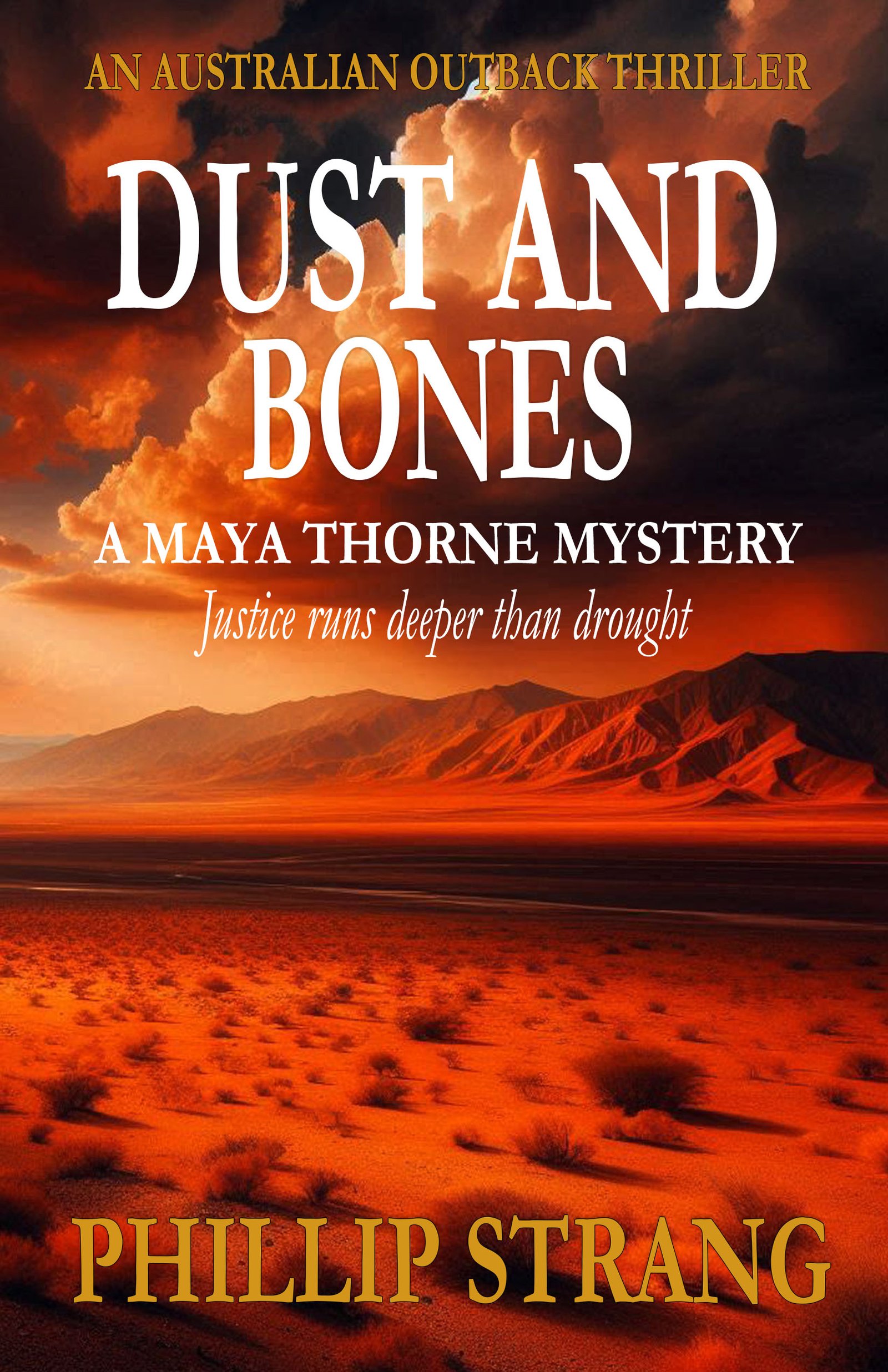
A MAYA THORNE MYSTERY
Get Dust and Bones Free
Justice runs deeper than drought.
Red dust. Shallow graves. A detective who hunts killers where the law runs thin and the nearest help is two hundred miles away.
Send Me the BookYou'll also receive occasional new release emails. Unsubscribe anytime. No spam, ever.
As an Amazon Associate, Phillip Strang earns from qualifying purchases. This page contains affiliate links — buying through them costs you nothing extra.