
Avoiding setting clichés is one of those craft problems that sneaks up on writers precisely because the clichés are so deeply embedded in the genre we love. The foggy London alley, the rain-lashed Scottish glen, the scorched outback with nothing moving for a hundred miles — these images work because they carry meaning, but by the time a reader has encountered them a dozen times, they’ve stopped working at all. They’ve become shorthand for atmosphere without actually delivering any.
Across eighteen series and more than 150 novels, I have found that setting is the single most misunderstood element of crime and thriller fiction — not because writers ignore it, but because they reach for the version of it they’ve already seen rather than the version that’s actually there. The difference between those two choices determines whether a location feels inhabited or painted.
The Cliché Isn’t the Place — It’s the Relationship to the Place
Here’s the thing about setting clichés: they’re almost never wrong about the geography. London does have fog. The Scottish Highlands are genuinely bleak in November. The Australian outback is brutal, empty, and red. The mistake isn’t describing these conditions; it’s using them as atmosphere rather than as pressure. When a writer drops fog over a London street, they often mean menace — but they’ve offloaded the work of creating menace onto a weather condition, which means the character moving through that fog isn’t actually experiencing anything specific. They’re moving through a genre expectation.
Setting becomes real when it creates friction specific to this story, this character, this situation. The detail that earns its place on the page isn’t the one that says this is London; it’s the one that says this particular woman has walked this street for twenty years and tonight it feels wrong in a way she can’t name. That specificity is doing double duty — it’s place, and it’s character, and it’s tension. That’s when setting stops being wallpaper.
Avoiding Setting Clichés by Going Deeper Into the Actual Location
The most reliable way I’ve found to escape setting clichés is to know the location in a way that makes the cliché irrelevant. Not to avoid it deliberately, but to know the place so thoroughly that you’re working with material the cliché can’t reach. When I was building the Maya Thorne series, the outback presented exactly this problem. Every crime novel set in remote Australia risks the same visual vocabulary — the red dust, the corrugated iron, the heat shimmer. These things are real. But they’re not the story.
What I found more interesting was the social geography: the way remote communities develop internal hierarchies invisible to outsiders, the particular silence that isn’t peaceful but watchful, the way distance erodes conventional authority structures so that whoever holds power in a small place holds it absolutely. That’s not a cliché. That’s pressure. The landscape became the container for that pressure rather than a substitute for it, and suddenly the setting was doing real work rather than signalling genre.
The same principle applies whether you’re writing police procedurals set in London or espionage thrillers threading through eastern European capitals. The question is always: what does this place actually do to people who live inside it? Not what does it look like, but what does it enforce?
What Goes Wrong: Common Mistakes and How They Function
The most common setting mistake in crime and thriller fiction is what I’d call atmospheric substitution — using a vivid location description to simulate tension without actually generating any. Consider a scene where a detective walks through a derelict industrial estate at dusk, broken glass underfoot, graffiti on every wall, a distant dog barking. Every element signals danger. But if the detective isn’t actively thinking, feeling, or discovering something, all that imagery is just borrowed mood. The writer has raided the stock room of genre atmosphere and arranged the furniture without populating the scene.
A related problem is tonal overdetermination — when the setting tells the reader what to feel before anything has happened. A village described as picturesque and impossibly quaint before a murder occurs is being used as ironic counterpoint, which is fine, but it’s also a contract the reader has seen signed a thousand times. The setting is forecasting its own subversion. More interesting is a place that is genuinely ambiguous — not pretty concealing dark, but simply ordinary in the way actual places are ordinary, which means that when something terrible happens, the setting offers no comfort and no irony, only the unsettling fact of its indifference.
The third failure mode is borrowed exoticism — the tendency to treat any location outside the writer’s immediate experience as inherently atmospheric. Casablanca is not automatically tense. The Scottish Highlands are not automatically brooding. The Sydney Harbour foreshore is not automatically glamorous. A location earns its atmosphere through the specifics of what happens there and who experiences it, not through its postcard reputation. Writing DCI Isaac Cook across more than twenty books meant resisting the gravitational pull of London-as-backdrop — the iconic landmarks, the tourist-map version of the city — and instead working in the specific, unglamorous, socially complex parts of the city where the crimes actually made sense. Notting Hill in the Cook series is not the film version of Notting Hill. It’s a neighbourhood with a specific history of racial tension, gentrification pressure, and economic stratification, and that’s where the murders come from.
How I Actually Work With Setting
My working approach is to treat setting as a secondary character — something that has its own agenda, its own pressures, its own way of behaving badly. When I’m planning a book, I don’t ask what the setting looks like; I ask what the setting wants. That sounds slightly absurd, but it produces useful answers. The Scottish Highlands in the DI Sarah Lynch series want to isolate. They want to cut people off from institutional support, from the procedural machinery that urban police work takes for granted. So I use that — the setting’s preference for isolation becomes a structural pressure on every investigation. Sarah isn’t battling the setting; she’s negotiating with it, and the reader feels that negotiation as real difficulty rather than decorative bleakness.
I also resist the first description that comes to mind. Not as an aesthetic principle, but as a practical diagnostic. If the first description is something I’ve read before — and I usually know when it is — then I’m not yet seeing the place I mean to write about. I’m seeing a composite of other books. That’s the cliché forming. The response isn’t to reach for something deliberately unusual; it’s to look harder at the actual place until something specific appears that belongs only here, only in this book. Sometimes that takes longer than the writing itself. It’s worth it. For writers interested in how setting functions differently across subgenres, the distinction between how it operates in noir crime fiction versus procedurals is particularly instructive — noir uses setting as moral argument, while procedurals tend to use it as context, and both can go badly wrong in their own way.
Setting as Pressure, Not Decoration
The best setting in crime and thriller fiction doesn’t describe a place; it enacts what living in that place does to people. It creates conditions — for misunderstanding, for violence, for the particular kind of silence that means something is being hidden. When setting achieves this, it stops being cliché by definition, because clichés are about surfaces and this is about structure. The fog doesn’t signal danger; it makes the witness unable to see who was there. The distance doesn’t signal isolation; it means the ambulance arrives twenty minutes too late. That’s setting doing narrative work, and no amount of genre shorthand can substitute for it.
Conclusion
The cliché is always a choice made under pressure — the pressure of deadline, of uncertainty, of a scene that won’t ignite. Recognising that is half the solution. The other half is doing the work of finding the specific, unglamorous, morally complicated truth of a place, and trusting that truth to carry more weight than any amount of borrowed atmosphere ever could.
About Phillip Strang
Phillip Strang is an Australian crime and thriller novelist. Across eighteen series and more than 150 novels, his work spans London police procedurals (DCI Isaac Cook), UK investigations (DI Tremayne), Australian outback crime (Maya Thorne), FBI thrillers (Alex Harlan), Scottish Highland mysteries (DI Sarah Lynch), and espionage (Steve Case). Learn more about Phillip or browse his complete catalogue on Amazon.
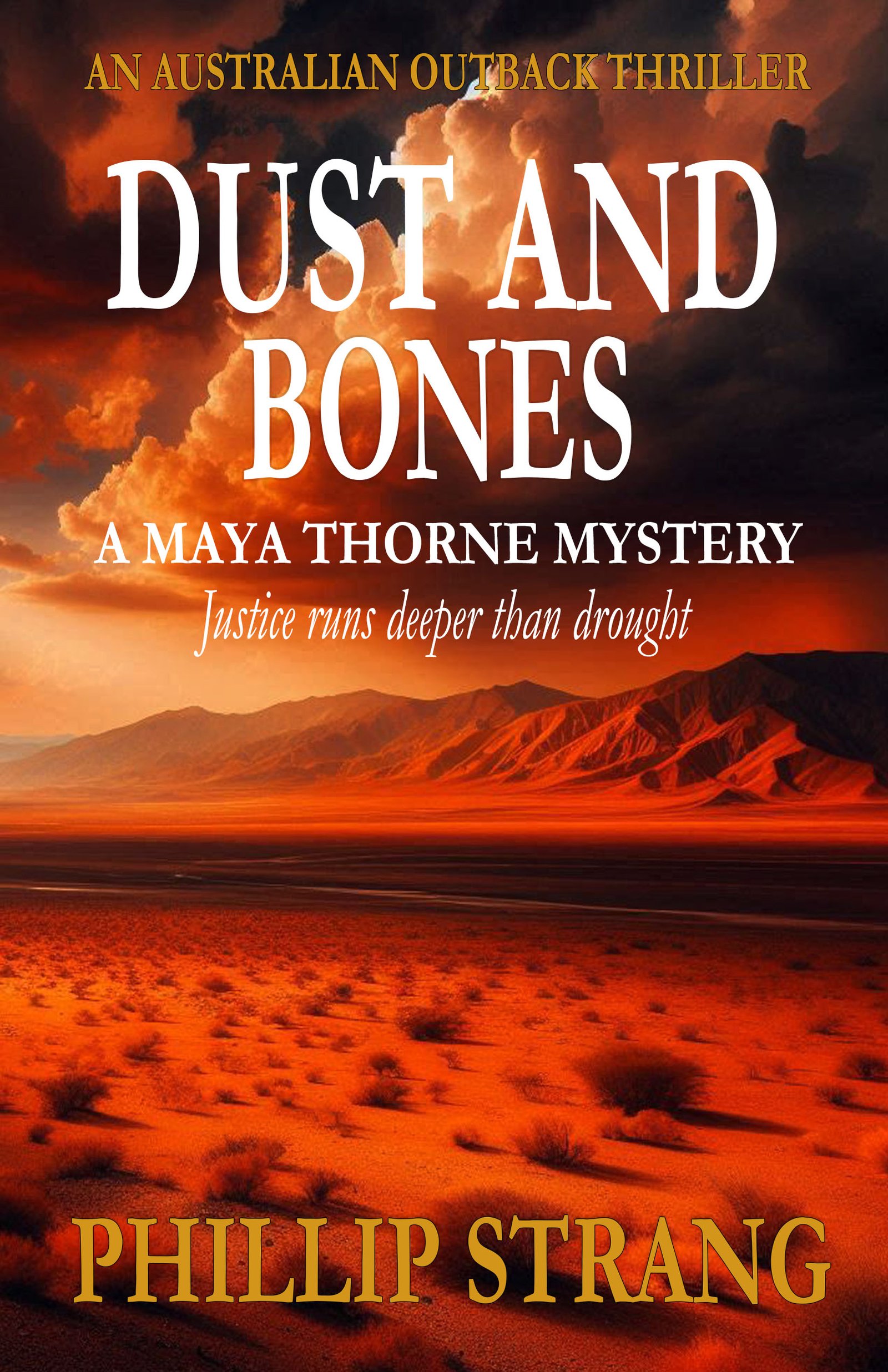
A MAYA THORNE MYSTERY
Get Dust and Bones Free
Justice runs deeper than drought.
Red dust. Shallow graves. A detective who hunts killers where the law runs thin and the nearest help is two hundred miles away.
Send Me the BookYou'll also receive occasional new release emails. Unsubscribe anytime. No spam, ever.
As an Amazon Associate, Phillip Strang earns from qualifying purchases. This page contains affiliate links — buying through them costs you nothing extra.