
The choice between coastal vs inland crime settings is not a matter of scenery preference — it is a structural decision that shapes the psychology of your story from the first page. Where you place a crime determines how your characters move, how isolated they feel, and how much the landscape itself becomes an antagonist. Get this choice wrong and a technically competent plot can feel airless and unconvincing; get it right and the setting does half your narrative work for you.
Across eighteen series and more than 150 novels, I have found that the most consequential craft decisions I make about any book happen before I write a single scene — and choosing the terrain is among the most consequential of all. Setting is not backdrop. It is pressure. It is the thing that pushes your characters into corners they cannot think their way out of easily, and the coast and the inland push in entirely different ways.
What the Coast Does to a Crime Story
Coastal settings carry a particular psychological weight that writers either harness or waste. The sea is not neutral. It suggests escape and it suggests drowning simultaneously, and that ambivalence is enormously useful in crime fiction. A body on a beach is found in a place where the world transitions — land to water, known to unknown — and that liminality infects the whole investigation. Suspects arrived by boat or left by sea. Evidence washes away or washes ashore at inconvenient times. Tides dictate timelines in ways that no detective can override.
Beyond the procedural mechanics, coastal communities have a particular social texture. They are often transient — seasonal workers, visiting yachties, tourists who exist outside normal accountability. That transience creates investigative friction. Witnesses disappear with the end of summer. Locals who have fished together for three generations close ranks against any authority from inland. The coast breeds insularity dressed up as openness, which is one of the most useful contradictions a crime writer can exploit. If you write best police procedural novels style work, the coastal community’s relationship with the law — often complicated by smuggling histories, by offshore ambiguity, by the sense that the sea operates outside jurisdiction — gives you layers that a suburban or urban setting simply cannot replicate.
The physical drama is also unignorable. Cliffs, caves, isolated headlands, boats at night. These are not clichés if you use them with precision. A cliché is a setting detail that does nothing except signal genre. A cliff becomes craft when it determines what your detective can see from which angle, and at what cost.
What Inland Settings Do Differently — and Better
Inland crime settings operate on a different kind of claustrophobia. Where the coast offers the illusion of escape — you can always look at the horizon and imagine leaving — the inland removes that psychological safety valve entirely. The Australian outback, the Scottish Highlands interior, the landlocked English village: these settings press in from all sides. There is nowhere to look that offers relief.
This is why inland settings tend to produce slower-burning, more psychologically intense crime fiction. The isolation is total rather than partial. Communities cut off by distance rather than by water develop different pathologies — secrets compound over generations because nobody ever truly leaves. The person who killed someone thirty years ago is still your neighbour. The detective investigating that old crime cannot check into a hotel and leave; they are stuck there too, breathing the same air, eating at the same pub.
My Maya Thorne series is set in the Australian outback, and the inland pressure is not metaphorical — it is literal heat, literal distance, literal scarcity of water. Those physical realities translate directly into investigative constraints. You cannot call for backup easily. Forensics take days to arrive. Witnesses are few and everyone knows everyone. The inland setting demands that the detective be more self-reliant, more willing to sit with uncertainty, and more vulnerable than their urban counterparts. That vulnerability is a gift to the writer because it creates genuine jeopardy without requiring the plot to manufacture danger artificially.
Coastal vs Inland Crime Settings: The Pacing Difference
Here is where the craft distinction becomes genuinely technical. Coastal settings naturally accelerate pacing because they introduce external time pressure. Tides change. Weather moves in fast off the water. The ferry leaves in two hours. A boat has been reported missing. These are concrete, ticking deadlines that require no authorial contrivance. The sea imposes its own schedule on your investigation, and that schedule rarely aligns with what your detective needs.
Inland settings resist that kind of acceleration. The pacing pressure in inland crime tends to come from social rather than physical time pressure. The town council meets Thursday. The landowner will sell and the community will scatter within the month. The elderly witness is ill and may not survive to testify. These are slower burns, and if you try to write an inland novel at the pace of a coastal thriller, you will find it fighting you at every turn. The setting will feel wrong even to readers who cannot articulate why.
My DI Sarah Lynch series is set in the Scottish Highlands, and the interior Highland landscape demands a specific narrative rhythm. The stories move at the pace of that environment — deliberate, attentive, accumulative. I cannot rush them without breaking something essential. The crime might be sudden and violent, but the investigation unfolds at the speed of a landscape that has been forming for millennia and is not impressed by urgency.
How I Actually Approach This Decision
When I start a new book or a new series, I do not begin by asking what the plot is. I begin by asking what kind of pressure I want the protagonist to be under. Physical exposure or social suffocation? Tidal urgency or generational weight? That question almost immediately answers the coastal vs inland question for me.
For anything with a strong noir sensibility — where moral ambiguity compounds over time and the investigator is complicit in the world they are examining — inland almost always serves better. Noir depends on entanglement, and it is harder to be truly entangled in a place you can see the exit from. Coastal settings work better when I want a more thriller-adjacent energy, where the plot needs to move faster than the characters can fully process.
The practical considerations matter too. I write what I know well enough to get the sensory details right without research becoming a crutch. The heat shimmer of the outback, the specific way Highland weather announces itself hours before it arrives, the sound a tide makes on different surfaces — these are not details you can synthesise convincingly from a desk. If your setting feels like a film set rather than a place, readers will disengage. The setting must have weight. It must cost your characters something to be there.
The Mistakes That Undermine Setting Work
The most common mistake I see in crime fiction with coastal settings is treating the sea as decoration. The writer puts a detective near water and then forgets it is there. The coast appears in establishing descriptions and then vanishes. This is wasted real estate. If your detective is in a coastal town, the sea should create problems, offer false leads, provide cover for criminals, complicate timelines. If it does none of these things, you have not set your story on the coast — you have set it anywhere and stapled a harbour view to the window.
The equivalent inland error is using isolation as pure atmosphere without consequence. Describing an empty moor beautifully but then having your detective access forensic resources, communication, and support as easily as they would in central London is a contradiction that erodes believability. Inland isolation must have teeth. It must cost the investigation something real and specific. A detective who is isolated but never truly alone — who always has signal, always has backup, always has institutional support — has not been placed in an inland setting in any meaningful craft sense. They have been placed in a studio with painted countryside behind them.
Conclusion
Setting a crime novel on the coast or inland is not an aesthetic choice made after the plot is assembled — it is a foundational structural decision that determines pacing, character vulnerability, social texture, and the nature of investigative jeopardy. Make it deliberately, make it early, and then let the landscape do its work.
About Phillip Strang
Phillip Strang is an Australian crime and thriller novelist. Across eighteen series and more than 150 novels, his work spans London police procedurals (DCI Isaac Cook), UK investigations (DI Tremayne), Australian outback crime (Maya Thorne), FBI thrillers (Alex Harlan), Scottish Highland mysteries (DI Sarah Lynch), and espionage (Steve Case). Learn more about Phillip or browse his complete catalogue on Amazon.
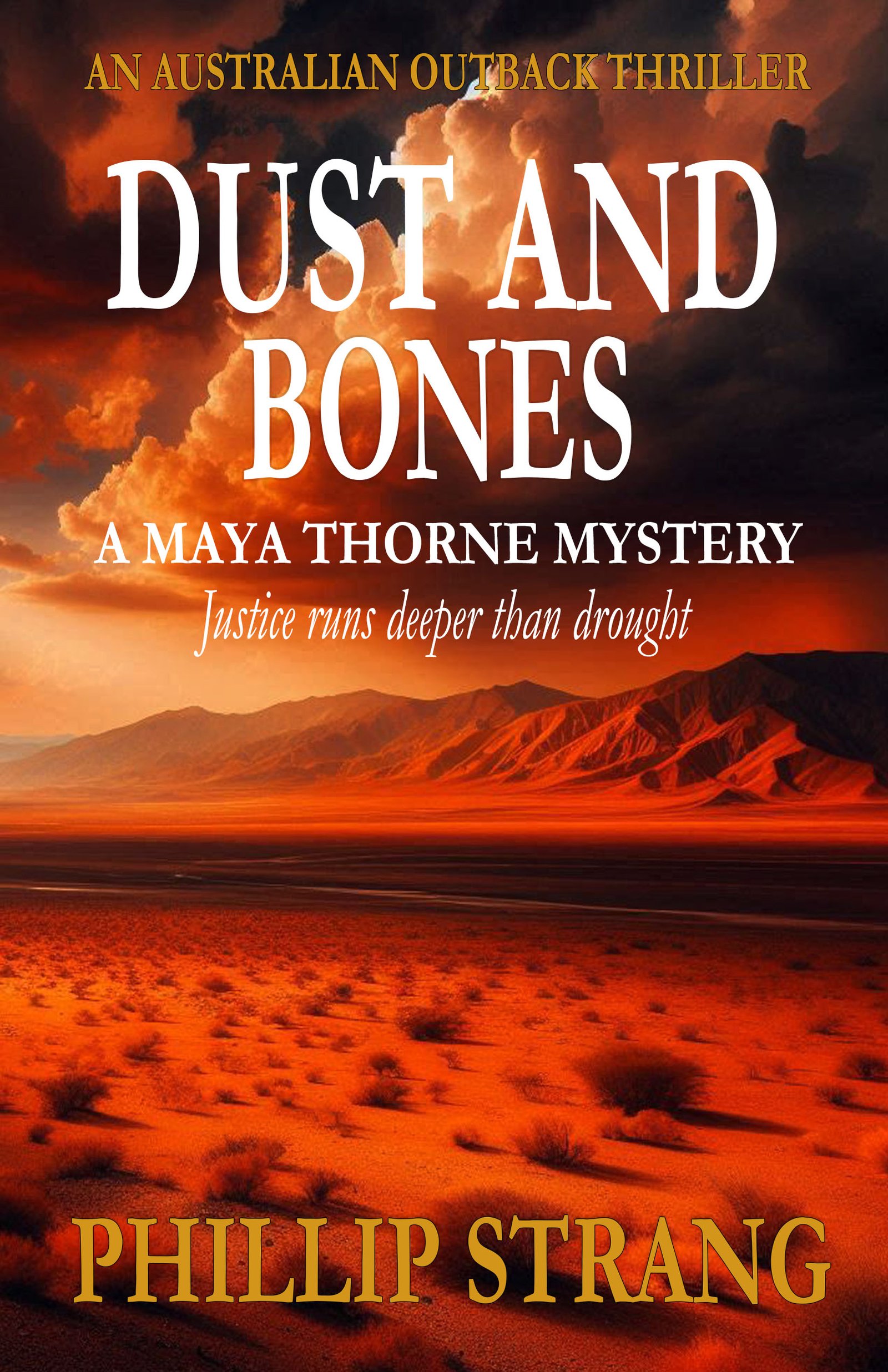
A MAYA THORNE MYSTERY
Get Dust and Bones Free
Justice runs deeper than drought.
Red dust. Shallow graves. A detective who hunts killers where the law runs thin and the nearest help is two hundred miles away.
Send Me the BookYou'll also receive occasional new release emails. Unsubscribe anytime. No spam, ever.
As an Amazon Associate, Phillip Strang earns from qualifying purchases. This page contains affiliate links — buying through them costs you nothing extra.