
Real-time narration in crime and thriller writing presents one of the most challenging technical demands in the genre. When a murder unfolds on the page or a terrorist plot reaches its climax, the author must balance immediate visceral impact with the careful orchestration of clues, character reactions, and plot momentum.
Across eighteen series and more than 150 novels, I have found that the most effective real-time crime sequences depend not on breathless prose or artificial urgency, but on precise control of narrative distance and the strategic withholding of information. The reader must experience the chaos while the author maintains absolute clarity about what is happening and why.
The Mechanics of Present Action
Real-time narration requires a fundamental shift in how you handle exposition and character interiority. In normal scenes, you can pause to explain backgrounds or delve into a character’s memories. During active crime sequences, every sentence must serve the immediate action while still advancing character and plot. This means front-loading essential information in earlier chapters and trusting that readers will carry it forward.
The tense choice matters enormously. Present tense creates immediacy but can become exhausting over extended sequences. Past tense allows for subtle foreshadowing within the narration itself. In my DI Tremayne series, I often use past tense even for active crime scenes because it allows the narrator to hint at consequences while maintaining the illusion that events are unfolding unpredictably.
Sentence structure becomes a precision instrument. Short, declarative sentences accelerate pace. Longer, complex sentences slow it down. The rhythm should mirror the emotional arc of the scene, not simply default to choppy prose because the action is fast.
Managing Multiple Perspectives
The greatest technical challenge in real-time crime narration is handling multiple viewpoints without losing coherence. The victim’s perspective, the perpetrator’s mindset, and the investigating officer’s growing understanding must interweave without creating confusion about timeline or causation.
I learned this lesson painfully in early drafts. Jumping between perspectives within a single scene often dilutes rather than intensifies the impact. Instead, I now structure real-time sequences in discrete blocks, each following one character’s experience completely before shifting to another. This creates a kaleidoscope effect where the same events gain new meaning when seen from different angles.
In my Steve Case espionage series, terrorist attacks unfold across multiple locations simultaneously. Rather than cutting rapidly between sites, I follow each location’s sequence to a natural pause point before shifting. This maintains the real-time feeling while allowing readers to fully process each perspective’s unique information.
How I Actually Write These Sequences
My approach to real-time crime scenes begins with a detailed timeline written outside the narrative. I map every action, every character’s location, and every piece of information that must be revealed or concealed, minute by minute. Only then do I begin writing the actual scene.
This preparation allows me to focus entirely on voice and pacing during the writing process. I know exactly what happens next, so I can concentrate on how to reveal it for maximum impact. The timeline becomes my safety net—I can take risks with narrative techniques because I know the structural foundation is solid.
I write these sequences in single sittings when possible. The momentum of the scene must feel authentic, and that requires the author to experience some version of that momentum during creation. If I stop mid-sequence, I always reread from the beginning before continuing. The rhythm must be consistent throughout.
During revision, I read these sections aloud more than any other parts of my novels. The ear catches pacing problems that the eye misses. If I stumble over a sentence or lose track of the action while reading, the reader certainly will.
The Information Management Problem
Real-time narration creates a fundamental tension between authenticity and comprehensibility. In actual crisis situations, people have incomplete information and make decisions based on assumptions that may prove wrong. But readers need enough accurate information to follow the plot logic.
The solution lies in careful selection of viewpoint characters. Each perspective must contribute unique, reliable information while acknowledging the limits of that character’s knowledge. A police officer responds to what appears to be a domestic dispute but lacks the context to understand it’s actually a cover for an assassination attempt. The reader gets the officer’s accurate observations while gradually piecing together the larger picture.
This technique works particularly well in police procedural novels, where the investigating officer’s growing understanding mirrors the reader’s journey through the mystery. The real-time sequences become moments of revelation rather than mere action.
Common Mistakes That Kill Momentum
The most frequent error I see in real-time crime writing is over-explanation. Authors panic that readers won’t understand the stakes or the geography or the relationships, so they insert clumsy exposition mid-action. A character pauses during a chase to think about how this reminds him of his military training in Afghanistan, complete with a paragraph of backstory. The momentum dies instantly.
Another momentum killer is false urgency—using short sentences and exclamation points to create excitement rather than building genuine tension through plot development. ‘The killer raised the knife! Sarah screamed! Blood everywhere!’ This reads like a parody of thriller writing rather than an effective crime scene.
Inconsistent physical geography destroys credibility in real-time sequences. If the warehouse has three exits in chapter four, it cannot suddenly have five exits when needed for the climax. Readers notice these inconsistencies more sharply during action sequences because they’re paying closer attention to concrete details.
The worst mistake is allowing characters to make obviously stupid decisions simply to maintain plot momentum. Real people make poor choices under stress, but those choices must feel psychologically authentic. A trained police detective doesn’t enter a dark building alone without backup unless there’s a compelling reason that readers can understand, even if they disagree with the decision.
Balancing Realism and Readability
Actual violent crimes unfold with shocking speed and often conclude anticlimactically. A murder might take thirty seconds; the investigation takes months. This creates obvious problems for thriller pacing, where readers expect the crime itself to generate significant dramatic tension.
The solution is to focus real-time narration on moments of decision rather than moments of action. The few seconds when a character chooses to trust or betray, to run or fight, to speak or stay silent—these psychological turning points can sustain detailed examination even when the physical actions are brief.
In my DCI Isaac Cook series, the actual murders are often glimpsed rather than detailed, but the killer’s decision-making process receives full real-time treatment. This approach maintains the immediacy of present action while developing character and advancing themes. It also avoids the gratuitous violence that can overshadow the puzzle elements that many crime readers prefer.
The key is remembering that real-time narration serves the story, not the reverse. Some scenes benefit from immediate, visceral treatment. Others work better as reported events that characters investigate and interpret. Action thriller novels might emphasize different moments than psychological mysteries, but both depend on choosing the right scenes for real-time treatment.
Conclusion
Real-time narration in crime fiction demands technical precision disguised as spontaneous urgency. The most effective sequences result from careful preparation, strategic information management, and an understanding that authenticity matters more than artificial excitement. Master these techniques, and your crime scenes will grip readers through genuine tension rather than mere breathlessness.
About Phillip Strang
Phillip Strang is an Australian crime and thriller novelist. Across eighteen series and more than 150 novels, his work spans London police procedurals (DCI Isaac Cook), UK investigations (DI Tremayne), Australian outback crime (Maya Thorne), FBI thrillers (Alex Harlan), Scottish Highland mysteries (DI Sarah Lynch), and espionage (Steve Case). Learn more about Phillip or browse his complete catalogue on Amazon.
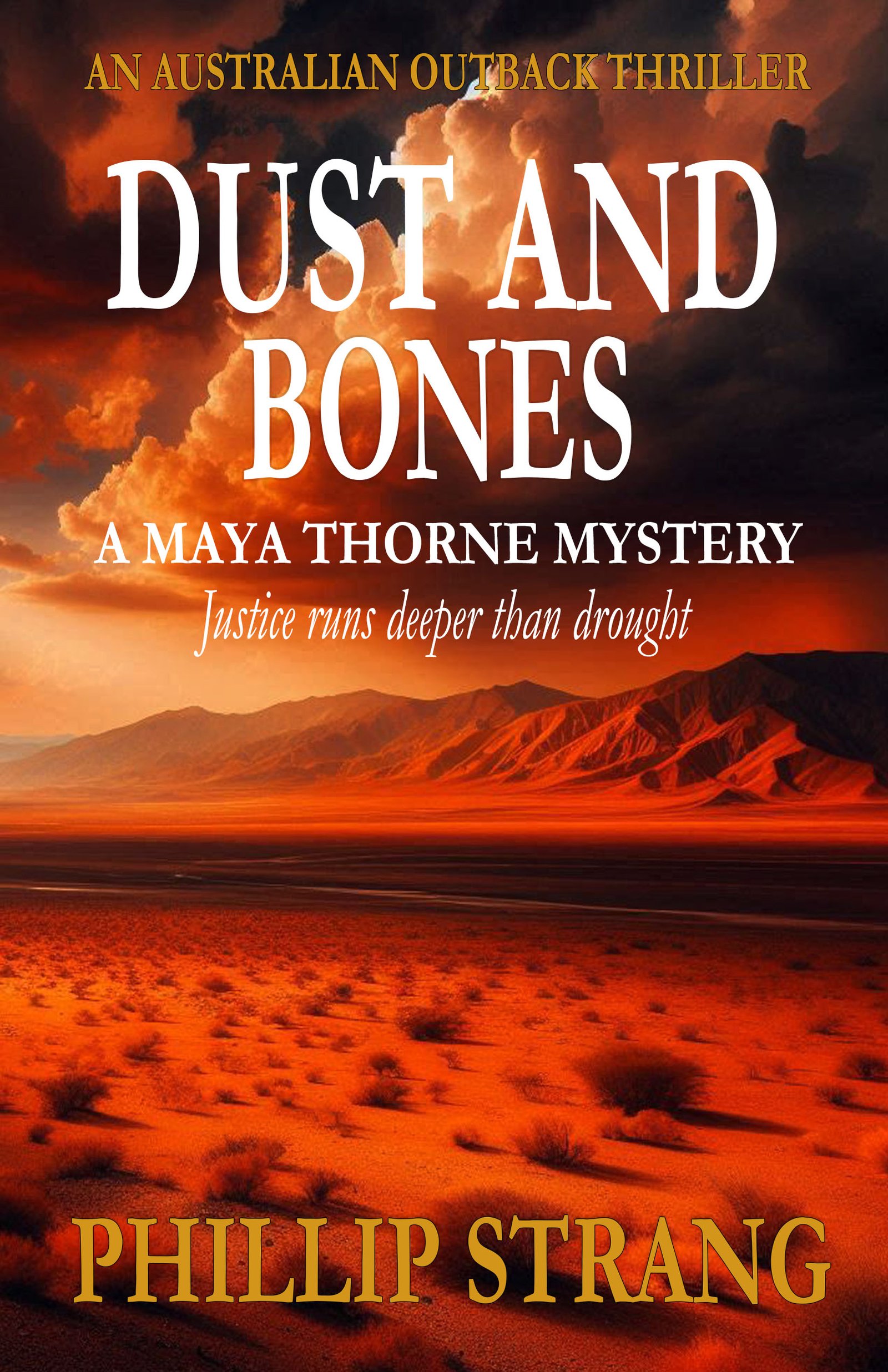
A MAYA THORNE MYSTERY
Get Dust and Bones Free
Justice runs deeper than drought.
Red dust. Shallow graves. A detective who hunts killers where the law runs thin and the nearest help is two hundred miles away.
Send Me the BookYou'll also receive occasional new release emails. Unsubscribe anytime. No spam, ever.
As an Amazon Associate, Phillip Strang earns from qualifying purchases. This page contains affiliate links — buying through them costs you nothing extra.